
A patient with severe COPD but no active wheezing reaches only a low heart rate on the treadmill and wants to avoid a long infusion, so the cardiologist plans vasodilator pharmacologic stress with Tc-99m sestamibi imaging. Which stress agent and administration plan best fits this patient?
Select an answer to reveal the explanation.
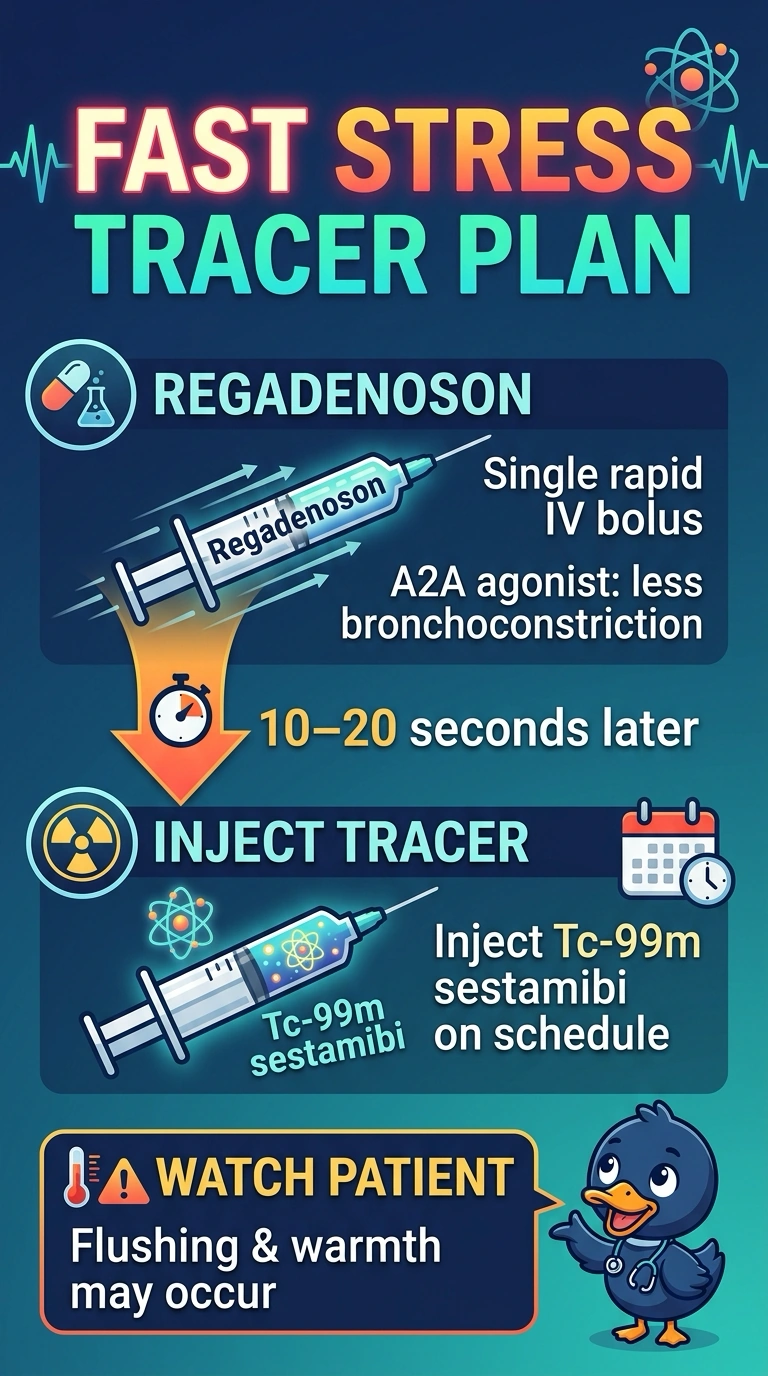
Short Explanation
With severe COPD but no active wheezing, you can use regadenoson as a quick IV push rather than a long infusion, then inject Tc-99m sestamibi 10–20 seconds later. It usually causes less bronchoconstriction than adenosine, but you’ll still want to use caution—and avoid it if wheezing is active.
Full Explanation
Regadenoson is a selective A2A-receptor agonist given as a single rapid IV bolus, so it avoids the sustained infusion the patient wishes to avoid and is commonly favored for vasodilator stress in stable COPD without active wheezing. Injecting Tc-99m sestamibi 10–20 seconds after the bolus aligns tracer delivery with the peak hyperemic response and permits myocardial perfusion imaging. Giving the tracer simultaneously with the bolus is mistimed: it does not allow the specified interval for the pharmacologic stress response to develop. Dipyridamole is a recognized vasodilator stress agent, but its standard administration is a several-minute infusion; that conflicts with the patient’s stated preference to avoid a long infusion, even though the tracer is appropriately administered after the infusion. Adenosine is also a standard vasodilator and tracer injection during peak effect is conventional, but its continuous infusion is the feature that fails the preference for brief administration. Adenosine and dipyridamole may also provoke bronchospasm, so COPD warrants individualized assessment rather than assuming that absence of wheezing eliminates risk. Exam caveat: severe COPD is not itself an absolute contraindication to regadenoson when the patient is clinically stable, but active bronchospasm changes the risk assessment. Practical check: confirm the IV is patent, follow the laboratory’s bolus-to-tracer timing protocol, and monitor symptoms, oxygenation, and ECG throughout stress and recovery.