
A patient with hepatocellular carcinoma confined to the right lobe is scheduled for yttrium-90 radioembolization, with compensated liver function and an unresectable tumor. Before the microsphere activity is ordered, the team must estimate how much of the dose could reach the lungs through an arteriovenous shunt. Which planning study supplies the lung shunt measurement?
Select an answer to reveal the explanation.
Short Explanation
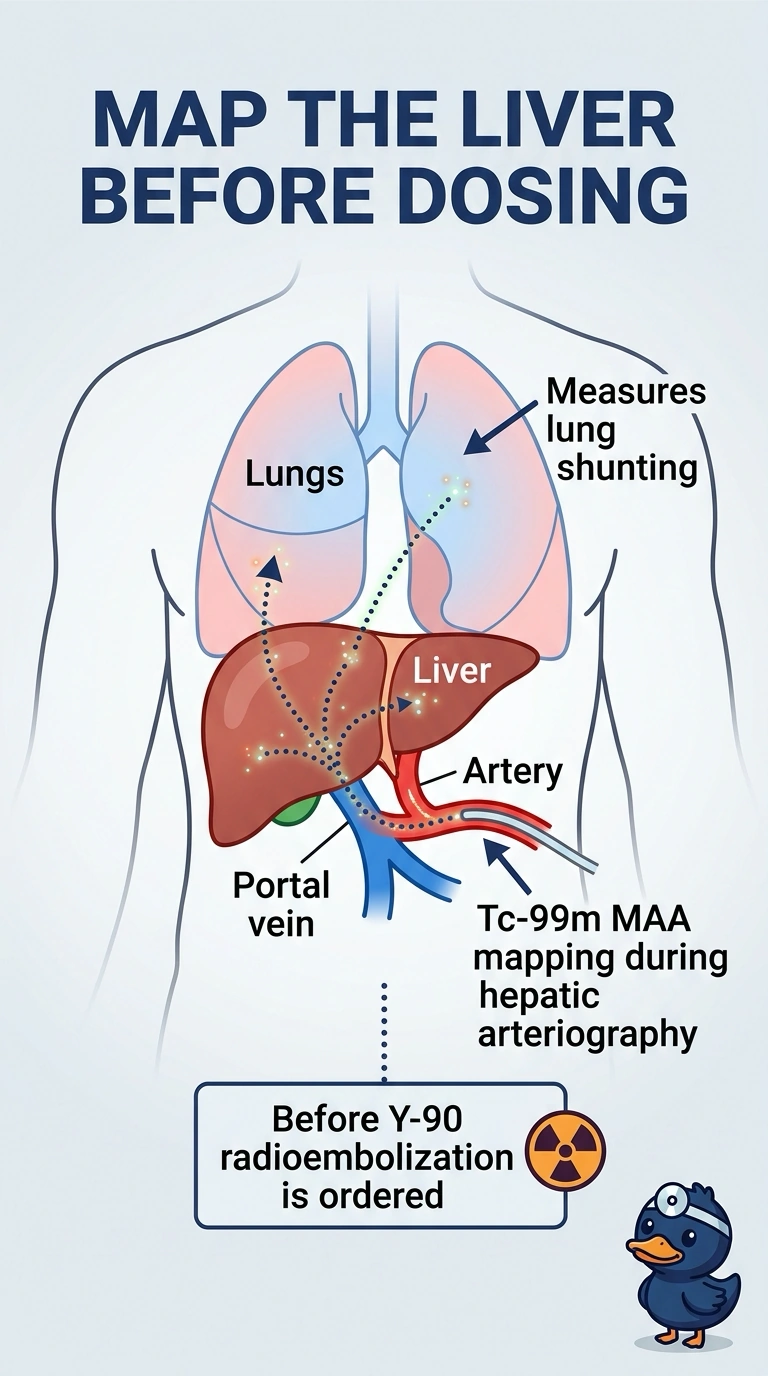
Your planning study is Tc-99m MAA mapping during hepatic arteriography—a test run that shows where microspheres may travel, including any shunt to your lungs. That measurement helps your team plan the Y-90 activity before ordering it.
Full Explanation
Radioembolization delivers microspheres into the hepatic artery. An arteriovenous shunt can carry some of them to the lungs, so hepatic arteriography paired with a technetium-99m macroaggregated albumin (Tc-99m MAA) injection is used to estimate lung shunting before activity is ordered. The mapping can also reveal extrahepatic activity that may indicate non-target flow. Blood counts and liver chemistry assess the patient's reserve rather than lung shunting. Cross-sectional liver imaging helps characterize tumor burden and anatomy but does not measure shunting at catheterization. Amino acid infusions are used for renal protection with peptide receptor radionuclide therapy, not Y-90 radioembolization. Mapping protocols may vary by institution; the key concept is to use the MAA study to estimate lung shunting before treatment planning is finalized.