
The PET/CT system sat idle overnight, and the morning list starts with an FDG study that needs CT-based attenuation correction. The console shows the scanner's required daily CT calibration is still pending. Which quality control step must be completed before the first patient acquisition?
Select an answer to reveal the explanation.
Short Explanation
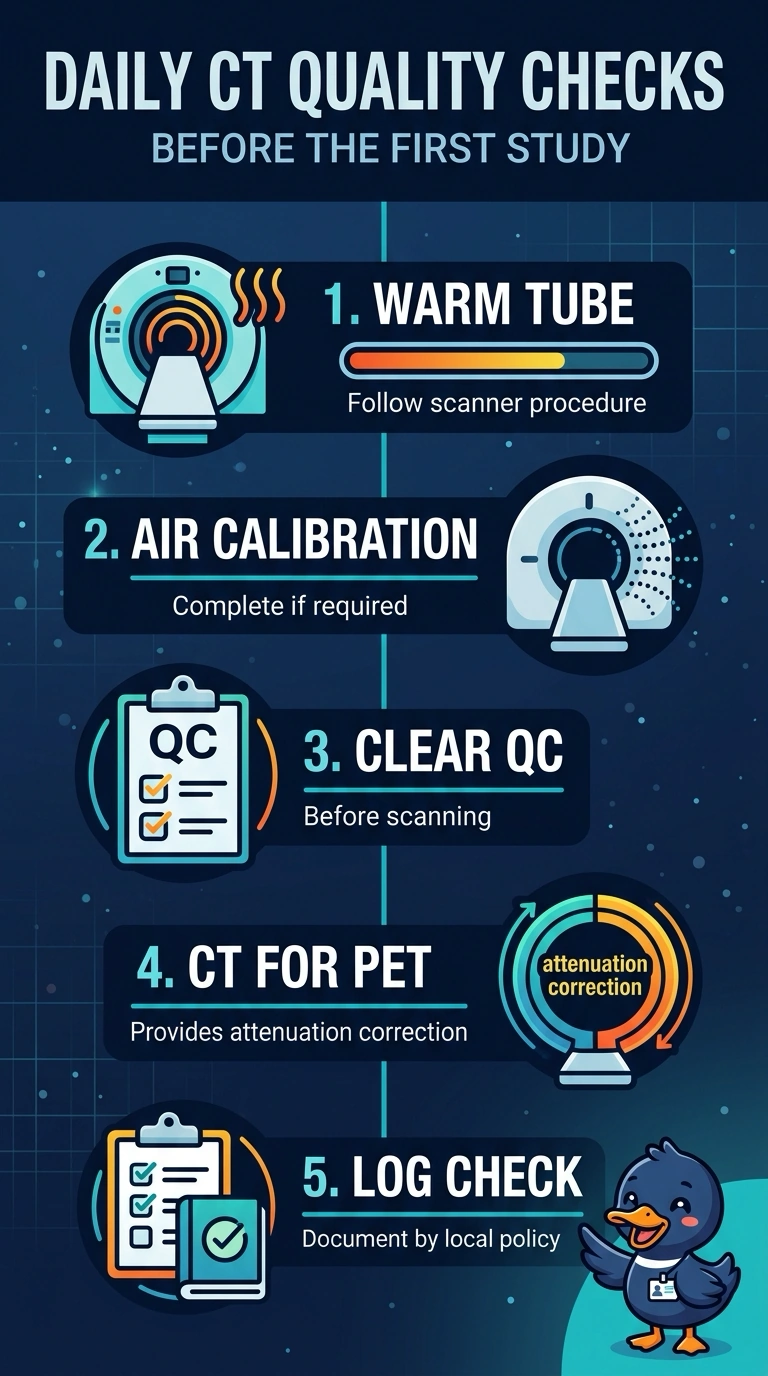
Before your first attenuation-corrected study, complete the console-required daily CT warm-up and air calibration—like zeroing a scale before you weigh anything. Warm-up alone won’t clear the pending calibration.
Full Explanation
Complete the scanner’s console-required daily CT warm-up and air calibration before acquiring the first FDG study that uses CT-based attenuation correction. Warm-up brings the CT tube and system to the operating conditions required by the manufacturer; air calibration measures the system’s response without a patient and supports accurate CT data for attenuation correction. If the required calibration is pending, proceeding could leave the CT data uncalibrated and compromise the attenuation-corrected PET result. A periodic CT phantom image-quality check is a different quality-control approach: it assesses image performance at its scheduled interval but does not replace the pending daily calibration. A dose calibrator constancy check is also valid QC, but it verifies activity-measurement performance, not CT performance, and cannot clear the CT requirement. Tube warm-up alone is incomplete if air calibration is also required; deferring calibration leaves the daily check pending for the first study. Exam caveat: follow the specific scanner’s console prompts and manufacturer procedure, since the required daily steps may vary; do not assume warm-up alone is sufficient. Practical check: before acquisition, verify that every required daily CT step is shown as complete on the console and document completion according to local policy.