
You are covering the injection room on a busy afternoon. Two identifiers on the armband match the order, and the appointment time matches the schedule, but the order gives the reason as restaging of colon cancer while the chart shows the patient is being worked up for a hip infection. The tray is still empty at this point. Which first step resolves the mismatch between the order's indication and the clinical picture?
Select an answer to reveal the explanation.
Short Explanation
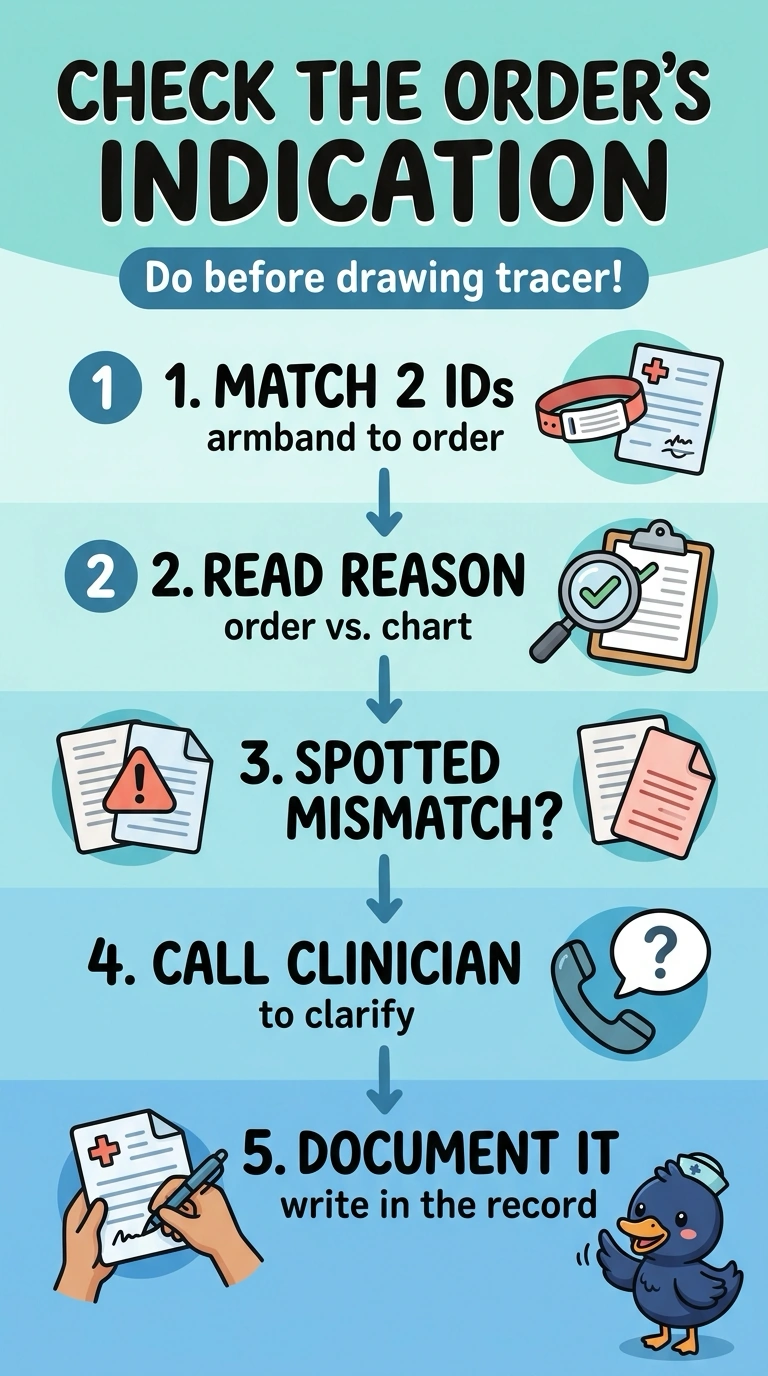
You’re right that a matching armband and appointment confirm who you are seeing, but not why the study is needed. Contacting the ordering clinician to clarify and document the indication before tracer is drawn keeps the study tied to the actual clinical question. It’s like checking the destination on the ticket, not just the name.
Full Explanation
Contact the ordering clinician to clarify why the order cites colon cancer restaging while the chart shows a hip-infection workup, and document the resolved indication before drawing any tracer. Matching identifiers and appointment time confirms who is present and when the visit is scheduled; it does not establish that the ordered study fits the clinical question. Having the supervising radiologist reconcile and document the indication before tracer preparation uses a sensible safety resource, but it does not replace clarification with the ordering clinician, who can confirm the intended indication and correct the order if needed. Calling the ordering clinician but documenting only after drawing tracer delays documentation and violates the required sequence: resolve and record the discrepancy before tracer is drawn. Asking the patient to explain the study and documenting that account is not enough because patient recollection cannot reconcile conflicting clinical documentation or authorize a protocol change; the ordering clinician must clarify the indication. Exam caveat: a correct identifier check never overrides a mismatch in indication, and a busy schedule is not a reason to proceed. Practical check: pause, verify the order and relevant chart context, contact the ordering clinician, record the clarification in the appropriate record, and only then prepare the tracer.