
A 54-year-old is six weeks after total thyroidectomy for papillary carcinoma and returns for a diagnostic whole-body iodine-131 scan. The protocol requires anterior and posterior views, and the survey must cover the entire body because distant spread is possible. Any focal area of uptake needs higher-detail images before the report is issued. Which acquisition plan best fits these requirements?
Select an answer to reveal the explanation.
Short Explanation
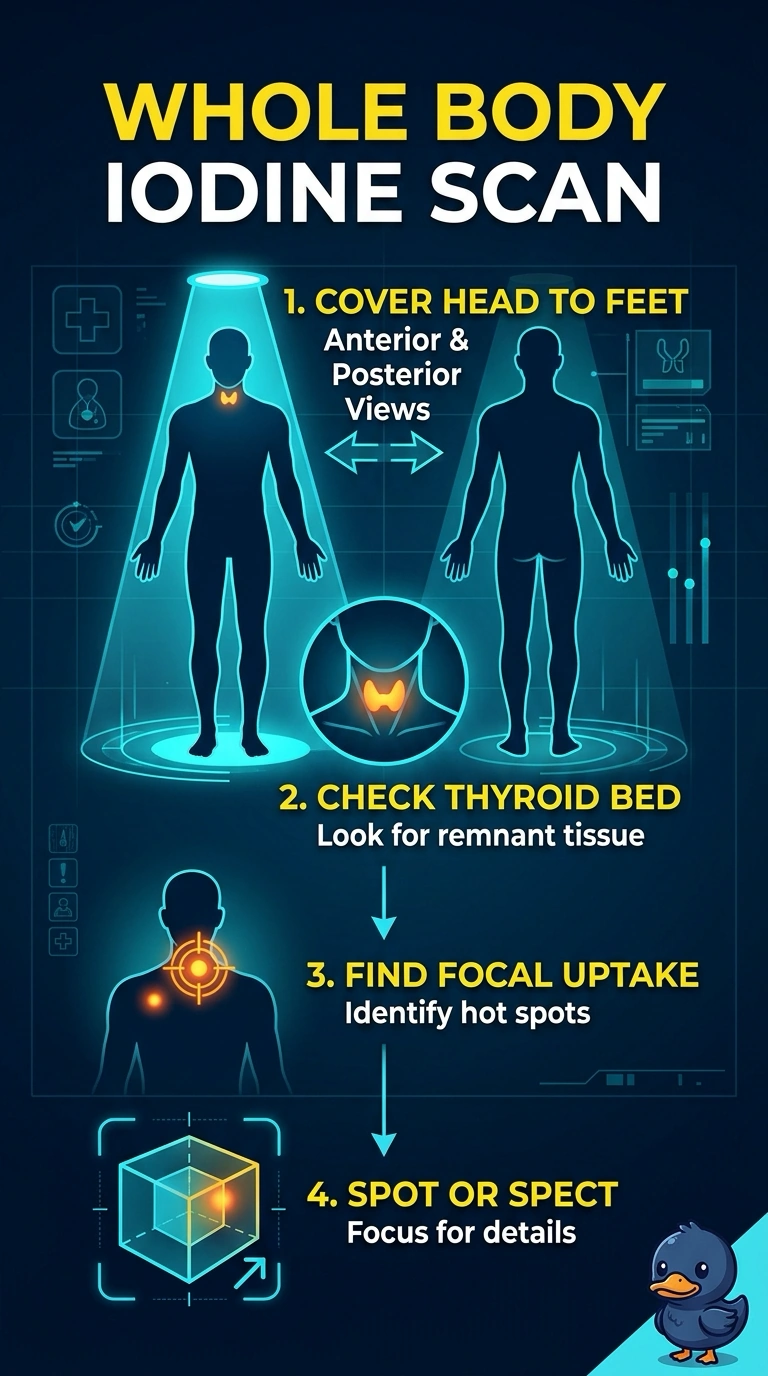
You’ll want a whole-body survey from vertex to feet, with both anterior and posterior views—like checking the entire map, not just one region. Then add spot or SPECT images wherever you see focal uptake to get a closer look.
Full Explanation
The correct plan meets all three protocol requirements: anterior and posterior views provide the specified projections, coverage from vertex to feet surveys the entire body for possible distant disease, and spot or SPECT imaging supplies greater detail for every focal uptake area before reporting. A vertex-to-mid-thigh survey is a common limited-coverage approach in some settings, but it omits the lower legs and feet; that matters here because the stated survey must include the entire body. Restricting additional imaging to uptake judged atypical on the initial survey is also a familiar interpretive strategy, but it fails the explicit instruction to obtain higher-detail images for any focal area, including one that initially appears likely physiologic. A whole-body anterior-only survey can be used in selected protocols, but it does not provide the required posterior view; adding targeted images does not replace that missing projection. Exam caveat: routine coverage conventions vary by indication and institution, so a standard limited survey should not be assumed to satisfy a case-specific whole-body protocol. Practical check: before acquisition, confirm the prescribed start and end landmarks, both required projections, and a workflow for documenting and further imaging each focal focus.