
A patient scheduled for a myocardial perfusion study nods along as you describe the tracer and the stress phase, but when you ask what happens during the study they say they will just take the picture medicine and walk a bit. Which communication approach will improve this patient's understanding before the study?
Select an answer to reveal the explanation.
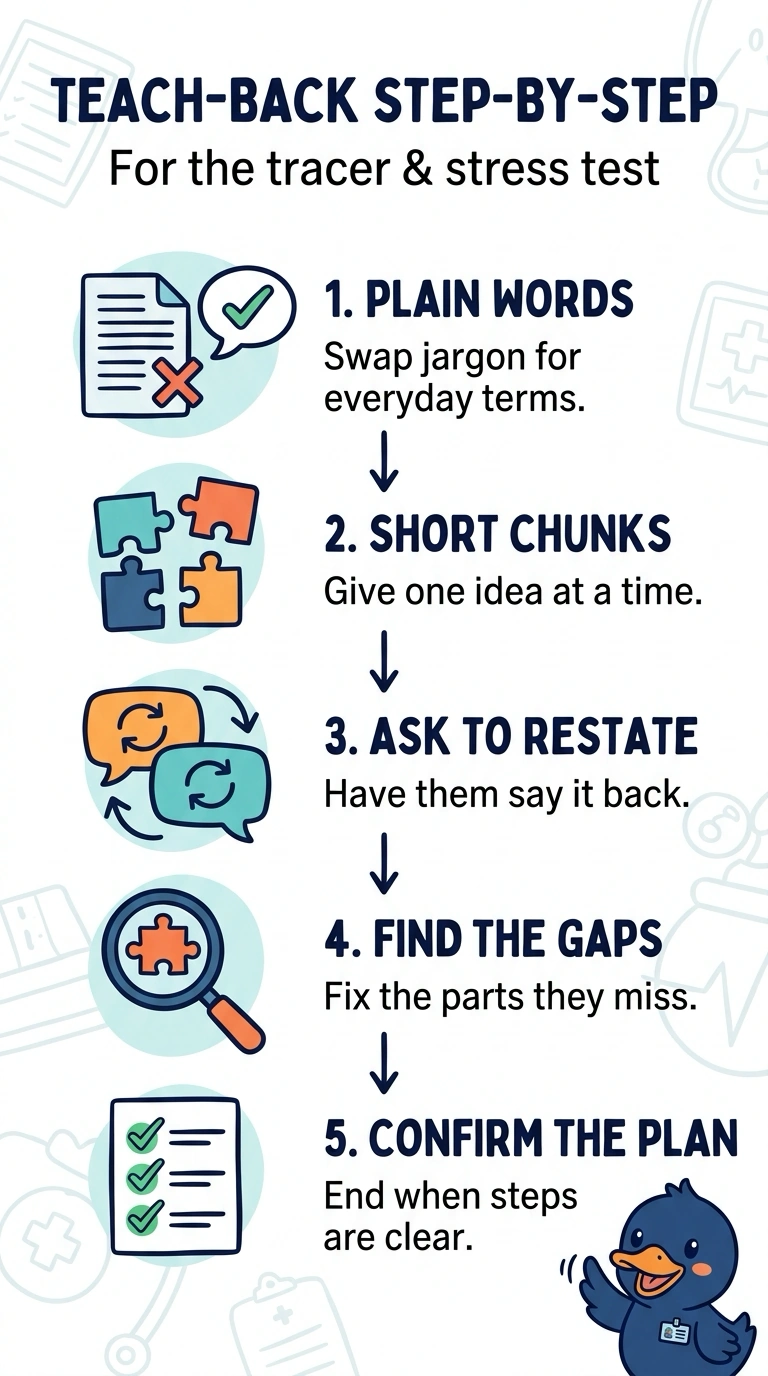
Short Explanation
Nodding alone does not confirm understanding. Teach-back lets you identify what needs to be explained more clearly.
Full Explanation
The patient’s description shows a specific misunderstanding: they think the study consists of taking a picture medicine and walking, rather than understanding what the tracer shows and why imaging is done under stress. Plain language reduces jargon, and teach-back checks whether the explanation has actually made sense; asking the patient to restate both the tracer’s role and the reason for the stress phase can reveal and correct gaps before the study. Inviting questions is useful, but it does not ensure the patient recognizes what they have misunderstood; without asking for a restatement, the clinician may leave the central misconception undiscovered. Teach-back focused only on the tracer checks one important fact but omits the purpose of the stress phase, which the patient has also misunderstood. Asking which terms need clarification can identify confusing vocabulary, but it does not establish whether the patient understands the sequence or purpose of the study. A nod, absence of questions, or ability to repeat isolated terms is not reliable evidence of understanding. Exam caveat: teach-back is a check on how clearly the clinician explained the information, not a test of the patient’s intelligence or memory. In practice, use brief, nonjudgmental prompts and have the patient describe the tracer’s role and why images are obtained during stress; clarify any gap and check again.