
An adolescent with painless recurrent lower gastrointestinal bleeding is referred for scintigraphy, and the clinical team suspects a Meckel diverticulum containing ectopic gastric mucosa. The study has to show tracer being taken up by that tissue while bowel activity and motion are kept low. Which radiopharmaceutical and acquisition plan best demonstrates ectopic gastric mucosa?
Select an answer to reveal the explanation.
Short Explanation
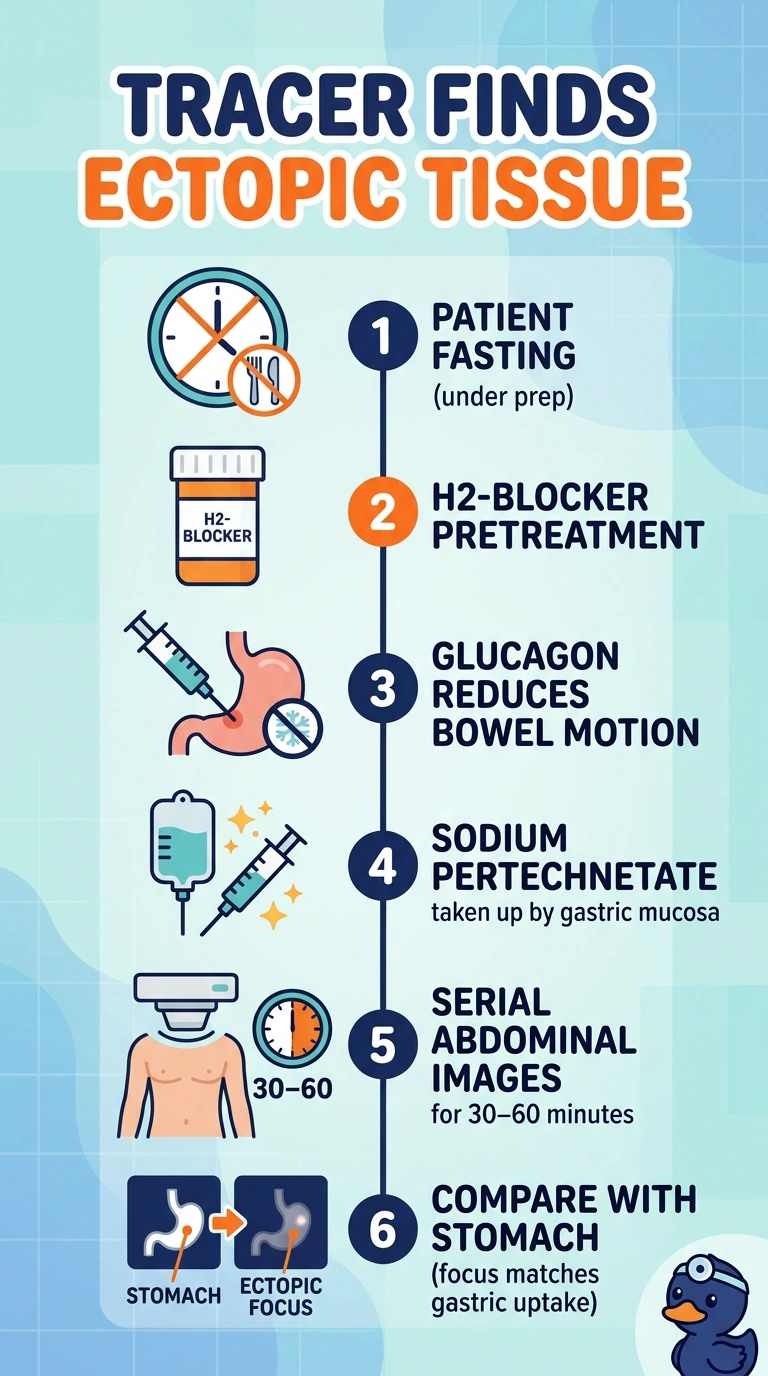
You use sodium pertechnetate after H2-blocker pretreatment, then take serial abdominal images for 30–60 minutes to show tracer retained in ectopic gastric mucosa. The tracer works like a spotlight on that tissue, and the pretreatment helps it stay visible while bowel activity and motion remain low.
Full Explanation
Sodium pertechnetate is taken up by gastric mucosal cells, including ectopic gastric mucosa in a Meckel diverticulum, so it directly targets the suspected tissue rather than merely demonstrating blood loss. H2-blocker pretreatment helps retain tracer in the mucosa and limits loss into the bowel lumen; serial abdominal imaging over 30–60 minutes can show a focus appearing with gastric activity while allowing assessment of its location and evolution. Pertechnetate without H2 blockade uses the correct tracer and imaging interval but omits the stated preparation that improves mucosal retention and reduces bowel activity. Delayed-only imaging after H2 blockade uses the appropriate tracer and preparation, but may miss or obscure the early appearance and temporal pattern needed to identify ectopic gastric uptake; delayed views are generally supplementary rather than a substitute for serial imaging. Labeled red blood cell scintigraphy is a valid method for localizing active gastrointestinal hemorrhage, but it tracks extravasated blood rather than specifically demonstrating ectopic gastric mucosa, and intermittent bleeding may not be occurring during the study. Exam caveat: a negative Meckel scan does not exclude a diverticulum, particularly if ectopic gastric mucosa is scant or absent. Practical check: confirm the ordered study specifies pertechnetate, appropriate H2-blocker preparation, and serial imaging, and review whether recent medications could affect tracer uptake.