
A patient with biopsy-proven cirrhosis is scheduled for a liver-spleen scintigram ordered to evaluate reticuloendothelial function. Before drawing up the dose, the technologist confirms why the ordered agent accumulates in the liver. Which localization mechanism accounts for this agent's liver uptake?
Select an answer to reveal the explanation.
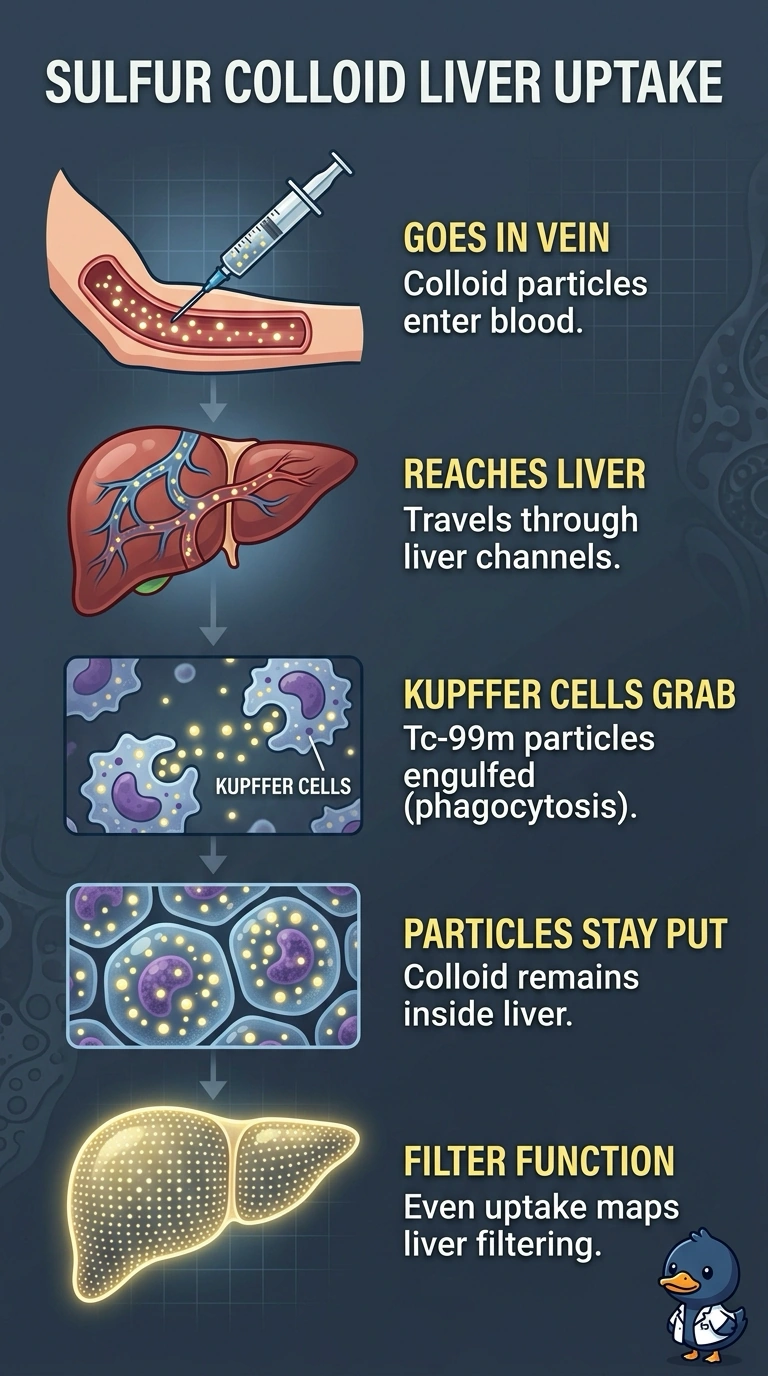
Short Explanation
Your Kupffer cells are the liver's housekeeping crew, and they swallow sulfur colloid right out of the blood. It's phagocytosis that the study is measuring. A hepatocyte agent like mebrofenin would tell you about bile flow instead.
Full Explanation
Sulfur colloid localizes by mechanical clearance rather than metabolism: the injected particles are recognized as foreign and engulfed by the Kupffer cells lining the liver sinusoids, with the spleen and marrow taking a smaller share, and that phagocytic uptake is exactly what a reticuloendothelial order is meant to test. Hepatobiliary transport fails as an explanation because mebrofenin crosses the hepatocyte membrane and is secreted into the bile canaliculi, a pathway that reports on hepatocyte function and bile drainage rather than on the filtering cells. Adsorption onto hydroxyapatite is the mechanism behind a skeletal tracer such as MDP, where uptake follows blood flow and osteoblastic activity, so it answers a bone question. Remaining intravascular is the labeled red blood cell approach, which only outlines the blood pool and never shows the liver's filtering cells. Exam caveat: when liver function is poor, colloid shifts toward marrow and lung, so a patchy pattern is a clue rather than an error. Practical check: confirm the order specifies a reticuloendothelial study and review recent imaging history before you draw the dose.