
Before the thyroid uptake clinic opens, the technologist runs well counter QC and finds that counts from the daily check source are 12 percent below the established reference value, while background is unchanged and the photopeak sits low in the channel. Which well counter QC procedure should be performed first?
Select an answer to reveal the explanation.
Short Explanation
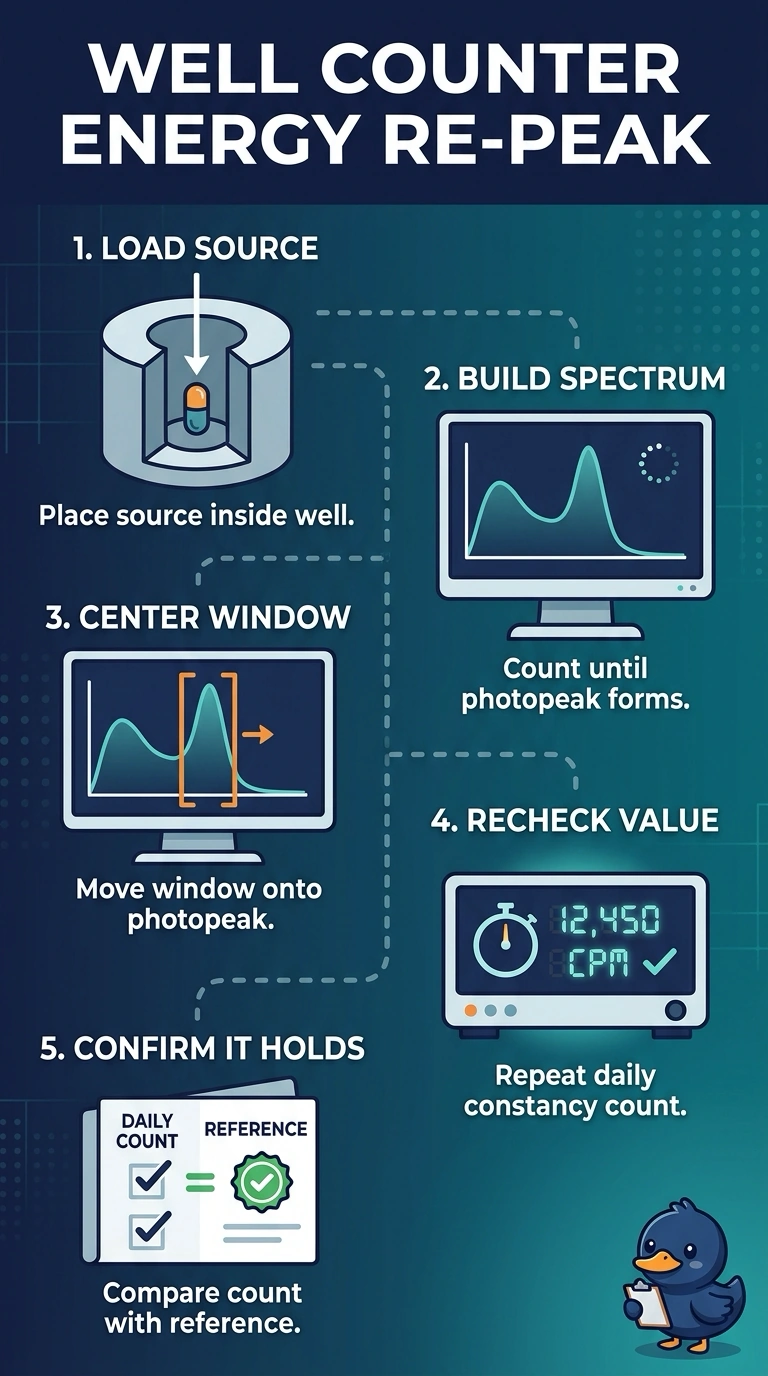
Your photopeak has drifted out of the window, so fewer counts land where they belong. That’s a gain problem, not routine statistical variation, and recalibrating the energy spectrum brings the window back into alignment. Think of it as retuning a radio before deciding the station got quieter.
Full Explanation
Energy calibration, often called peaking, places the counting window on the photopeak, so recalibrating the energy spectrum with the check source and recentering the window is the appropriate first procedure when the spectrum drifts. A window that no longer sits over the peak silently discards counts, explaining why the source total falls even though the source itself is unchanged. Unchanged background indicates that background conditions are stable, while a photopeak sitting low in the channel directly suggests gain shift rather than chance. Extending the constancy count treats a systematic error as routine statistical variation; it will not correct the displaced window, so the daily value remains depressed and uptake measurements may be affected. Comparing reference-standard counts with dose calibrator activity is a sensitivity check, but it cannot provide a reliable comparison while the window is mispositioned and counts are already being lost. Testing count-rate linearity at several activities evaluates the counter’s response across its working range; it is a useful periodic procedure but does not correct the peak position. Exam caveat: an uptake probe has similar daily expectations, so a peak problem on one device should prompt a recheck of the other. Practical check: after recalibrating, repeat the constancy count and confirm that it returns to the established reference range before counting any patient sample.