
After drawing a Tc-99m dose, the prep bench holds a used needle with a drop of blood, a gauze pad soiled with blood and radiopharmaceutical, and an absorbent pad that soaked up a spilled dose. Facility policy requires radioactive items to be held for decay-in-storage before disposal, with blood-contaminated items then disposed of as regulated medical waste. Which route for the needle, gauze, and absorbent pad follows policy?
Select an answer to reveal the explanation.
Short Explanation
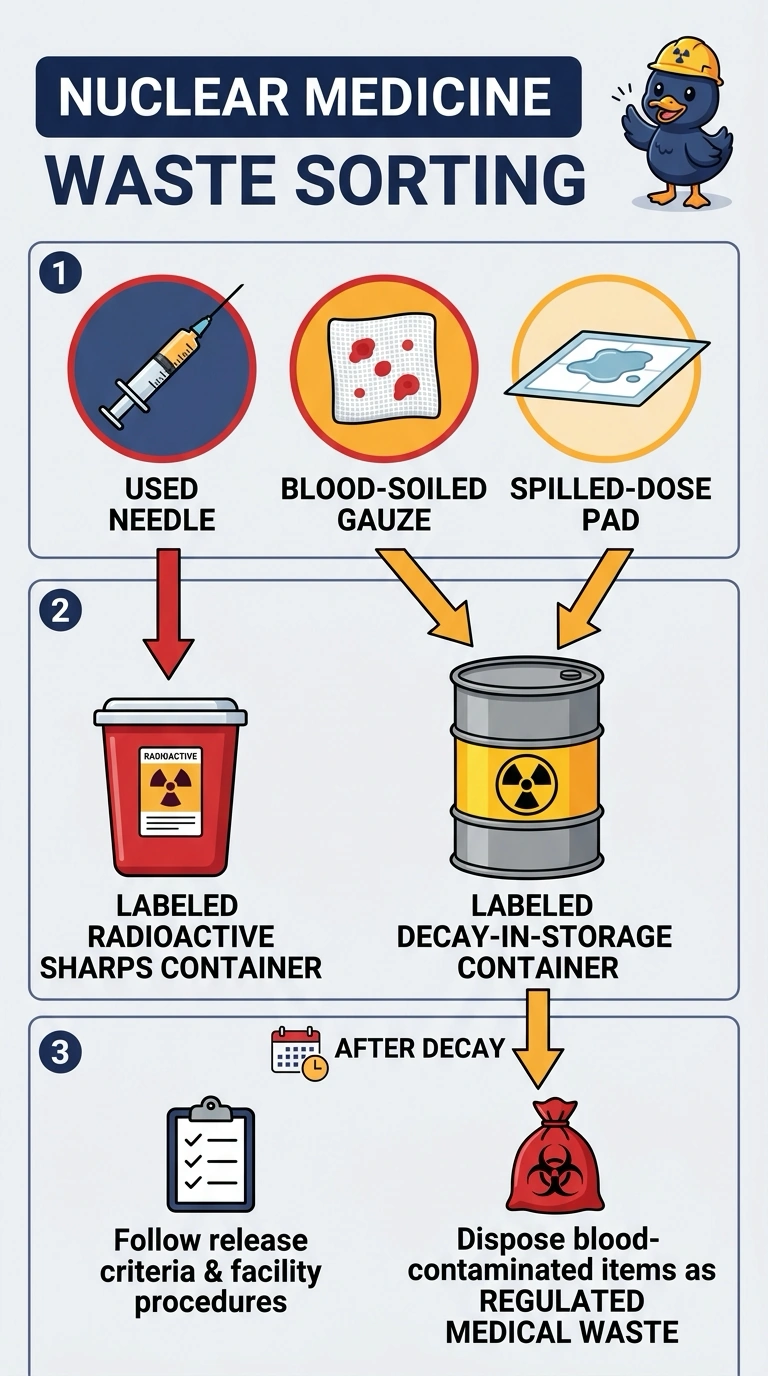
You’ll sort the needle into a labeled radioactive sharps container and the gauze and absorbent pad into labeled decay-in-storage containers, like putting each item in its proper bin. After the radioactive material decays, dispose of the blood-contaminated items as regulated medical waste, following policy.
Full Explanation
The correct route separates radioactive control from the required biohazard disposal: the blood-dropped needle goes into a labeled radioactive sharps container, while the blood- and radiopharmaceutical-contaminated gauze and spill-absorbent pad go into labeled decay-in-storage containers. After decay and release under facility policy, the blood-contaminated items must enter the regulated-medical-waste stream, with the needle handled through the appropriate sharps route. The “decay, then ordinary waste” approach fails because radioactive decay does not remove blood contamination or cancel the medical-waste requirement. The ordinary-sharps/regulated-gauze approach fails because it sends a radioactive needle to a nonradioactive container and sends contaminated gauze to disposal before required decay-in-storage. The approach that stores the needle and gauze but puts the pad in ordinary waste fails because the pad absorbed radioactive material and must also be held for decay. Exam caveat: decay-in-storage release criteria and final waste routes are governed by facility procedures and applicable regulations; decay alone is not authorization for ordinary disposal. Practical check: confirm each item’s label and container match its radioactive, sharps, and blood-contamination status, then verify release criteria before transfer to final disposal.