
A technologist is setting up a whole-body bone scan with Tc-99m MDP. Available for the camera are low-energy high-resolution, low-energy high-sensitivity, and medium-energy high-sensitivity collimators. The order requires coverage from skull to toes in one continuous pass, the patient can tolerate only a short table time, and the tracer emits 140 keV photons. Which collimator and acquisition setting fits this whole-body study?
Select an answer to reveal the explanation.
Short Explanation
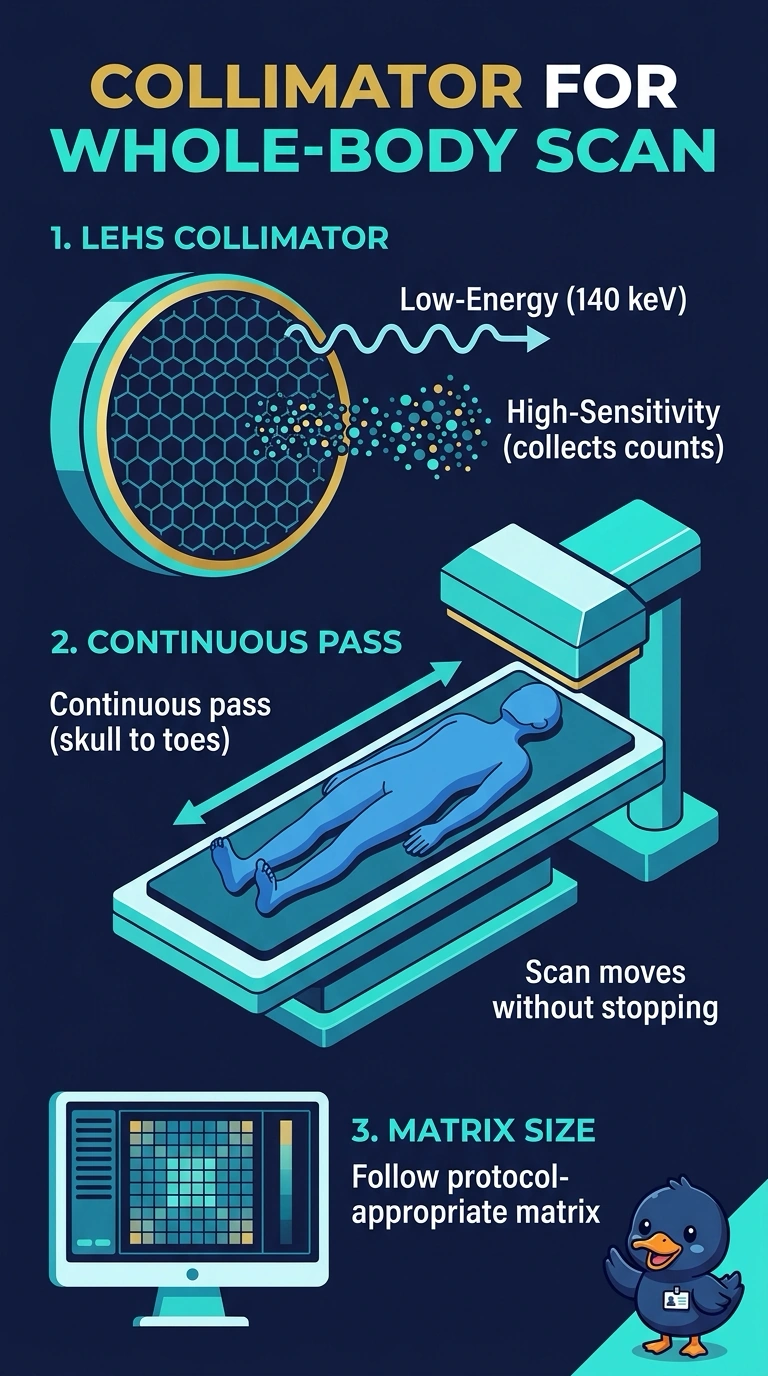
Collimator choice is a trade between how many photons you collect and how sharp the picture is, and a whole-body scan under time pressure favors sensitivity. The low-energy design is appropriate for Tc-99m's 140 keV photons. Use the camera's validated whole-body matrix and acquisition protocol.
Full Explanation
Collimator selection starts with photon energy and then with the trade-off between sensitivity and resolution. A low-energy collimator is appropriate for Tc-99m's 140 keV photons, and a high-sensitivity design can collect more counts per unit time than a high-resolution design. That makes it a suitable choice when a skull-to-toes continuous pass must be completed quickly. A low-energy high-resolution collimator favors resolution over sensitivity, while a medium-energy collimator is not the appropriate energy match for this low-energy photon. A zoomed sternum spot view does not meet the whole-body coverage requirement. Matrix size, zoom, and acquisition parameters should follow the camera's validated protocol.