
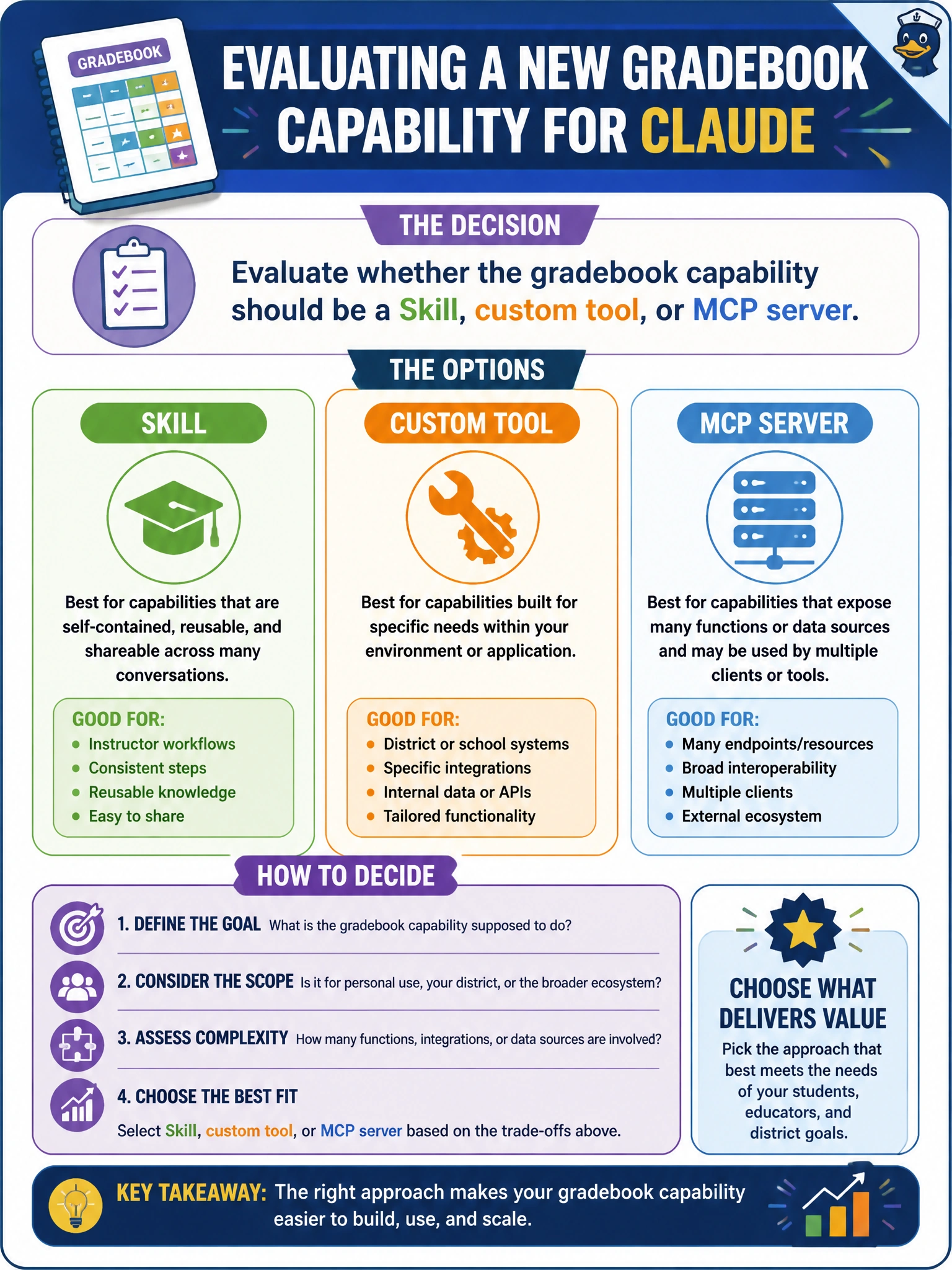
A school district evaluates a new gradebook capability for Claude. Which decision approach fits?
Select an answer to reveal the explanation.
Short Explanation
New gradebook power isn't one-size-fits-all—weigh Skill vs custom tool vs MCP before you build. Jumping straight to a Skill, a custom tool, or an MCP server locks you into a shape before you've checked what the capability actually needs.
Full Explanation
When a school district evaluates a new gradebook capability for Claude, the durable approach is to decide explicitly whether it should be a Skill, a custom in-app tool, or an MCP server based on reuse, live-data needs, and consumer count. Style or rubric guidance often fits a Skill; a single-app calculation may fit a custom tool; multi-app live gradebook APIs usually fit MCP. Packaging the gradebook capability as a Skill with templates and grading scripts overcommits to a guidance format before checking whether a custom tool or MCP server better matches reuse, live-data needs, and consumer count. Building the gradebook capability as a custom tool using structured grade inputs locks it into a single-app tool before confirming whether broader Skill reuse or MCP-based live SIS access is the better fit. Exposing the district student system through an MCP server for live roster gradebook access jumps to live networked infrastructure without first determining whether a Skill or custom tool is sufficient for the district's gradebook needs. Exam caveat: the decision can change as adoption grows—document promotion criteria (for example, second consumer triggers MCP extraction) rather than treating the first choice as permanent. Operational check: write a one-page decision record for the gradebook feature listing consumers, whether live SIS data is required, and whether the content is guidance versus API access; map that record to Skill, custom tool, or MCP before implementation begins.