
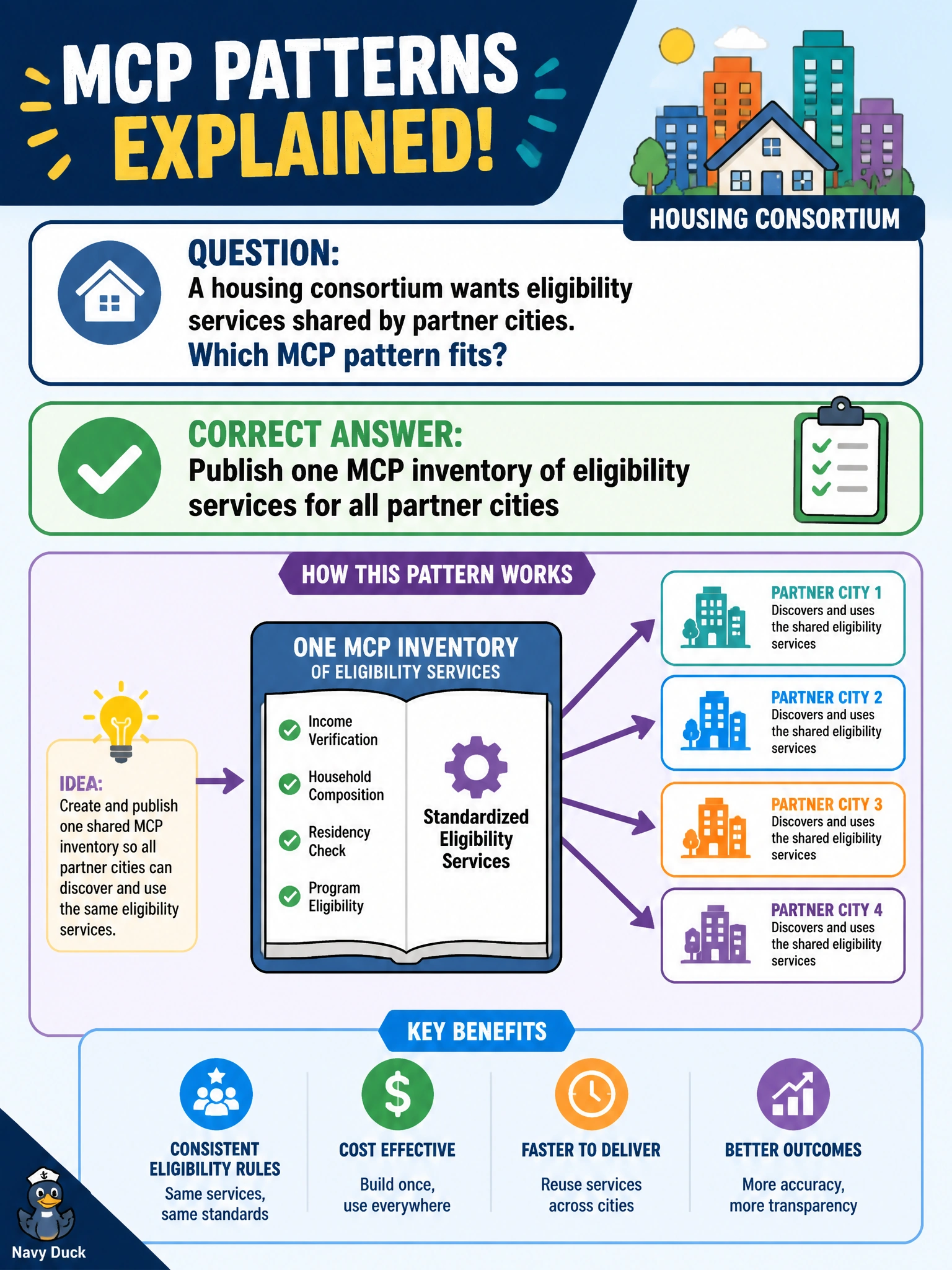
A housing consortium wants eligibility services shared by partner cities. Which MCP pattern fits?
Select an answer to reveal the explanation.
Short Explanation
Don't route every cross-city eligibility call through a lead-city agent delegate—that bottlenecks all partners and lets one city control access. Publish one MCP inventory and share it instead.
Full Explanation
A housing consortium that wants eligibility services shared by partner cities should publish one MCP inventory of those eligibility capabilities so each city can discover and call the same maintained tools instead of rebuilding connectors. Shared inventory improves consistency of rules exposure, speeds onboarding of new partners, and reduces duplicate integration cost across jurisdictions that already share policy intent. Maintaining synchronized per-city MCP registries duplicating eligibility tool definitions fragments implementations and blocks consortium-wide improvements when rules or backends change. Exposing eligibility rules as plain prompt text for agents to interpret directly replaces live, versioned tool access with unstructured natural language, inconsistent interpretation, and no structured error handling. Routing cross-city eligibility calls through a lead-city agent delegate creates a single bottleneck and puts one city in charge of every partner's lookups, undermining equitable administration. Exam caveat: a shared MCP inventory still needs per-city auth, data residency, and policy overlays—sharing the tool interface is not the same as sharing raw resident PII or collapsing local ordinance differences. Operational check: onboard two partner cities to the same eligibility MCP entries, update one tool schema centrally, confirm both cities receive the change, verify plain prompt text is not the integration path, and ensure each city’s credentials only authorize its own resident lookups where required.