
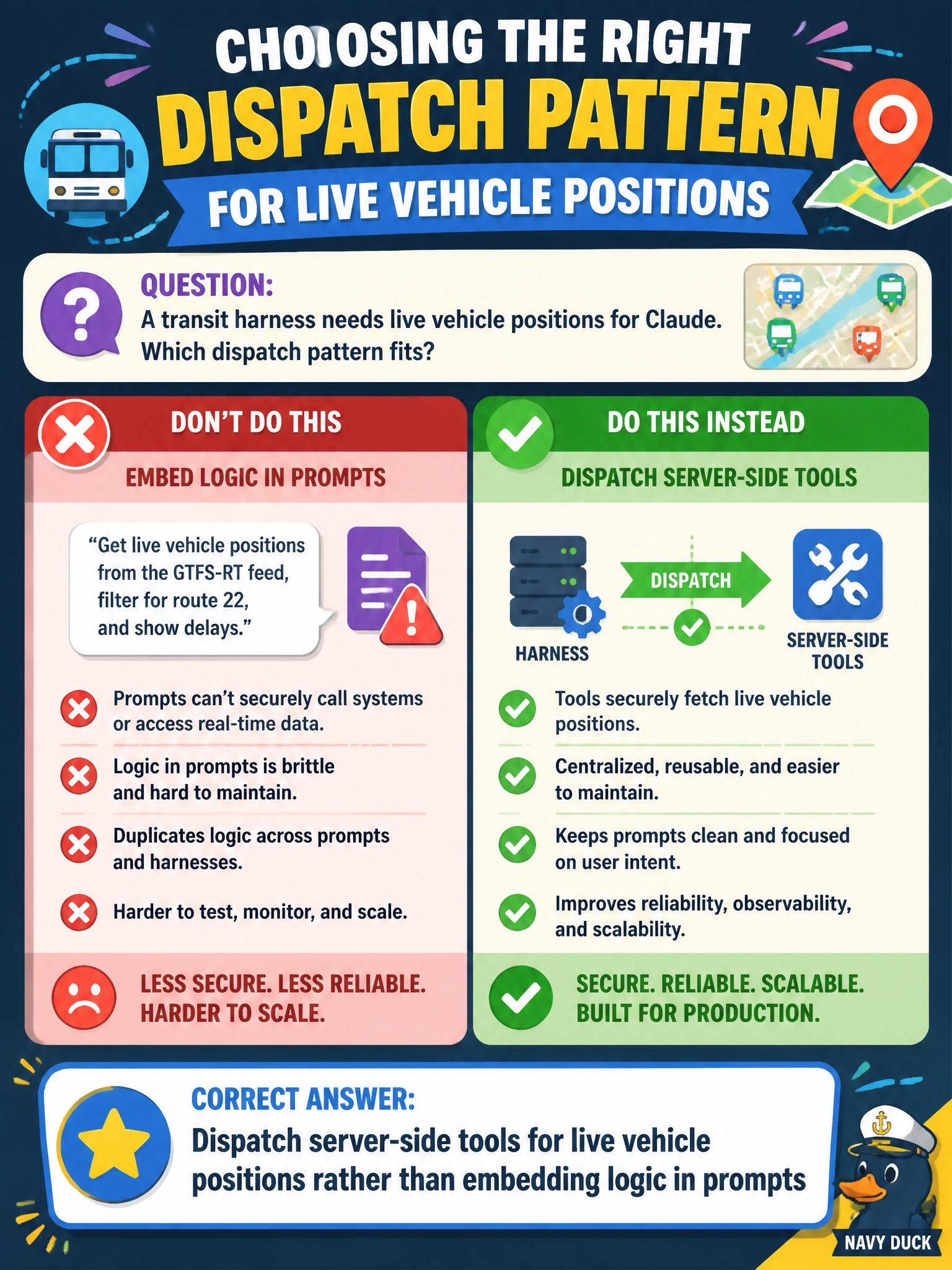
A transit harness needs live vehicle positions for Claude. Which dispatch pattern fits?
Select an answer to reveal the explanation.
Short Explanation
Exposing static GTFS schedules through server-side tools gives you timetable times, not live bus positions—don't mistake schedule-aware for real-time. Providing route shapes and stop locations via server-side tools gives you map geometry, not vehicle locations, so you'll still be blind. Delegating live position fetching to client-side tools from browser geolocation gives you the rider's spot, not the bus's, so it's the wrong data source entirely.
Full Explanation
Live vehicle positions change continuously; a transit harness should dispatch server-side tools that fetch current positions rather than embedding operational logic or frozen snapshots inside prompts. Tool dispatch keeps context smaller, returns fresh data per turn, centralizes authentication to the AVL or GTFS-realtime backend, and lets operations apply caching and rate limits in one place. Exposing static GTFS schedules through server-side tools for schedule-aware responses gives you timetable times, not live vehicle positions, so the harness still can't answer where a bus actually is right now. Providing route shapes and stop locations via server-side tools for map rendering context gives you static map geometry, not live vehicle positions, so it can't tell you where a bus is now and leaves the harness blind during real-time queries. Delegating live position fetching to client-side tools invoked directly from browser geolocation handlers gives you the rider's location, not the vehicle's, so it can't serve as a source of vehicle truth and completely misses the transit harness's need for bus positions. Exam caveat: server-side tools still need caching, rate limits, and graceful degradation when the AVL feed is down—tooling does not remove operational resilience design, and prompts should never be treated as a real-time database. Operational check: compare a tool-fetched position to the live feed for a known vehicle ID, confirm the system prompt does not contain static GTFS schedule data, verify a feed outage returns a structured tool error instead of fabricated coordinates, and measure that successive turns call the tool rather than reusing stale static schedule data from a previous turn.