
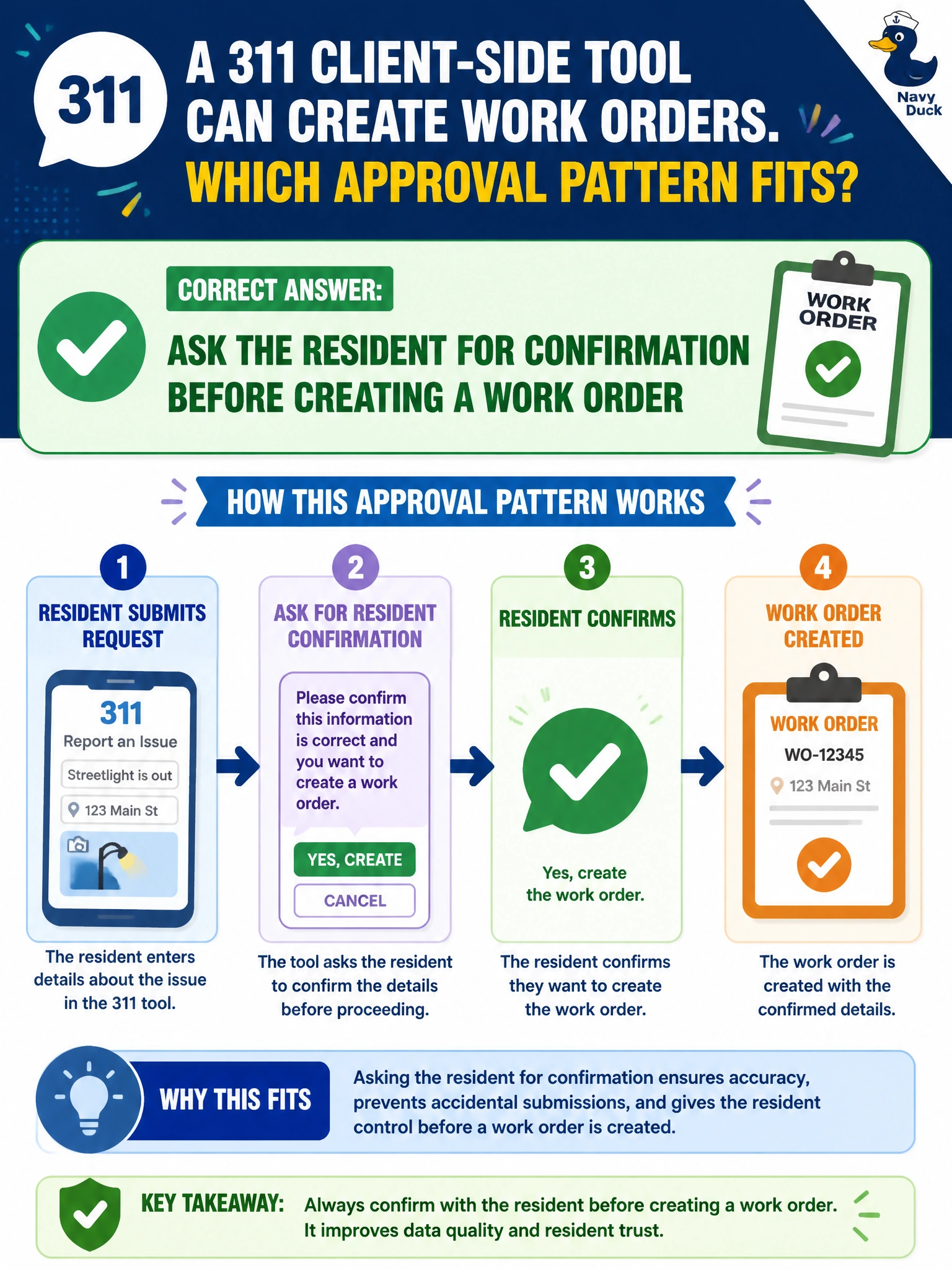
A 311 client-side tool can create work orders. Which approval pattern fits?
Select an answer to reveal the explanation.
Short Explanation
Opening a work order spends city crew time, so you ask the resident to confirm before the tool fires. Don't let a confirmation after submission, one-time session consent, or a supervisor's approval stand in for the resident's own go-ahead.
Full Explanation
Creating a 311 work order is a consequential civic action: it queues city crew time, may notify residents or supervisors, and can generate measurable cost against departmental budgets. For a client-side tool that can create work orders, the approval pattern that fits is asking the resident for confirmation before creating the work order, preserving explicit human assent for side-effecting operations and reducing accidental duplicate tickets from ambiguous chat. The approach that requests resident confirmation after the work order is submitted is wrong because confirmation comes too late to prevent the side effect; the ticket is already created, crew time may already be committed, and the resident's assent cannot undo an unwanted or duplicate work order. The approach that obtains one-time session consent covering future work orders is wrong because blanket consent is not informed, per-request assent; it removes the check that each work-order payload matches the resident's current intent and details, and it cannot distinguish among different locations, categories, or priorities for separate tickets. The approach that routes work order confirmation to the shift supervisor is wrong because the resident, not the supervisor, must assent to a request filed on their behalf; routing confirmation to a supervisor bypasses the resident's explicit consent and can create work orders the resident never approved. Exam caveat: confirmation UX must show the key fields that will be submitted—location, category, description, and priority—so consent is informed rather than a blind click, and accessibility requirements still apply on mobile 311 surfaces. Operational check: run a triage session that drafts a work order, verify the create tool remains blocked until the resident confirms the preview, then cancel and confirm no ticket appears in the 311 system of record; also confirm a successful confirmation creates exactly one work order with the previewed fields.