
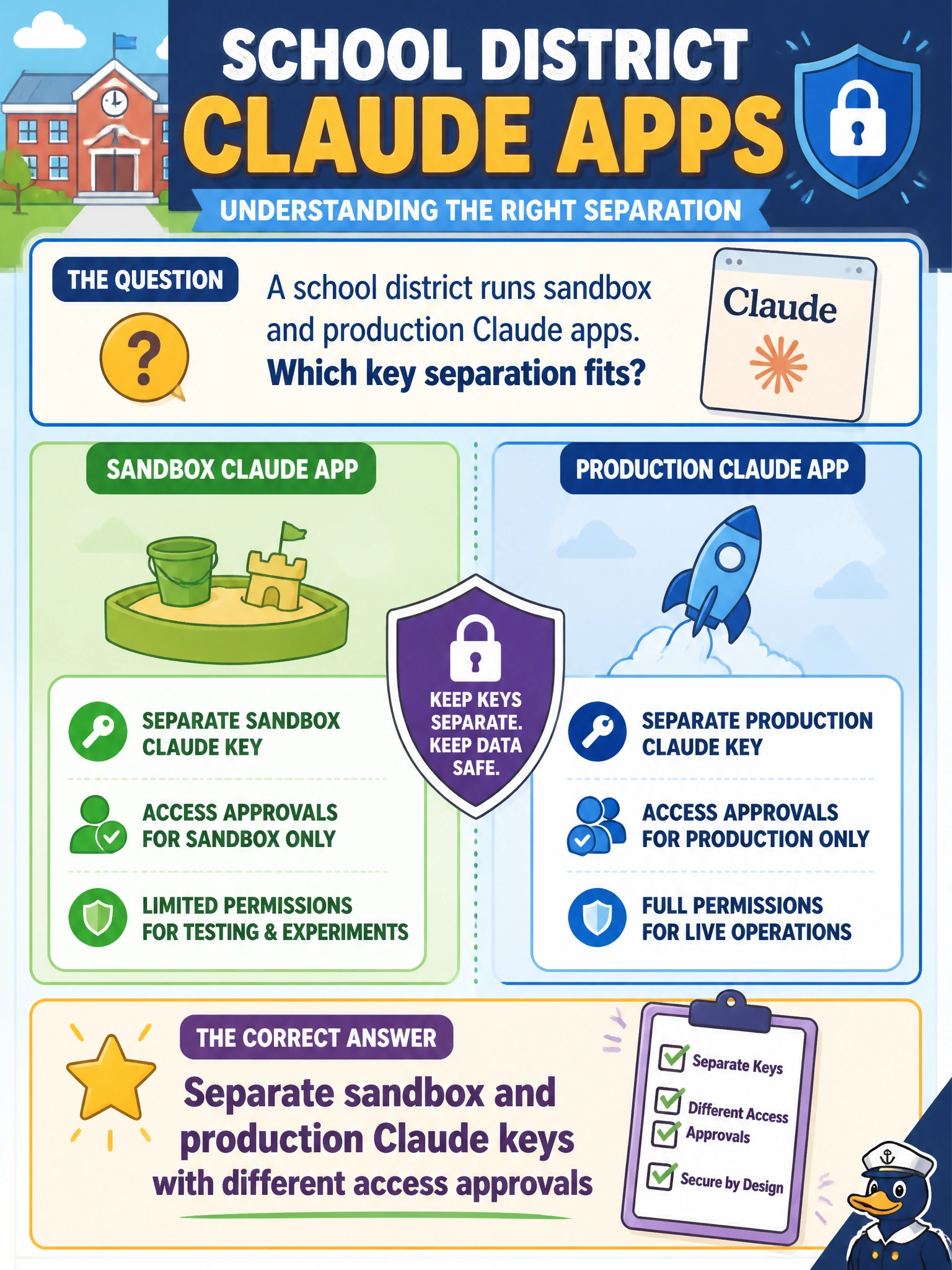
A school district runs sandbox and production Claude apps. Which key separation fits?
Select an answer to reveal the explanation.
Short Explanation
Sandbox and production are different rooms—give each its own Claude key and its own approval door.
Full Explanation
Sandbox and production Claude apps in a school district serve different trust boundaries: sandbox traffic may include experimental prompts, student-like test data, and looser developer access, while production serves live student-facing workflows under stricter approvals. Separating sandbox and production Claude keys with different access approvals confines blast radius and makes environment intent explicit in identity systems. Using separate sandbox and production Claude keys with a shared approval workflow still routes both environments through the same gate, so a sandbox approval can implicitly unlock production access and defeats the purpose of distinct access approvals. Issuing short-lived sandbox Claude keys linked to production billing projects ties experimental usage to live production budgets, so sandbox spend can distort production cost centers and blur financial accountability between environments. Storing sandbox and production Claude keys together with team audit logging co-locates credentials across trust boundaries, so a single key-store exposure compromises both environments even if logs record the access. Exam caveat: separate keys alone are insufficient if both keys share the same over-privileged tool backends; pair key separation with environment-scoped tool and data access. Operational check: attempt a sandbox app call using the production key and confirm it fails, then confirm distinct approval tickets exist for each key and that student accounts cannot mint or use production credentials.