
A court clerk task should list only missing filing fields, nothing else. Which prompt constraint fits?
Select an answer to reveal the explanation.
Short Explanation
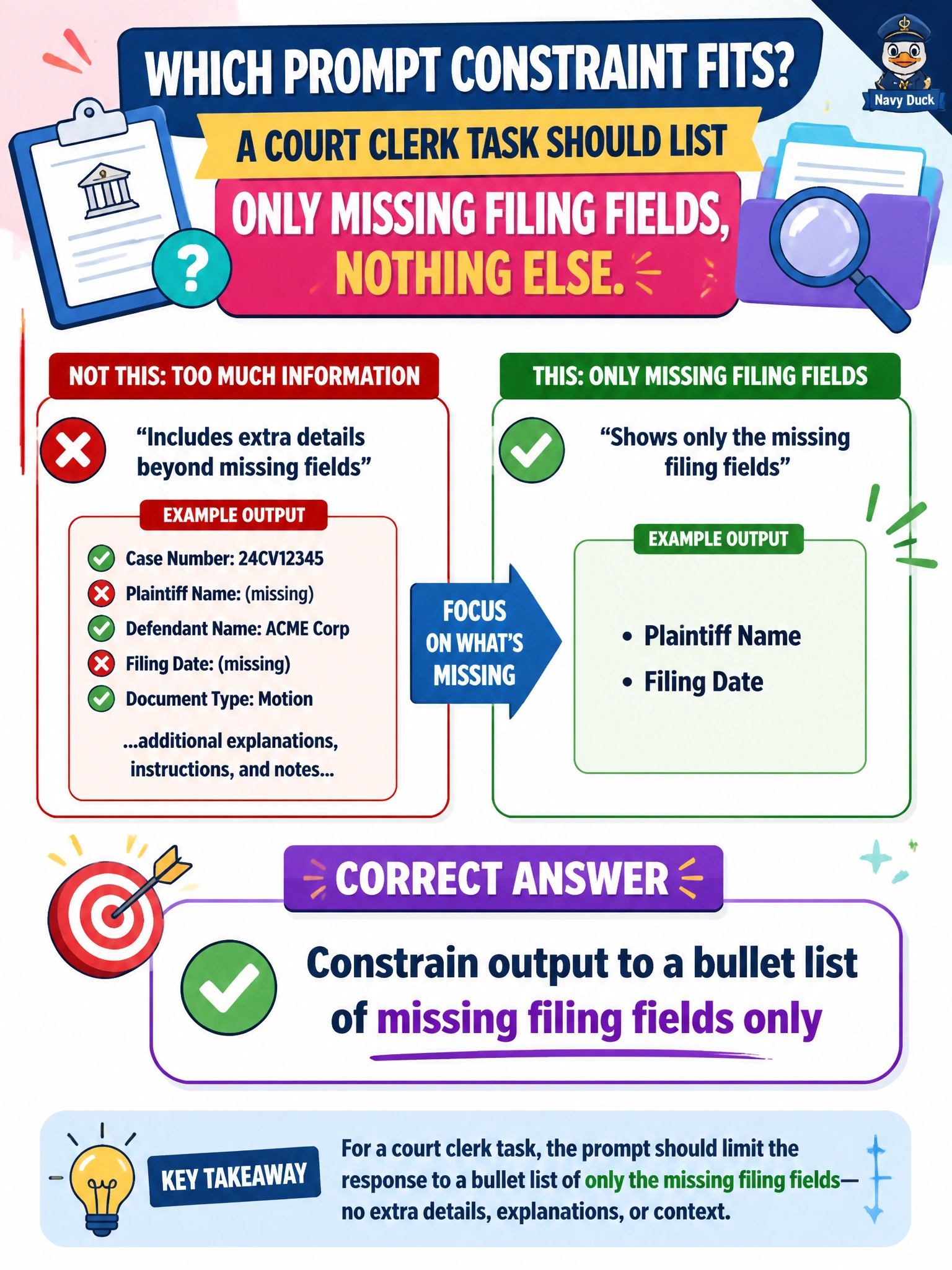
When clerks only need what's missing, say so: bullets of missing fields only. Don't add sample values, status notes, or a case summary first.
Full Explanation
Constraining court-clerk output to a bullet list of missing filing fields keeps Claude inside an operational checklist rather than an advisory essay. That correct constraint works because clerks need actionable gaps—unsigned affidavit, missing fee code, absent certificate of service—not a bullet list pairing missing fields with sample values or a short case summary ahead of the list. Explicit output shape also improves downstream form-routing: bullets map cleanly to deficiency letters and case-management checkboxes.
Constraining output to a bullet list pairing missing fields with sample values fails because it adds content the clerk didn't request—sample values go beyond identifying gaps and risk telling filers what to file. Formatting output as a table of missing filing fields with status notes fails because status notes are extra commentary beyond the missing-field list, and the clerk task calls for a simple bullet list only. Requiring a short case summary ahead of the list of missing filing fields fails because a case summary is extra prose that delays the actionable list and has no place in a field-completeness check.
Exam caveat: output constraints do not replace the authoritative checklist; if the checklist itself is outdated, constrained bullets will still miss newly required fields. Operational check: bind the prompt to the published filing checklist version ID, reject responses that contain non-bullet prose or fields not on the list, sample weekly exports for invented requirements, and escalate any off-checklist item to court administration before it reaches litigants.