
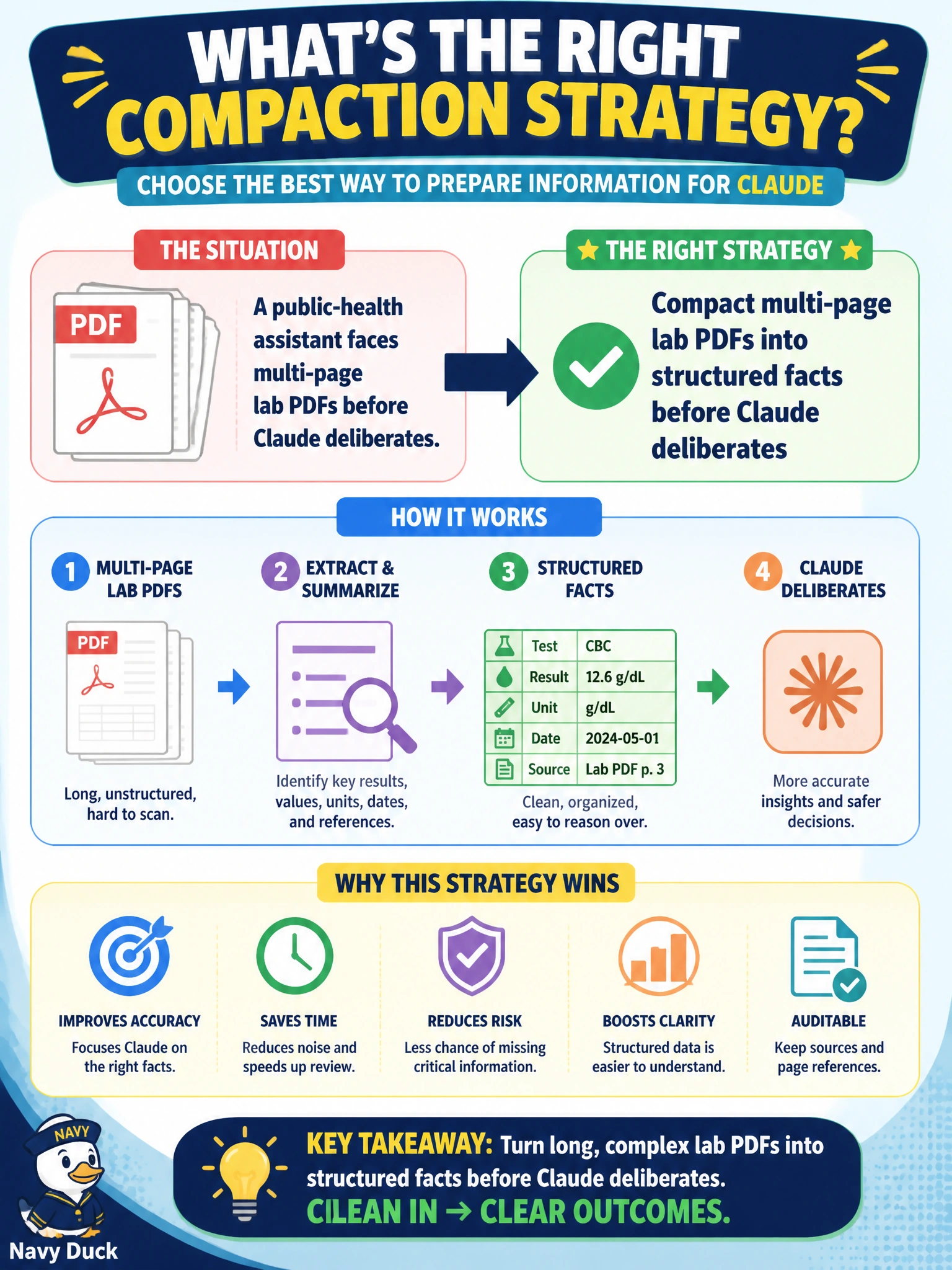
A public-health assistant faces multi-page lab PDFs before Claude deliberates. Which compaction strategy fits?
Select an answer to reveal the explanation.
Short Explanation
Multi-page labs bury the lede—compact them into structured facts before Claude starts deliberating.
Full Explanation
Compacting multi-page lab PDFs into structured facts before Claude deliberates is the correct strategy for public-health assistants because raw page dumps waste context and bury the clinically actionable fields. Extraction into structured facts—specimen type, result values, reference ranges, collection times, flags—preserves signal for deliberation while fitting token limits. The assistant then reasons over durable findings instead of OCR sprawl, headers, and repeated footers common in municipal lab exports.
Summarizing multi-page lab PDFs into narrative prose for Claude deliberation context fails because it discards the structured fields—specimen type, result values, reference ranges, collection times, flags—that make lab results actionable and forces Claude to re-extract facts from loose text. Chunking multi-page lab PDFs into overlapping passages for Claude deliberation retrieval fails because it avoids compaction altogether, leaving Claude to reassemble raw OCR sprawl from overlapping chunks instead of reasoning over durable findings. Rendering multi-page lab PDFs into page images before Claude deliberates fails because images inflate context, destroy extractable structure, and make Claude interpret pictures rather than compacted clinical facts.
Exam caveat: compaction pipelines can drop rare but critical comments (hemolysis notes, amended results); validation must include amended-report fixtures, not only clean single-page normals. Operational check: feed a multi-page abnormal lab PDF through the compactor, verify required fields and amendment markers appear in the structured object, measure token reduction versus verbatim paste, and confirm Claude’s deliberation cites the structured facts rather than missing pages.