
A court assistant debug session must find why Claude never saw a filing-status tool reply. What analysis step fits?
Select an answer to reveal the explanation.
Short Explanation
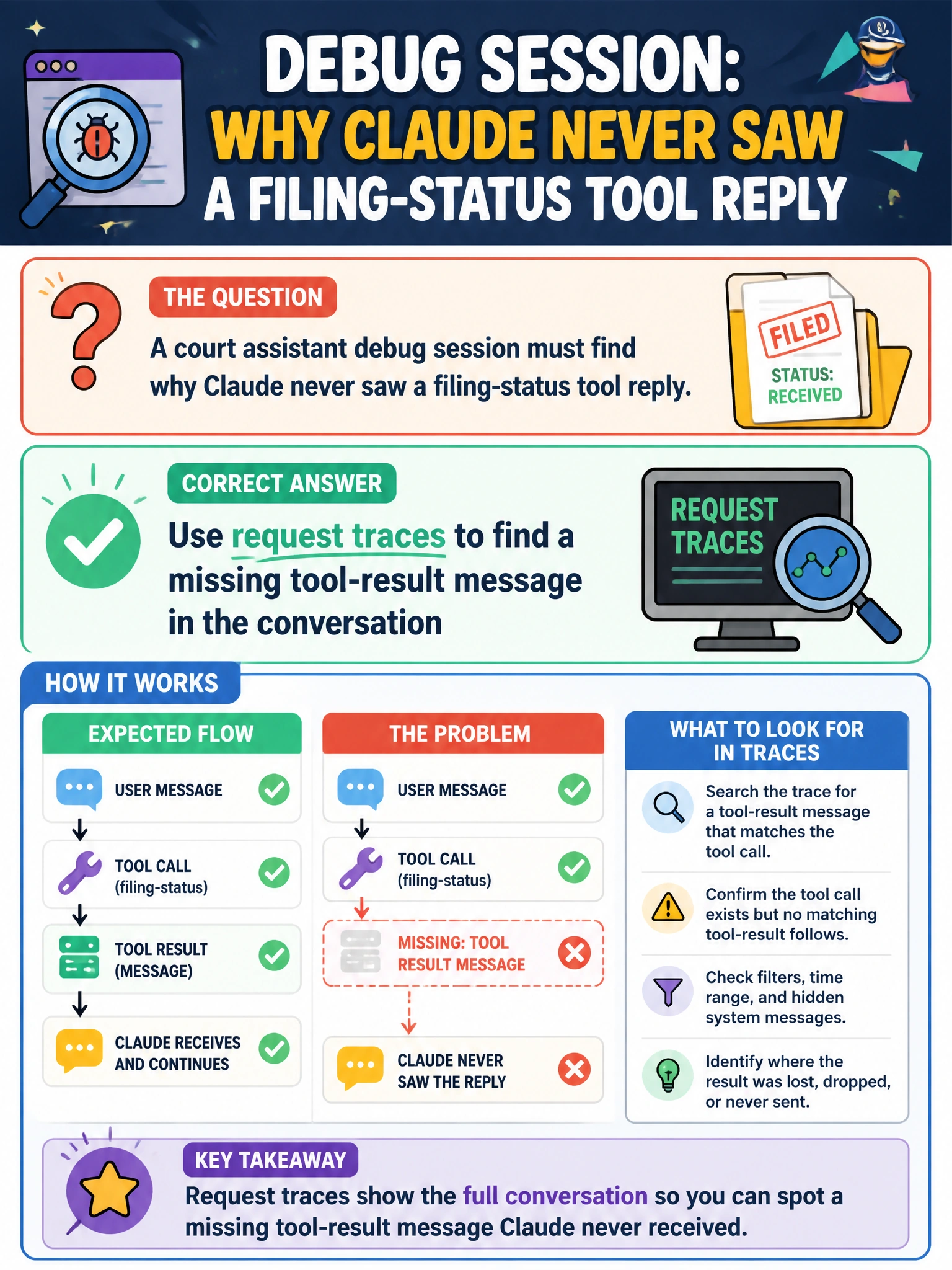
If Claude never saw the filing-status reply, dig the request trace for a missing tool-result message—that's the usual wiring gap. Don't get sidetracked by token dashboards, schema checks, or latency charts—none of them surface a missing tool-result turn.
Full Explanation
If a court assistant debug session must explain why Claude never saw a filing-status tool reply, the right analysis step is to use request traces to locate a missing tool-result message in the conversation. Multi-turn tool use requires the tool output to be reinserted into the message list; without that message, the model cannot condition on the filing status even if the tool ran successfully elsewhere. Reviewing token usage dashboards for filing-status request volume patterns fails because volume patterns do not restore a missing tool-result turn. Inspecting the tool input schema for filing-status parameter validation details instead of inspecting the message trace fails conceptually—parameter validation has no bearing on whether the Messages API transcript includes tool results. Analyzing response latency metrics for filing-status tool endpoint performance trends fails as a misdiagnosis: latency trends do not replace message-completeness debugging for ordinary filing-status tools. Exam caveat: some "missing tool result" bugs are race conditions where the UI renders before the tool-result message is appended—trace timestamps matter. Operational check: dump the exact Messages request body, confirm each tool_use has a matching tool_result, and add a preflight that refuses to call Claude when a pending tool_use lacks its result.