
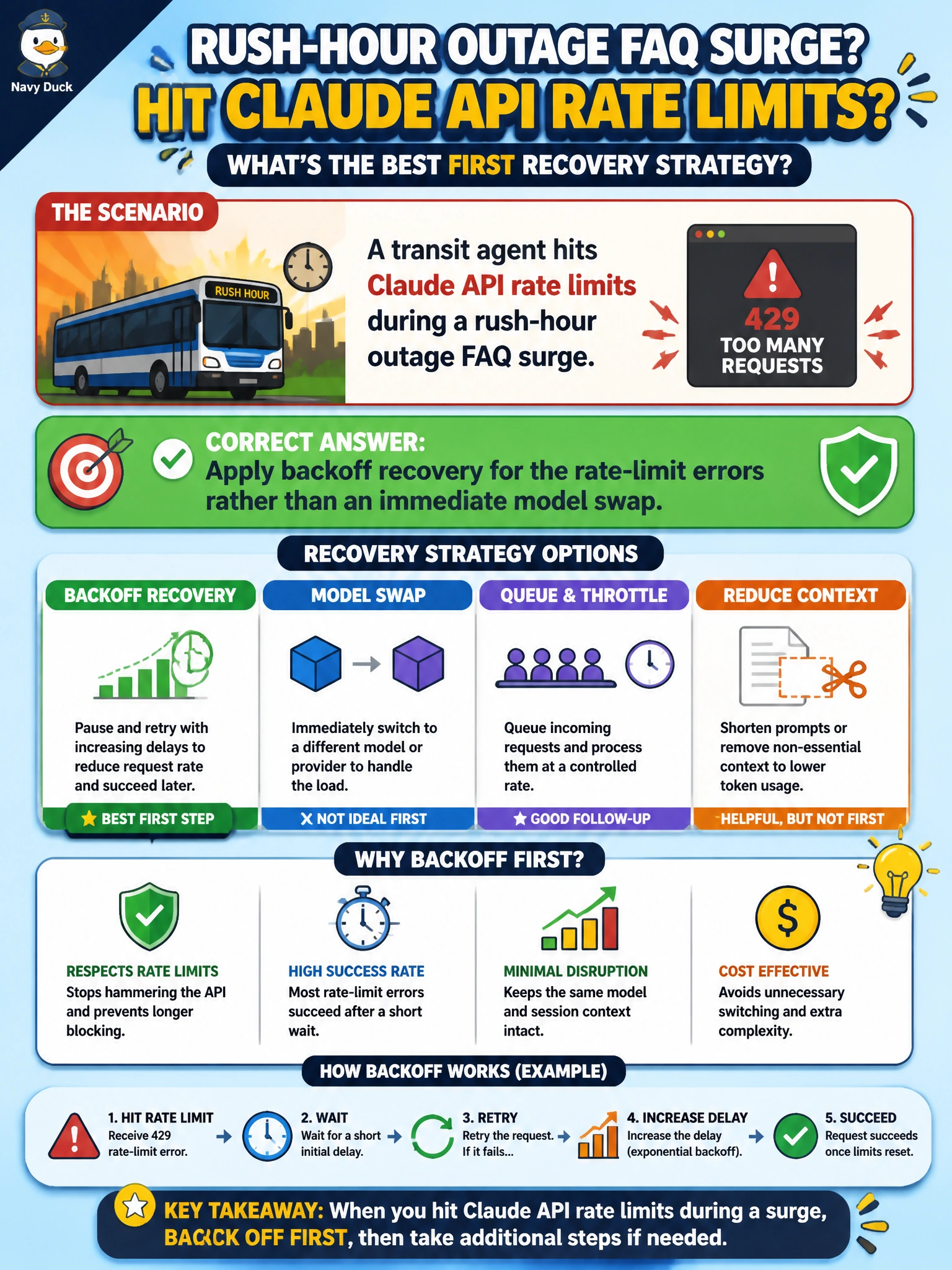
A transit agent hits Claude API rate limits during a rush-hour outage FAQ surge. Which recovery strategy fits first?
Select an answer to reveal the explanation.
Short Explanation
Rate limits aren't a reason to fail over to a standby model. Back off, wait, and retry so the transit FAQ can ride out the surge.
Full Explanation
During a rush-hour transit FAQ surge, Claude API rate-limit responses are a capacity and pacing problem first. Applying backoff recovery—respect Retry-After or exponential delays with jitter—preserves correctness of the rider-facing path without discarding a working model configuration. Rate limits signal "slow down," not "the model is wrong."
Failing over to a standby model deployment to absorb the FAQ surge load spike fails because it still shares quota and retry discipline; a panic failover adds deployment risk without fixing pacing. Shortening the retry delay for 429 responses to clear the FAQ backlog sooner fails because it ignores the pacing signal and can amplify the surge into a retry storm, turning a transient wait into repeated failures. Using circuit-breaker handling on the FAQ request path to throttle transit requests during overload fails because it can halt legitimate in-flight requests along with the throttled ones, amplifying the outage instead of just pacing around it.
Exam caveat: backoff must be bounded and paired with load shedding or cached FAQ answers so retries do not amplify the surge into a retry storm. Operational check: inject synthetic 429s in staging, confirm the transit client backs off and eventually succeeds, and verify dashboards distinguish rate-limit errors from model or auth failures.