
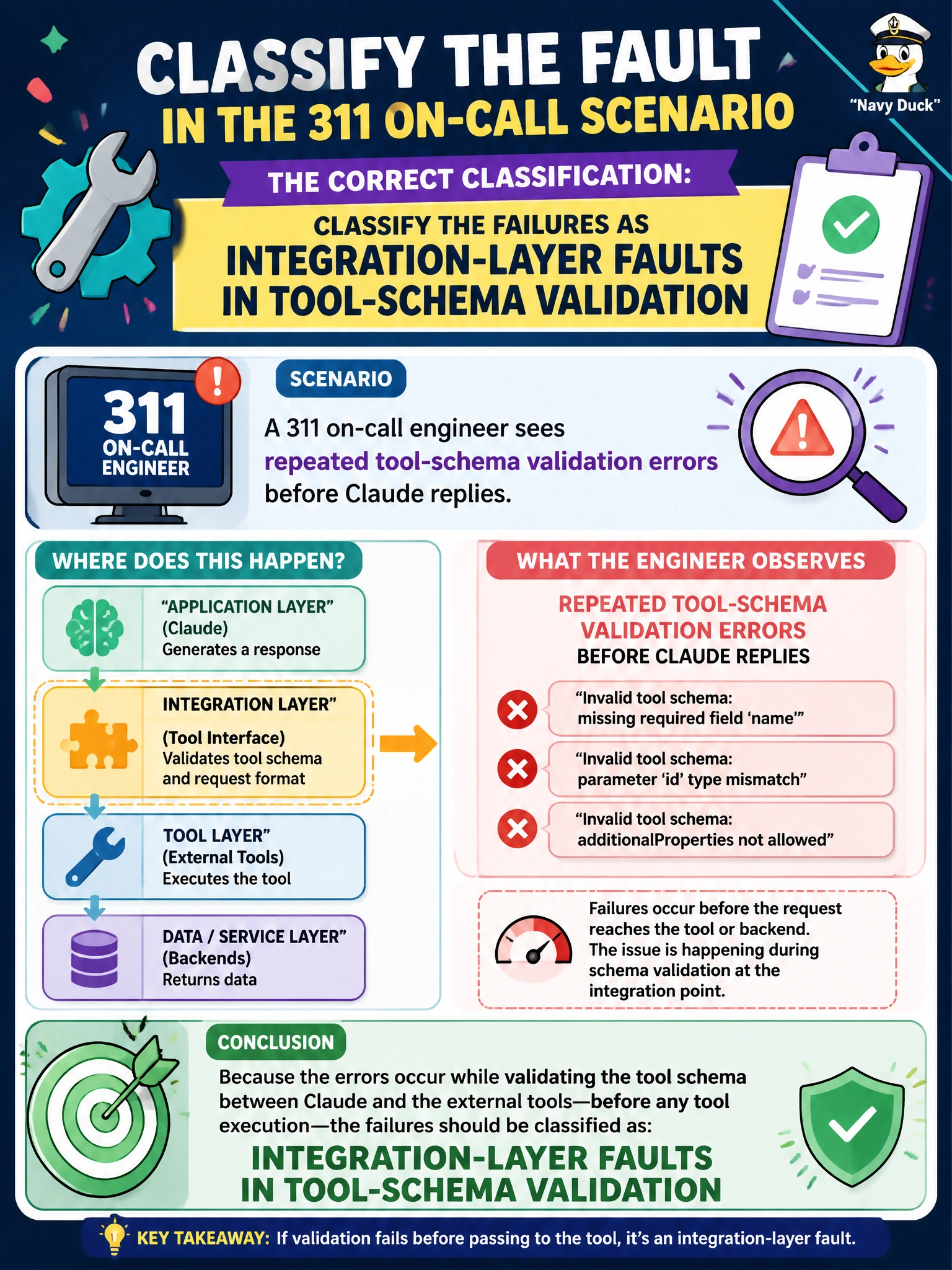
A 311 on-call engineer sees repeated tool-schema validation errors before Claude replies. How should the fault be classified?
Select an answer to reveal the explanation.
Short Explanation
If you're seeing tool schema rejections before Claude even talks, that's an integration-layer problem—not a model-layer response generation fault. The rejection happens at the schema check, so the fault isn't in the model's output generation.
Full Explanation
When a 311 on-call engineer sees repeated tool-schema validation errors before Claude produces a reply, the fault belongs in the integration layer: the client or gateway is rejecting malformed tool payloads against the declared schema. Classification matters because recovery differs—schema and serializer fixes, not prompt poetry, restore the tool path for resident services.
Classifying the failures as model-layer faults in response generation fails because the rejection occurs before model generation and is driven by schema contracts, not the model's output. Classifying the failures as transport-layer faults in network delivery fails because the errors are schema validation rejections at the integration layer, not network delivery issues; hiding the alarm does not fix the malformed payload, it just lets the same integration fault recur silently on every later call. Inspecting the tool schema for required vs. optional field definitions, not just format, is a reasonable debugging step but still misses the point of this question—before digging into field definitions, the on-call engineer first needs to classify where the fault lives, and jumping straight to field-level inspection skips naming the integration-layer cause the traces already point to.
Exam caveat: some "Claude failed" tickets are actually client-side schema drift after an API version bump—always separate model faults from transport and schema faults in runbooks. Operational check: capture the rejected payload and schema error code from traces, revalidate locally against the published tool schema, and redeploy only after a successful dry-run tool call from the 311 staging client.