
A housing IT lead needs nested CLAUDE.md files to specialize guidance for a case-management microservice. What hierarchy behavior should they explain?
Select an answer to reveal the explanation.
Short Explanation
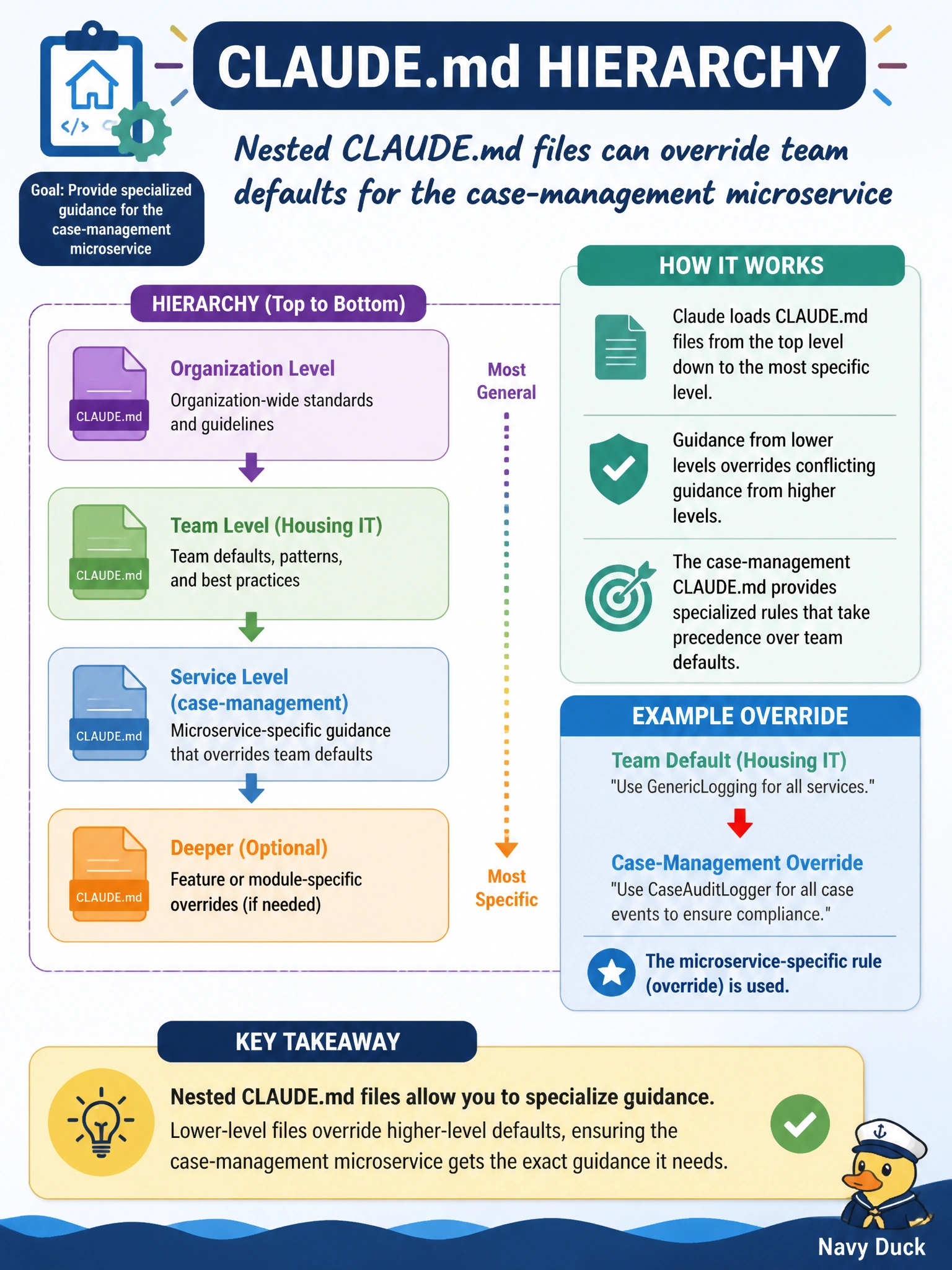
Think of CLAUDE.md like nested house rules. The closer file is the one you listen to first, so it can override the team defaults for that case-management microservice instead of deferring upward or spreading repo-wide.
Full Explanation
Nested CLAUDE.md files specialize guidance for a housing case-management microservice by allowing closer-scope instructions to override broader team defaults. Hierarchy behavior is intentional: global or team CLAUDE.md sets baseline civic conventions, while a service-local file can tighten tone, domain vocabulary, escalation rules, and microservice-specific workflows without rewriting the entire org playbook.
Claiming nested CLAUDE.md files defer to parent guidance for the case-management microservice fails because nested files are designed to specialize and override broader team defaults for that local scope, not simply step back and let the parent file decide. Asserting that nested files apply repository-wide beyond the case-management microservice fails because CLAUDE.md is layered specialization scoped to the service directory, not a blanket rule that extends across the entire repository. Saying nested files merge upward into parent scope fails because CLAUDE.md context is loaded for the working tree and continues to shape subsequent turns from the local directory, not by bubbling up into parent scope.
Exam caveat: conflicting nested instructions can confuse agents if parent and child files contradict without clear precedence documentation—write overrides as explicit deltas, not silent rewrites of unrelated policies. Operational check: place a distinctive instruction only in the microservice CLAUDE.md, start a session from that directory, and verify the agent follows the local rule rather than the conflicting team default.