
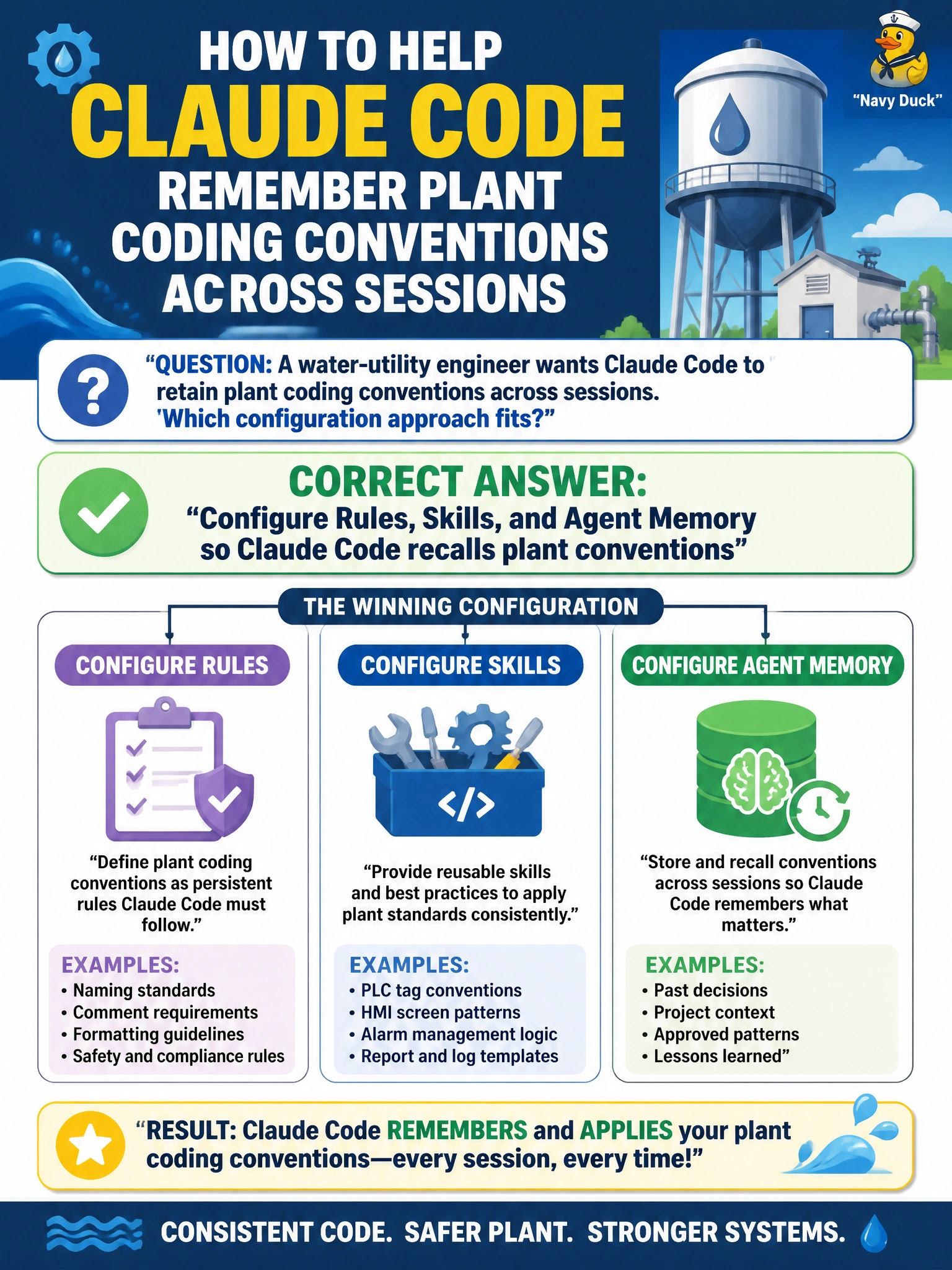
A water-utility engineer wants Claude Code to retain plant coding conventions across sessions. Which configuration approach fits?
Select an answer to reveal the explanation.
Short Explanation
Plant coding conventions shouldn't vanish overnight. Configure Rules, Skills, and Agent Memory so Claude Code remembers how the utility writes code.
Full Explanation
Plant coding conventions must persist across Claude Code sessions rather than depending on daily verbal reminders. Configuring Rules, Skills, and Agent Memory so Claude Code recalls plant conventions works because durable configuration carries naming, safety, testing, and OT-adjacent practices into new sessions, reducing drift when engineers resume work days later. Water-utility teams get continuity without re-teaching the agent each morning.
Defining plant conventions in a custom slash command for manual deployment tasks fails the stem's goal: a slash command only fires when someone remembers to type it, so conventions stop applying the moment an engineer forgets to invoke it or works outside that deployment flow—there's no persistent recall across ordinary sessions. Registering plant conventions with an MCP server that provides live plant telemetry data fails by concept: an MCP server is the right tool for live operational data such as sensor readings, not for storing static coding conventions, and conflating the two leaves the persistence problem unsolved. Delegating plant conventions to a subagent scoped to single-session code review work fails because that subagent's context disappears when the session ends, so conventions never carry forward the way durable Rules, Skills, and Agent Memory do.
Exam caveat: persistent memory and rules must stay accurate and scoped—stale or over-broad memories can reintroduce outdated plant practices, so owners should review and prune them. Operational check: enable and document Rules, Skills, and Agent Memory for the utility’s Claude Code workspace, seed them with approved plant conventions, and periodically audit remembered items against current engineering standards.