
A water utility SCADA-adjacent assistant must not invent free-text plant control commands. What schema design fits?
Select an answer to reveal the explanation.
Short Explanation
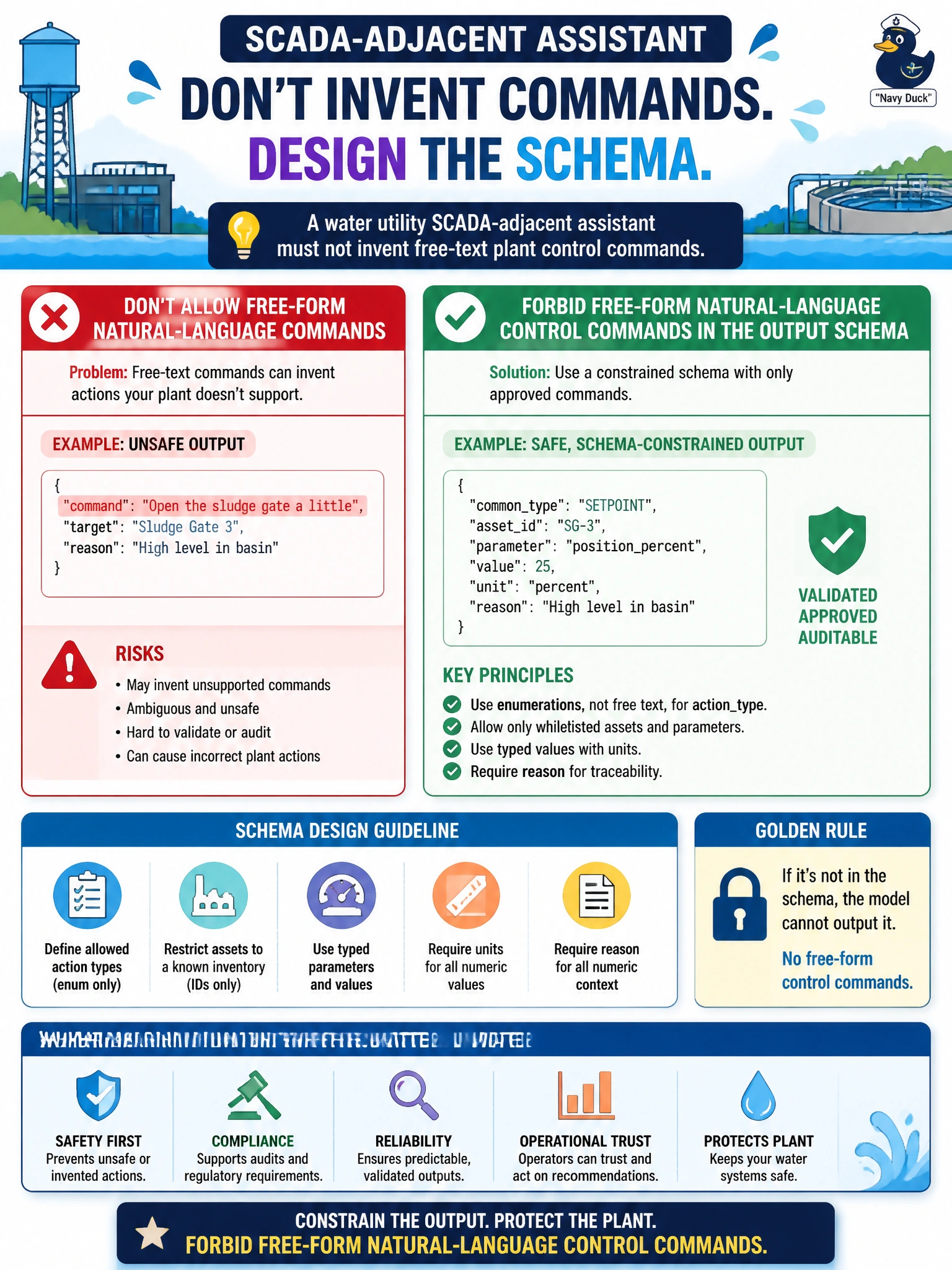
SCADA-adjacent Claude is not a joystick, so you don't let open string fields, flexible templates, or descriptive setpoint paragraphs put control language in front of operators. You lock the schema against free-text actuation instead.
Full Explanation
SCADA-adjacent assistants must constrain outputs that operators could mistake for executable plant control. Forbidding free-form natural-language control commands in the output schema works because schema boundaries turn "helpful" free text into rejected or structured non-actuation responses, reducing the chance Claude invents valve, pump, or setpoint instructions that look actionable. Water utilities can still allow read-oriented summaries or approved status fields while blocking unconstrained control phrasing. Permitting valve commands as open string fields with operator review downstream fails because open string fields still allow unstructured command text to reach operators, who may copy or act on it under stress; downstream review is not a substitute for a schema that blocks free-text actuation. Using flexible text templates for reusable plant actuation commands fails because templates still produce free-form control language that looks like an authorized procedure, bypassing the need for a hard schema boundary between advice and actuation. Returning suggested setpoints as descriptive paragraphs for SCADA translation fails because descriptive paragraphs are unstructured control output that invites manual transcription errors and unauthorized actuation instead of confining the model to read-only status and escalation fields. Exam caveat: schema forbids free-form control text but does not replace OT access controls, change windows, or dual-authorization for real actuation—Claude remains advisory unless integrated through approved control paths. Operational check: define an allowed output schema (status fields, citations, escalation flags) that excludes free-text actuation, reject responses that include command-like strings in CI contract tests, and require operators to use native SCADA tools for any control change.