
A court filing assistant must fill party and case fields for downstream systems. Which output design fits?
Select an answer to reveal the explanation.
Short Explanation
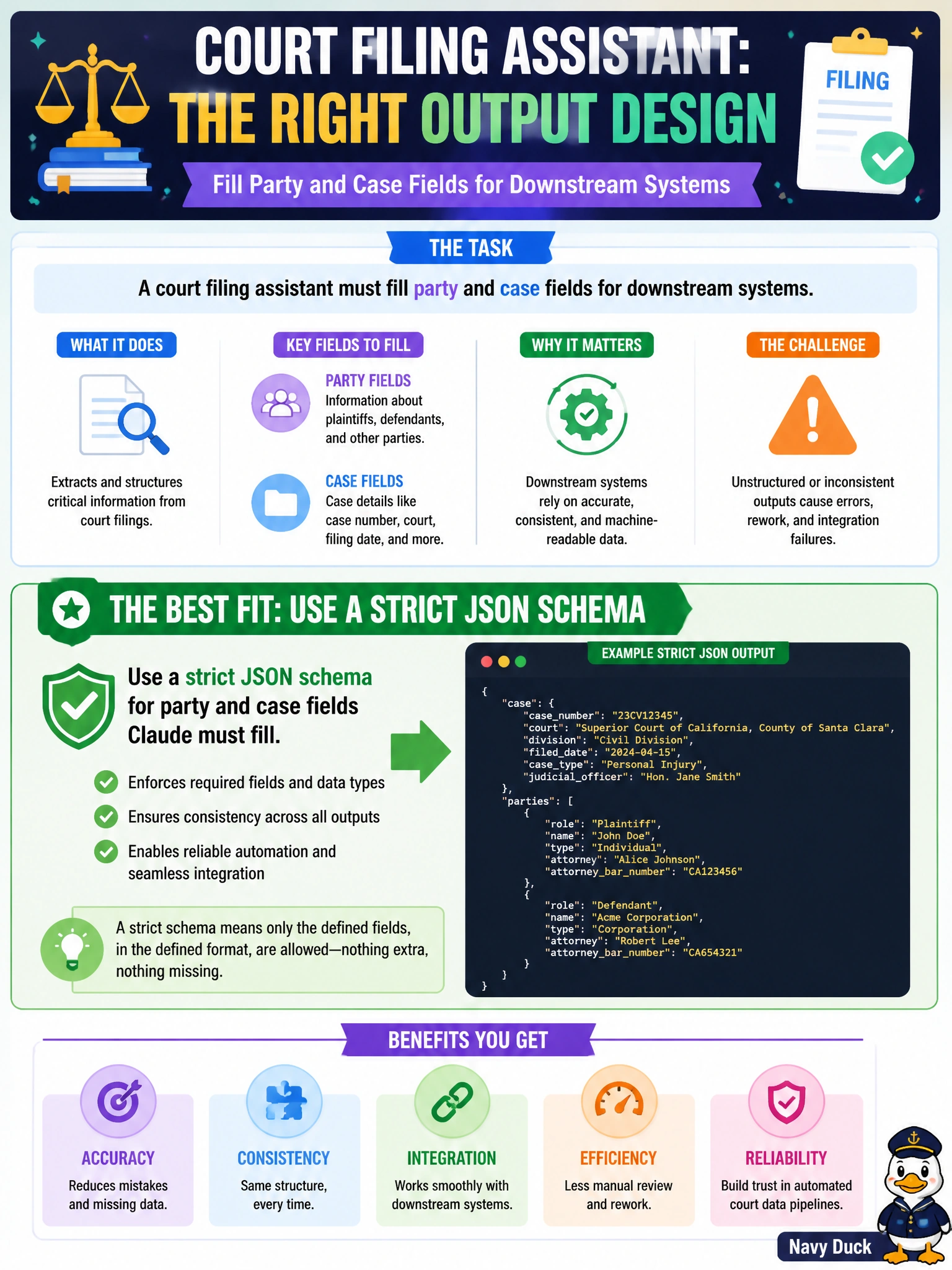
Courts don't file vibes—they file fields. Give Claude a strict JSON schema for party and case data so the clerk system can actually consume it.
Full Explanation
Court filing assistants that must fill party and case fields for downstream systems should use a strict JSON schema for those fields Claude must fill. Schema-constrained output fits because clerk and case APIs expect stable keys, types, and required party/case attributes—not narrative prose. Strict JSON schema design makes Claude outputs machine-consumable, enables validation before filing, and reduces silent field drift across responses. Using a flexible JSON object with optional party fields when available fails by concept: optional fields let required party and case attributes go missing, and a loose object cannot guarantee the stable keys and types the filing API requires. Returning a styled PDF summary of party and case details for review fails by concept: a styled document is meant for human eyes, not for machine consumption, and it supplies no structured fields the case API can ingest. Providing an HTML table of party names for clerk display purposes fails by concept: an HTML table is formatted for clerk viewing, not for API consumption, and it cannot be validated as a structured party and case payload. Exam caveat: schema success still requires server-side validation and human review for high-stakes filings—client-side Claude schema adherence is necessary but not sufficient—and schemas should version when court case data models change. Operational check: constrain Claude with the party/case JSON schema, validate outputs against the schema in the court app, reject non-conforming responses before any case API write, and confirm a golden fixture round-trips into the downstream filing system.