
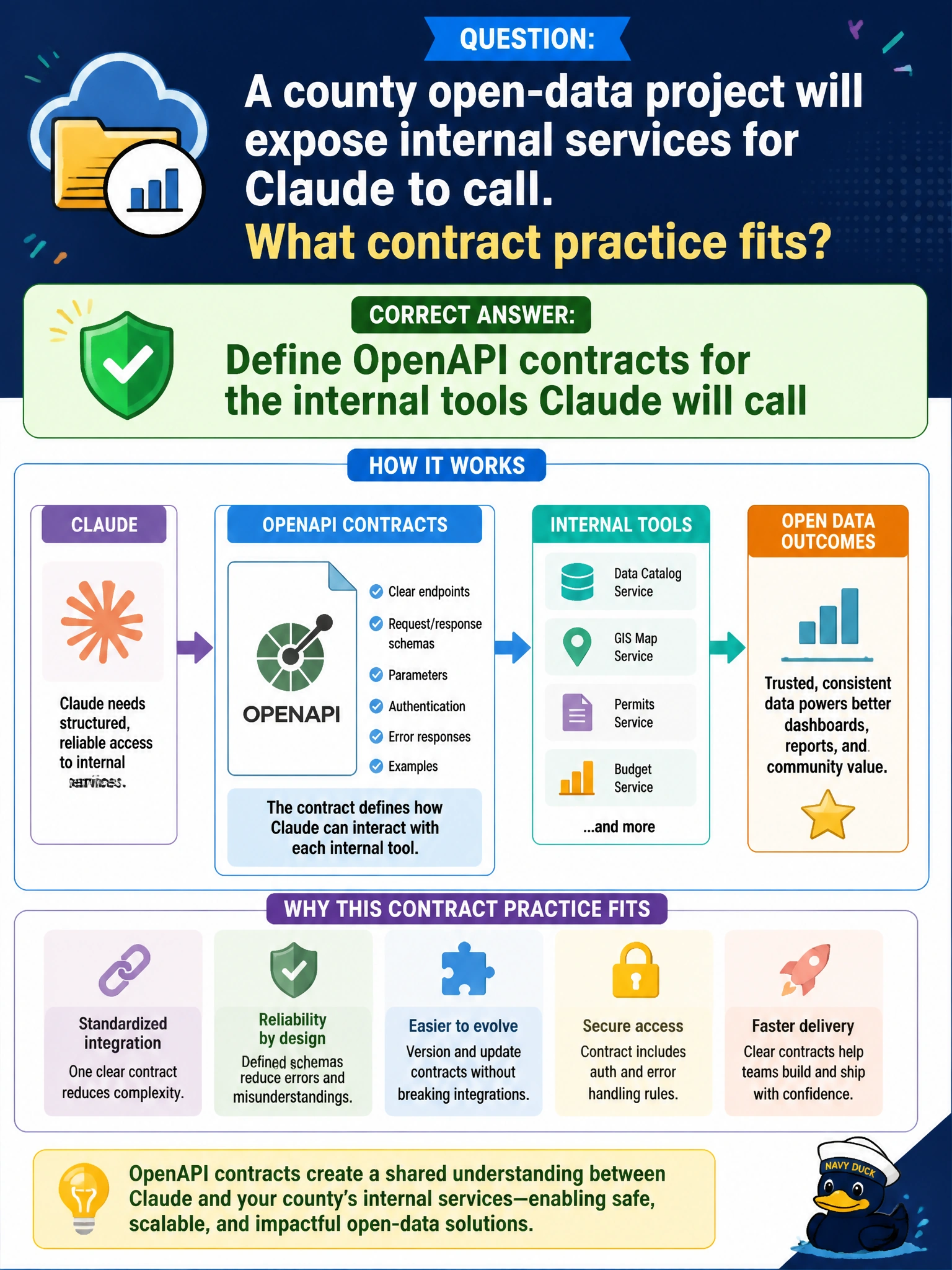
A county open-data project will expose internal services for Claude to call. What contract practice fits?
Select an answer to reveal the explanation.
Short Explanation
Claude can't read your mind about query params. Publish OpenAPI so the tools Claude calls have a real contract.
Full Explanation
County open-data projects that will expose internal services for Claude to call should define OpenAPI contracts for those internal tools. Explicit contracts fit because Claude tool use depends on predictable paths, parameters, types, and error shapes; OpenAPI documents that interface so client generators, reviewers, and model tool schemas stay aligned. Contract-first design reduces brittle guessing and makes municipal internal APIs reviewable like other public-sector integrations. Updating the client to handle new fields but failing immediately on any unexpected field fails by concept: contracts must tolerate additive, backward-compatible changes or every minor payload addition breaks the integration. Having Claude normalize all API responses into a schema automatically fails by concept: delegating contract enforcement to probabilistic normalization is not a substitute for a defined, testable interface. Sharing Postman collections describing internal tools for Claude to reference fails by concept: Claude-callable civic tools in this exam framing expect describable HTTP contracts that map to tool schemas, not Postman collections meant for HTTP client testing. Exam caveat: publishing an OpenAPI file does not automatically make an endpoint safe to expose—authn/z, rate limits, and field-level redaction still apply—and internal contracts should version breaking changes deliberately. Operational check: author an OpenAPI document for the internal county service Claude will call, generate or hand-write a matching Claude tool schema, run contract tests against a mock server, and reject tool rollout if parameters drift from the published contract.