
A parks team wants to introduce a new Claude tool to field staff carefully. Which delivery practice fits?
Select an answer to reveal the explanation.
Short Explanation
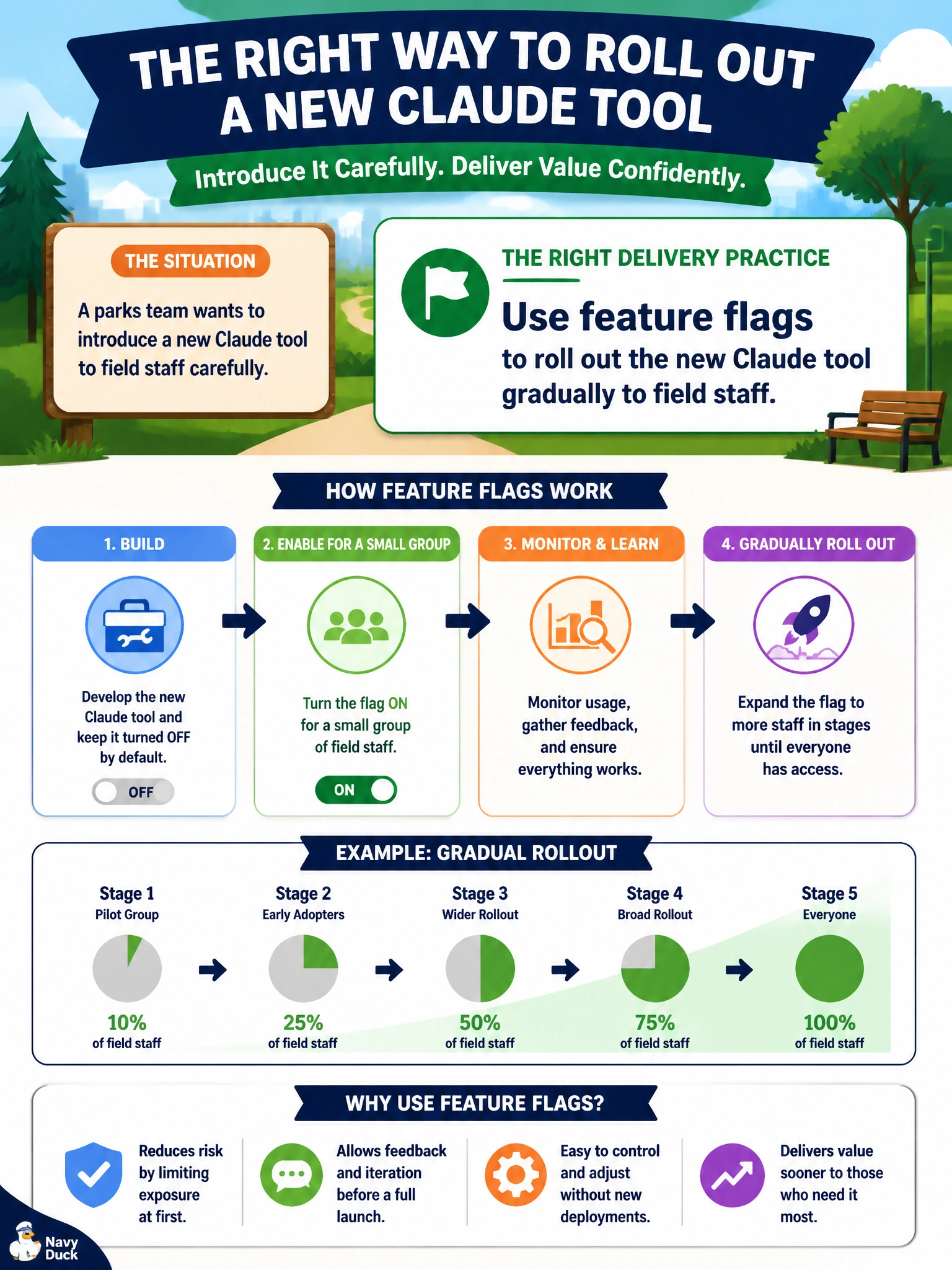
Blue-green deployment flips every field staff shift at once, so it's not the careful rollout you need. Feature flags let you open the gate a few crews at a time.
Full Explanation
Parks teams introducing a new Claude tool to field staff carefully should use feature flags to roll out that tool gradually. Progressive delivery fits because field crews, connectivity, and trail workflows vary: flags let a few crews pilot the tool, gather failure modes, and expand coverage without flipping every field staff shift over through blue-green environments at once. Gradual exposure preserves a clear rollback path by disabling the flag if hazard-tool behavior misfiles or confuses staff. Deploying the new Claude tool using blue-green environments for field staff shifts fails by concept: blue-green cuts all users in a shift over at once, which is still a big-bang release that maximizes blast radius across field operations. Publishing the new Claude tool in the catalog for voluntary adoption fails by concept: voluntary sign-up leaves adoption uneven and unmanaged rather than delivering the tool through a deliberate pilot. Adding detailed usage metering to the new Claude tool for field staff fails by concept: metering is observability, not a delivery control, and it does nothing to limit who sees the tool or stop a bad rollout mid-flight. Exam caveat: feature flags must be wired to authorization and telemetry—not just a boolean in a config file nobody monitors—and flagged Claude tools still need content and safety review before any cohort is enabled. Operational check: enable the new parks Claude tool flag for a small pilot crew in staging or limited production, monitor error rates and staff feedback, keep the prior path available, and only then widen the flag percentage with an explicit rollback owner.