
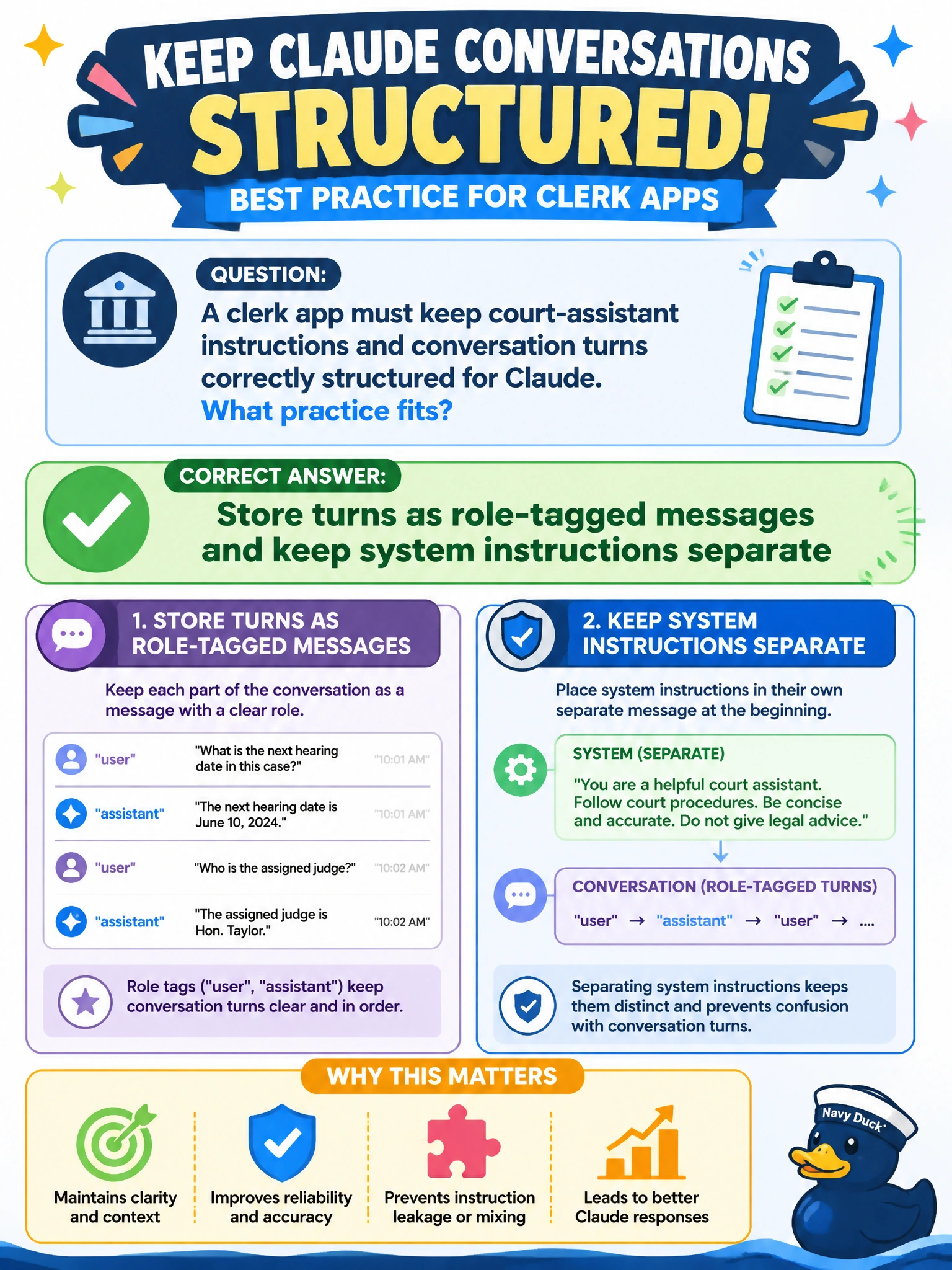
A clerk app must keep court-assistant instructions and conversation turns correctly structured for Claude. What practice fits?
Select an answer to reveal the explanation.
Short Explanation
Court bots need a clear seating chart: system rules on one side, user and assistant turns on the other. Role tags keep those seats straight.
Full Explanation
Clerk applications that keep court-assistant instructions and conversation turns correctly structured for Claude must store turns as role-tagged messages and keep system instructions separate. That Messages API practice works because system-level rules (jurisdiction scope, citation limits, refusal boundaries) stay authoritative and stable while user and assistant turns preserve dialogue state without contaminating the instruction channel. Clear role separation improves instruction following, auditability of who said what, and safer debugging when a clerk conversation goes off-policy. Appending system instructions to the latest user message to preserve context window fails by concept: folding policy text into a user turn does not actually solve a context-window problem—the same instructions still have to be resent, or silently dropped, as the conversation grows—and in the meantime it turns authoritative rules into ordinary dialogue content that can be overridden or diluted on any later turn. Sending every instruction as an assistant message so Claude talks to itself fails by concept: assistant role is for model outputs, not for authoritative policy injection, and confuses conversation state. Dropping roles entirely and sending one undifferentiated text blob fails by concept: the API contract depends on structured roles; flattening destroys turn boundaries the model and client both rely on. Exam caveat: separating system instructions does not replace application-layer authorization—clerks still need authenticated sessions and redaction for sealed matters—and overly long system prompts should be versioned and reviewed like other court software. Operational check: capture a sample clerk transcript as role-tagged messages with an isolated system block, send it through the Messages API client, and verify the assistant respects system refusals that were deliberately omitted from user turns.