
An emergency dashboard needs Claude to draft live briefings during an active incident. Which API mode fits?
Select an answer to reveal the explanation.
Short Explanation
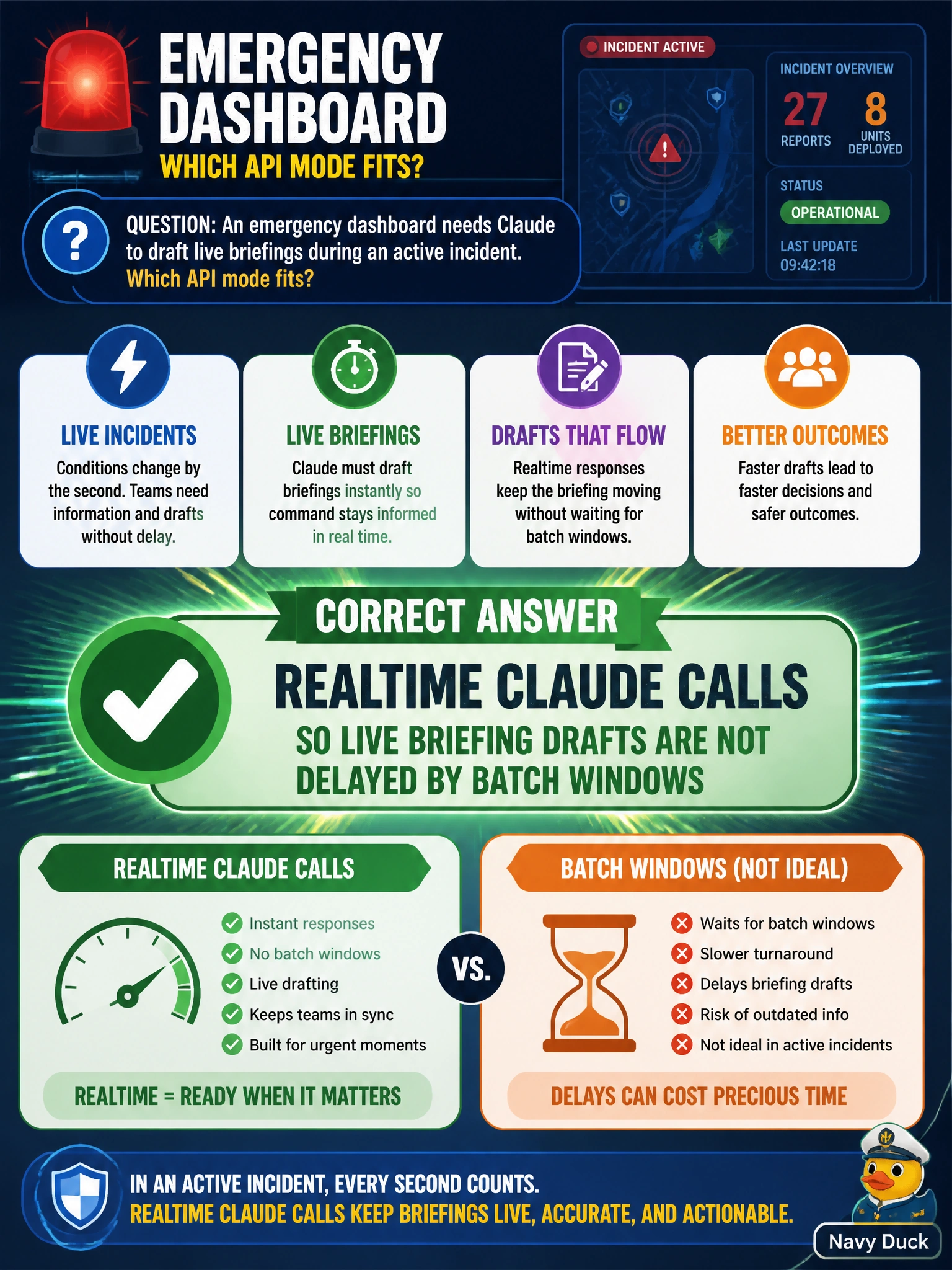
When the sirens are already going, you don't wait for a Message Batches API run. Realtime calls keep incident briefings moving while the event is still live.
Full Explanation
Emergency dashboards that need Claude to draft live briefings during an active incident require realtime Claude calls so drafts are not delayed by Message Batches API processing. Realtime Messages API invocation fits because incident command needs progressive situational language while events are still unfolding: waiting for Message Batches API processing means the briefing is obsolete before it arrives. Synchronous or near-real-time generation keeps human operators in the loop with fresh drafts they can edit and approve under emergency operations timelines. Message Batches API calls for efficient briefing processing fail by concept: batched processing may be useful for throughput but cannot support live briefing needs during an active incident. Files API storage of live incident logs for consolidated briefing retrieval fails by concept: it stores logs for later access but removes any realtime generation capability from the emergency workflow. Prompt caching on live incident context to accelerate repeated briefing calls fails by concept: caching only speeds up repeat calls and does not provide the realtime drafting mode an active incident requires. Queuing all incident text for Message Batches API processing fails by concept: batch cadence is unrelated to operational urgency and guarantees unacceptable latency. Exam caveat: realtime does not mean unsupervised publication—drafts for public or interagency briefings still need human review, rate limits, and fallback messaging when the API is unavailable during surge load. Operational check: from the emergency dashboard staging environment, trigger an incident briefing request against a live Claude endpoint (not a Message Batches API queue), measure time-to-first-draft against the on-call SLA, and confirm the UI remains usable if the call fails so operators are not blocked waiting on Message Batches API processing.