
A 311 agent needs the open ticket ID across clarification turns without stuffing the entire chat history each time. What pattern best addresses that need?
Select an answer to reveal the explanation.
Short Explanation
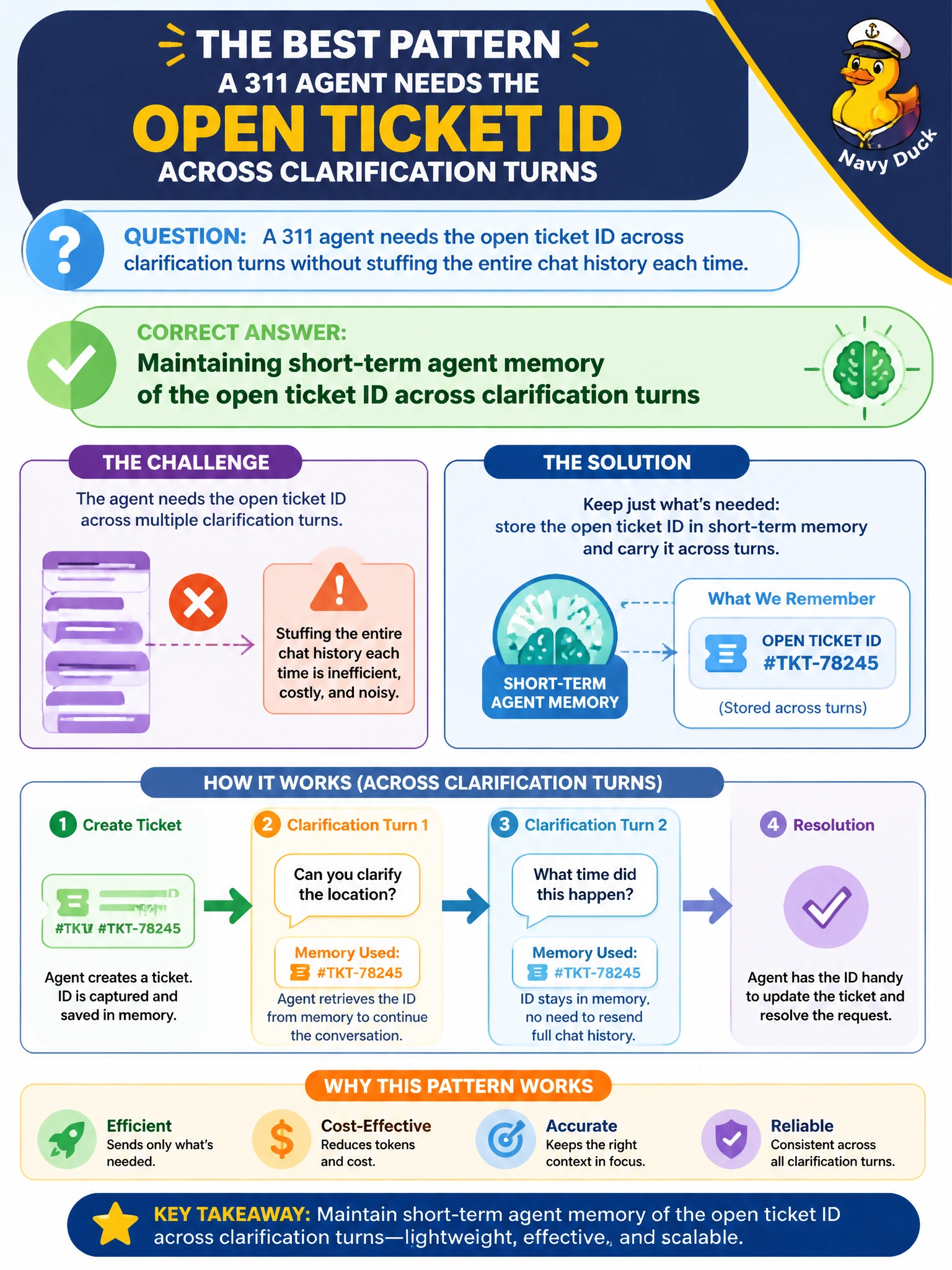
The ticket ID is the sticky note on the monitor—small, durable for the conversation, not a semantic search through past transcripts that would be slow and irrelevant for the current session. Short-term agent memory keeps that sticky note handy.
Full Explanation
Maintaining short-term agent memory of the open ticket ID across clarification turns best addresses a 311 agent's need to retain the ticket ID without stuffing the entire chat history each time. Short-term memory keeps small durable session state—the sticky note on the monitor—available across turns while avoiding the cost and noise of re-injecting full transcripts into every call or tool description. Clarifications can proceed with continuity on the same ticket.
Storing the open ticket ID in long-term resident profile memory for future service requests fails because it's scoped to the resident, not the session, and conflates current ticket continuity with future requests. Retrieving the ticket ID through semantic search over past transcripts during clarification fails because it searches historical transcripts rather than maintaining the current session's ticket ID, introducing latency and irrelevance. Summarizing the resolved ticket into shared team memory after case closure fails because it happens after the ticket is closed, so it cannot maintain the ID across active clarification turns.
Exam caveat: short-term memory is session-scoped state, not long-term resident profile storage; the latter persists across residents and requests, not just this ticket's clarification turns. Protect ticket IDs like other case identifiers and clear memory at session end per retention policy.
Operational check: store open ticket ID in short-term agent memory after intake, confirm subsequent clarification turns use it without relying on long-term resident profile memory or semantic search of past transcripts, ensure tool calls receive the ID from memory rather than a post-closure team summary, and verify memory eviction on session close.