
An architect must design a Claude-based system that, when given a user question, must never answer from memory alone — it must always cite a specific retrieved source document for every factual claim. Default Claude behavior allows the model to draw on training knowledge even when retrieval is available. What prompt engineering approach most reliably enforces the citation-mandatory policy?
Select an answer to reveal the explanation.
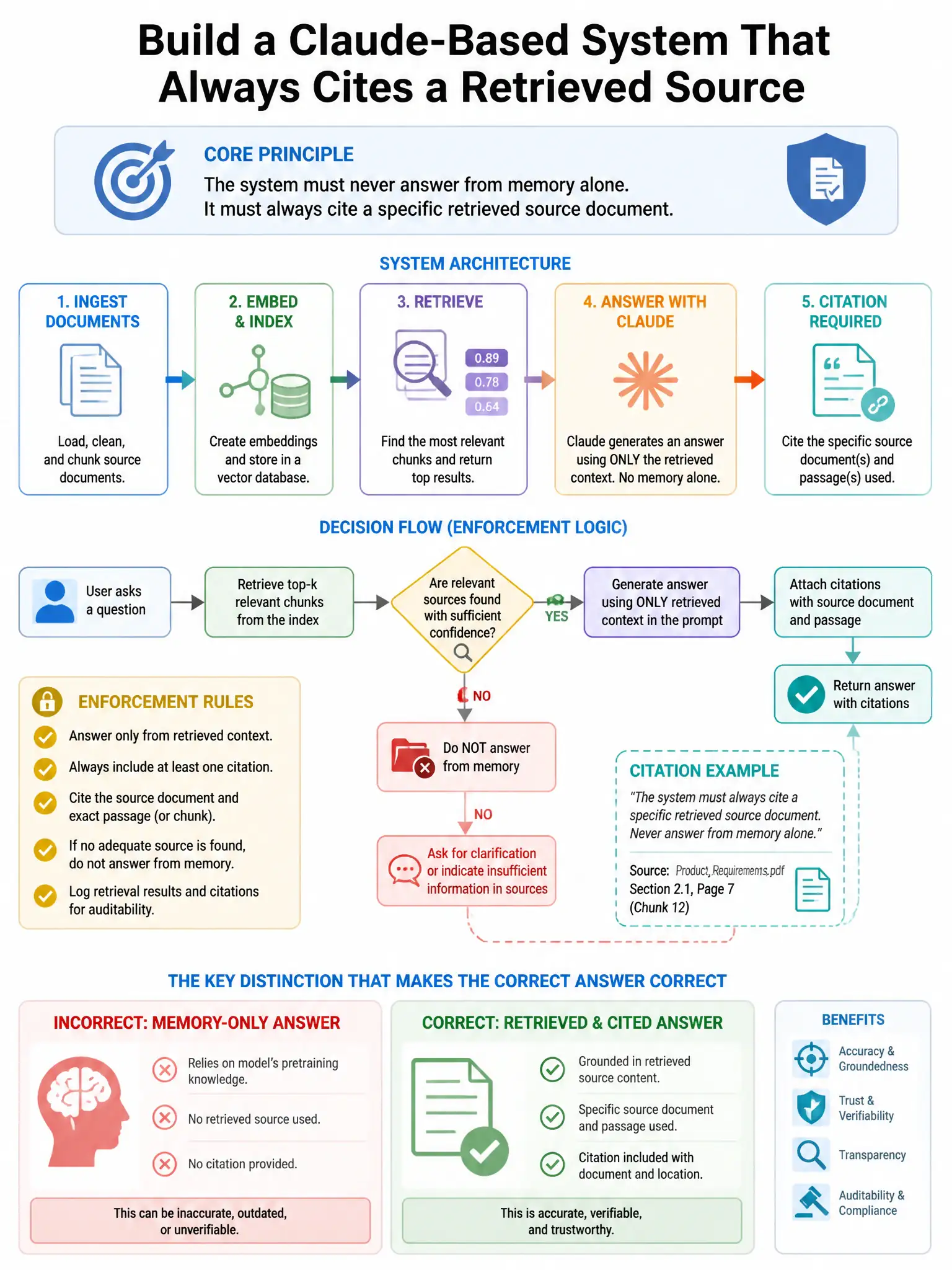
Short Explanation
Here's the deal — you need a structured output schema that wraps every factual statement in a citation block with the source document ID, plus an explicit fallback saying 'No source available' when retrieval doesn't support a claim. That makes unsupported claims detectable and blocks silent use of training knowledge.
Full Explanation
The structured output schema option is correct because enforcing citation-mandatory behavior requires both a structural constraint and an explicit fallback instruction. Requiring every factual statement to be wrapped in a citation block containing the source document ID makes unsupported claims syntactically detectable, while instructing Claude to state 'No source available' rather than relying on training knowledge prevents silent use of parametric knowledge. Post-generation validation that every claim has an associated citation block provides a quality gate. The vague system-prompt instruction to 'Always cite your sources' is wrong because it is too vague and does not create a detectable schema that can be validated programmatically; Claude may partially comply or interpret 'sources' loosely. Setting temperature to 0 is wrong because temperature controls output sampling distribution and has no effect on whether Claude draws on training knowledge versus retrieved context; the same prompt at temperature 0 will still produce training-knowledge-derived claims if the retrieval context is incomplete. Fine-tuning a Claude model on citation-complete examples is wrong because fine-tuning is not available as a self-service option for Claude, and even fine-tuned models can violate behavioral constraints probabilistically without the structural schema enforcement described in the structured output schema option.