
Your RAG system is being used for customer support at a software company. Retrieved passages come from technical documentation, community forums, and internal knowledge base articles. Users report that answers about current software behavior are sometimes incorrect because forum posts from 2019 are retrieved with higher similarity than recent documentation updates. What architectural control directly addresses this temporal relevance problem?
Select an answer to reveal the explanation.
Short Explanation
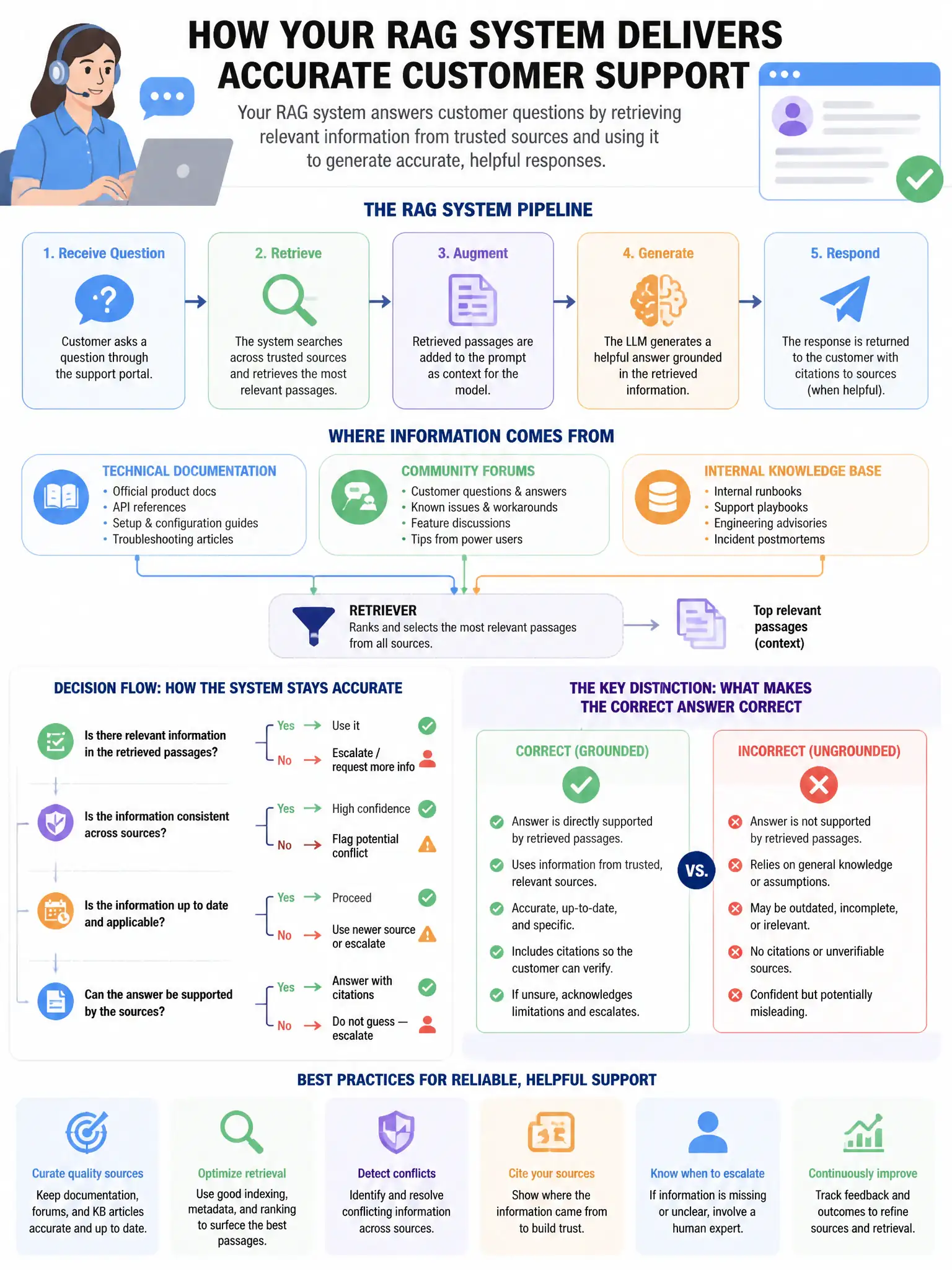
Here's the deal — you need to score retrieval with both similarity and recency, weight trusted sources higher, and pass dates and source types to Claude so it can reason about what's current.
Full Explanation
The correct control is hybrid retrieval with temporal weighting: combine vector similarity scores with a recency decay function, apply source-type weights such as official documentation over knowledge base articles over forum posts, and pass document dates and source types to Claude as metadata in the retrieved context. The temporal relevance problem has two components: retrieval ranking, where outdated posts outrank recent docs on similarity alone, and generation awareness, where Claude doesn't know which sources are more reliable. The hybrid scoring with recency decay addresses retrieval ranking. Source-type weighting applies domain knowledge about reliability. Passing dates and source metadata to Claude enables it to reason about temporal relevance during generation, for example recognizing that a 2019 forum post conflicts with 2024 documentation and that the documentation is likely current. The approach that periodically re-embeds all documents is wrong because re-embedding with newer models changes the semantic representation but does not alter the temporal ordering of documents; a 2019 forum post re-embedded with a 2024 model still has the same publication date and can still outrank recent documentation on semantic similarity. The approach that filters the corpus to exclude all documents older than one year is wrong because a hard one-year cutoff would delete valuable long-term documentation that remains valid; many technical concepts, APIs, and configurations remain stable for years, and age is a factor, not a binary cutoff. The approach that increases chunk overlap is wrong because chunk overlap affects whether multi-sentence concepts stay together in chunks; it has no relationship to document recency or retrieval ranking.