
A supervisor agent coordinates five domain-specialist subagents (medical, legal, financial, technical, general). When the supervisor receives a question spanning two domains (e.g., 'What are the legal and financial implications of a medical malpractice settlement?'), how should the supervisor topology handle this cross-domain query?
Select an answer to reveal the explanation.
Short Explanation
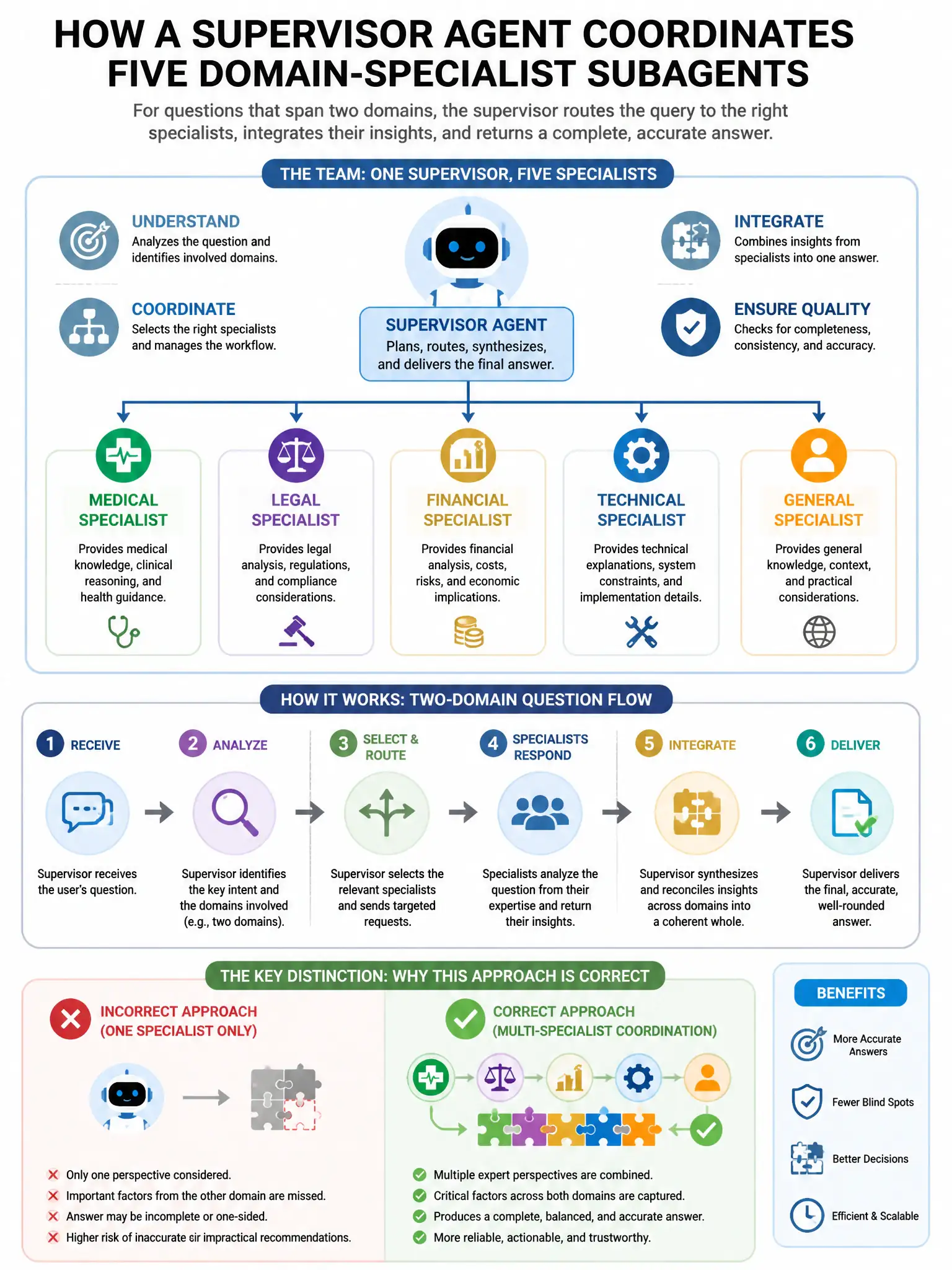
Here's the deal — you fan out to the legal and financial specialists in parallel, let each give a domain-scoped analysis, then have the supervisor synthesize them and reconcile conflicts. That's how you get real depth from both domains without one agent guessing outside its lane.
Full Explanation
The correct approach is to fan out to both the legal and financial specialist agents in parallel, have each produce a domain-scoped analysis, and have the supervisor synthesize the two specialist outputs into a coherent integrated response with explicit reconciliation of any conflicting recommendations. This is correct because the supervisor-specialist topology's value for cross-domain queries is precisely the ability to obtain deep domain expertise from each specialist independently and then synthesize. Fanning out to the legal and financial agents in parallel is efficient because it allows concurrent execution. Having each produce a domain-scoped analysis ensures depth in each domain. Supervisor synthesis with explicit reconciliation of conflicts, such as a legal recommendation that conflicts with a financial strategy, produces a higher-quality answer than any single agent could. Routing the query to the general agent only is wrong because routing to the general agent when specialists are available trades depth for breadth unnecessarily; the topology was designed to preserve specialist quality. Routing the query to the most likely primary domain and allowing that specialist to answer for both domains is wrong because routing to a single specialist and asking them to answer for a related domain produces shallow coverage of the secondary domain — the financial agent is not optimized for deep legal analysis and vice versa. Rejecting the query and asking the user to submit two separate single-domain questions is wrong because rejecting multi-domain queries is a poor user experience that fails to leverage the topology's core capability; the supervisor exists precisely to coordinate across domains.