
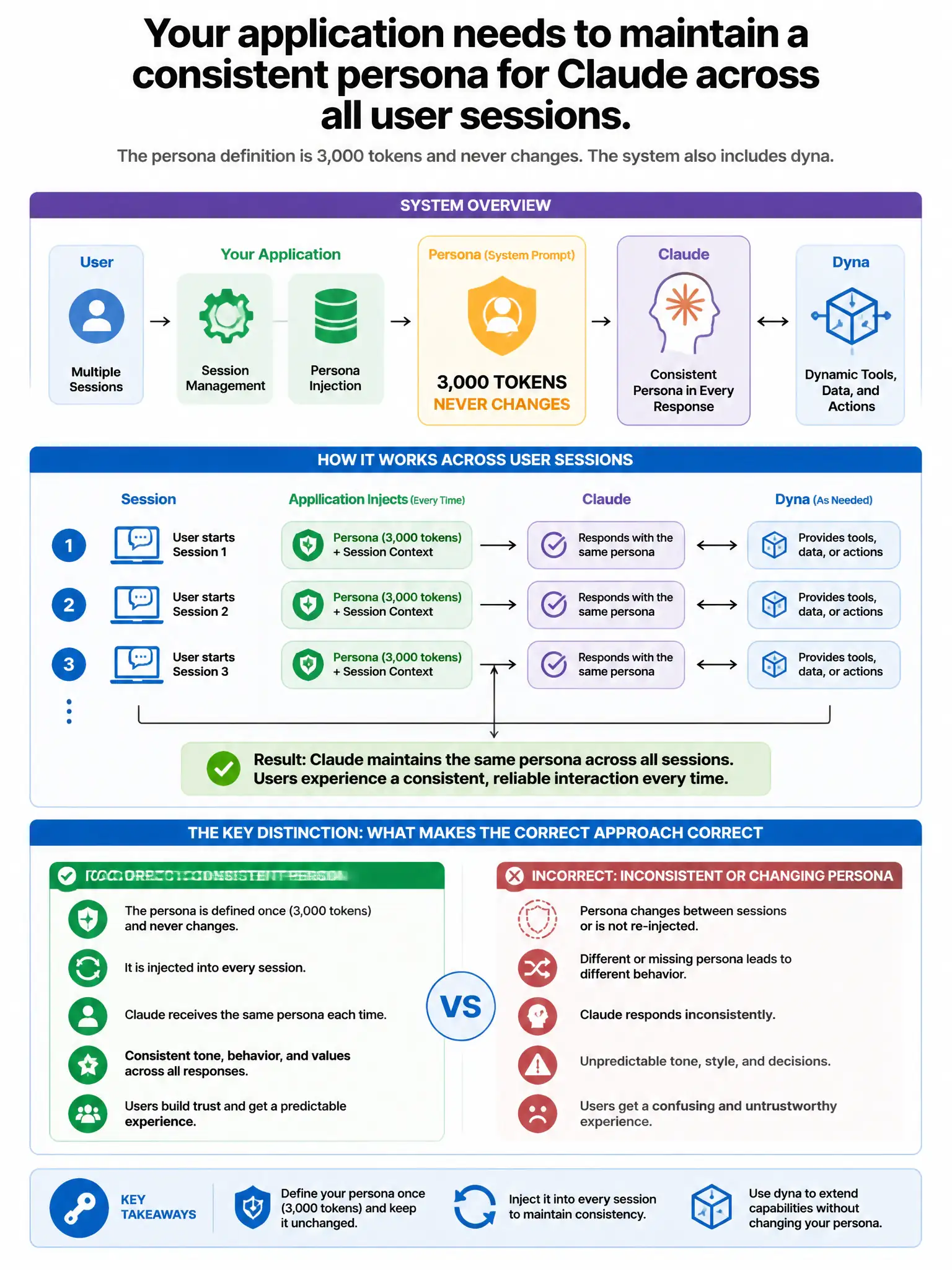
Your application needs to maintain a consistent persona for Claude across all user sessions. The persona definition is 3,000 tokens and never changes. The system also includes dynamic user context injected per-request. What API design minimizes token costs while maintaining persona consistency?
Select an answer to reveal the explanation.
Short Explanation
Here’s the deal — you should use prompt caching by marking the static persona system prompt with a cache control breakpoint. The first call writes the cache at the base input rate, and later calls read it at about 10% of that cost, so a high-volume deployment keeps the persona consistent while slashing token spend.
Full Explanation
The prompt caching approach is correct because prompt caching is the correct API mechanism for static, reused content like a persona definition. By placing the persona in the system prompt and marking it with a cache control breakpoint, the first call writes the cache, billed at the base input rate, and all subsequent calls read from cache at approximately 10% of the input token cost. For high-volume deployments, this provides about a 90% cost reduction on the persona prefix. The dynamic user context is injected after the cached prefix and is billed normally. The user-turn message approach is wrong because user-turn messages are not automatically cached by default — prompt caching requires explicit cache control breakpoint configuration, and system prompts are the appropriate location for persona definitions, not user turns. The fine-tuning approach is wrong because Anthropic does not offer a self-service fine-tuning API for Claude models that would allow baking persona definitions into model weights; this feature does not exist as described. The abbreviation and shorthand compression approach is wrong because abbreviations and shorthand in a persona definition would likely change Claude's behavior in subtle ways, such as tone, vocabulary, and consistency, and the manual compression effort is not justified when prompt caching provides a more effective and reversible cost reduction.