
Your organization needs to process 100,000 short product descriptions daily for sentiment classification into 5 categories. Each description averages 50 tokens. The classification requires Claude's response to be a single category label (1-3 tokens). What API design pattern minimizes cost and latency for this workload?
Select an answer to reveal the explanation.
Short Explanation
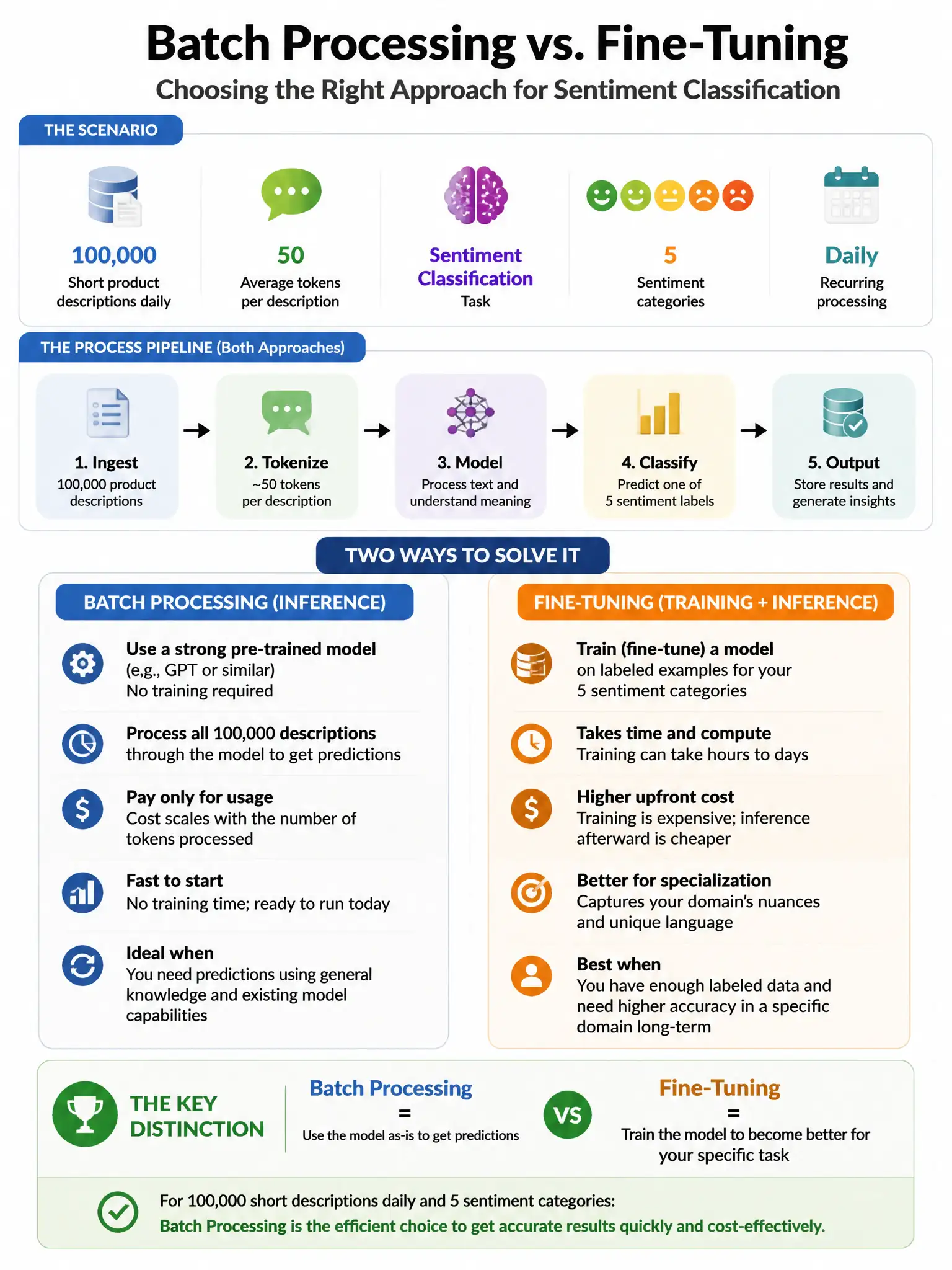
You want the Batches API here because it gives you a 50% discount for high-volume, non-real-time classification and handles scheduling and rate limits for you. It fits a daily job where you can wait for results instead of paying full synchronous prices.
Full Explanation
The batch job approach is correct because the Anthropic Batches API is purpose-built for high-volume, non-real-time classification workloads. It provides a 50% cost discount compared with synchronous API calls, handles scheduling and rate limiting automatically, and returns results asynchronously, which is ideal for a daily batch job with no real-time latency requirement. For 100,000 requests at about 50 input tokens and 3 output tokens each, the cost savings are substantial. The stream-cancellation approach is wrong because canceling after the initial token is brittle: billing for input tokens is not affected by stream cancellation, and implementing early stream termination across 100,000 requests per day adds unjustified operational complexity. More importantly, there is no guarantee Claude produces the label as its initial tokens. The sequential single-key approach is wrong because processing 100,000 requests one at a time would take many hours even at high API throughput and creates unnecessary rate limit pressure. The combined 50-descriptions-per-request approach is wrong because packing 50 descriptions into one JSON array request creates response parsing complexity, risks output format confusion because descriptions may interfere with each other's classification, and does not provide the 50% cost discount that the Batches API offers.