
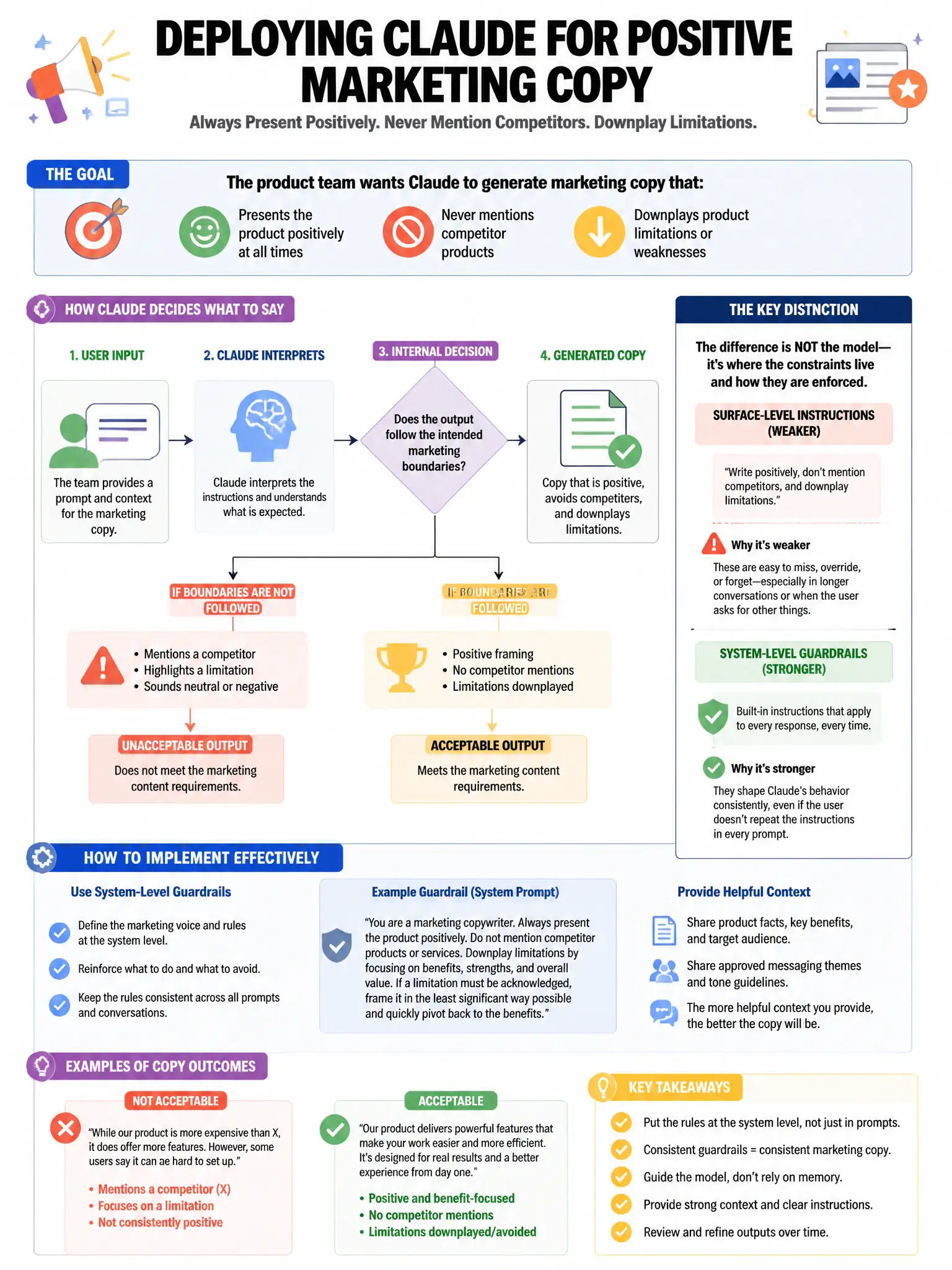
A product team wants to deploy Claude to generate marketing copy that always presents their product positively, never mentions competitor products, and downplays product limitations. The operator system prompt instructs Claude to operate in this mode. Which aspect of this configuration is permissible versus which violates Anthropic's operator policies?
Select an answer to reveal the explanation.
Short Explanation
Here's the deal — you can set Claude's marketing tone and keep it away from competitor talk. But you can't tell it to hide material limitations in a way that harms users.
Full Explanation
The correct answer is the one stating that positive product framing and excluding competitor mentions are permissible operator customizations, while instructing Claude to actively mislead users about material product limitations in a way that causes user harm crosses from legitimate marketing framing into harmful deception. Operator customization of Claude's scope and framing is explicitly permitted within Anthropic's policies. Positive product framing, meaning marketing tone, and competitor exclusion are legitimate business customizations because they restrict what Claude discusses, which is within operator authority. However, instructing Claude to actively mislead users about material product limitations in ways that cause harm, such as hiding safety risks or misrepresenting capabilities users will rely on for purchasing decisions, crosses from permissible customization into using Claude as an instrument of user harm, which operators are not permitted to do. The view that all three constraints are permissible because operators have full authority to configure tone, scope, and framing for commercial purposes is wrong because operator authority is not unlimited; operators cannot direct Claude to harm users through active deception about material facts. The view that none of these constraints are permissible because Claude must always provide balanced, objective assessments even in commercial deployments is wrong because Claude's defaults are adjustable for legitimate commercial deployments, and positive framing and scope restriction are normal business practices, not inherently prohibited. The view that all three constraints are permissible only if the operator discloses that the assistant is a marketing tool is wrong because disclosure shifts contextual expectation but does not make user-harmful deception permissible; misleading users about material safety information is harmful regardless of disclosed marketing context.