
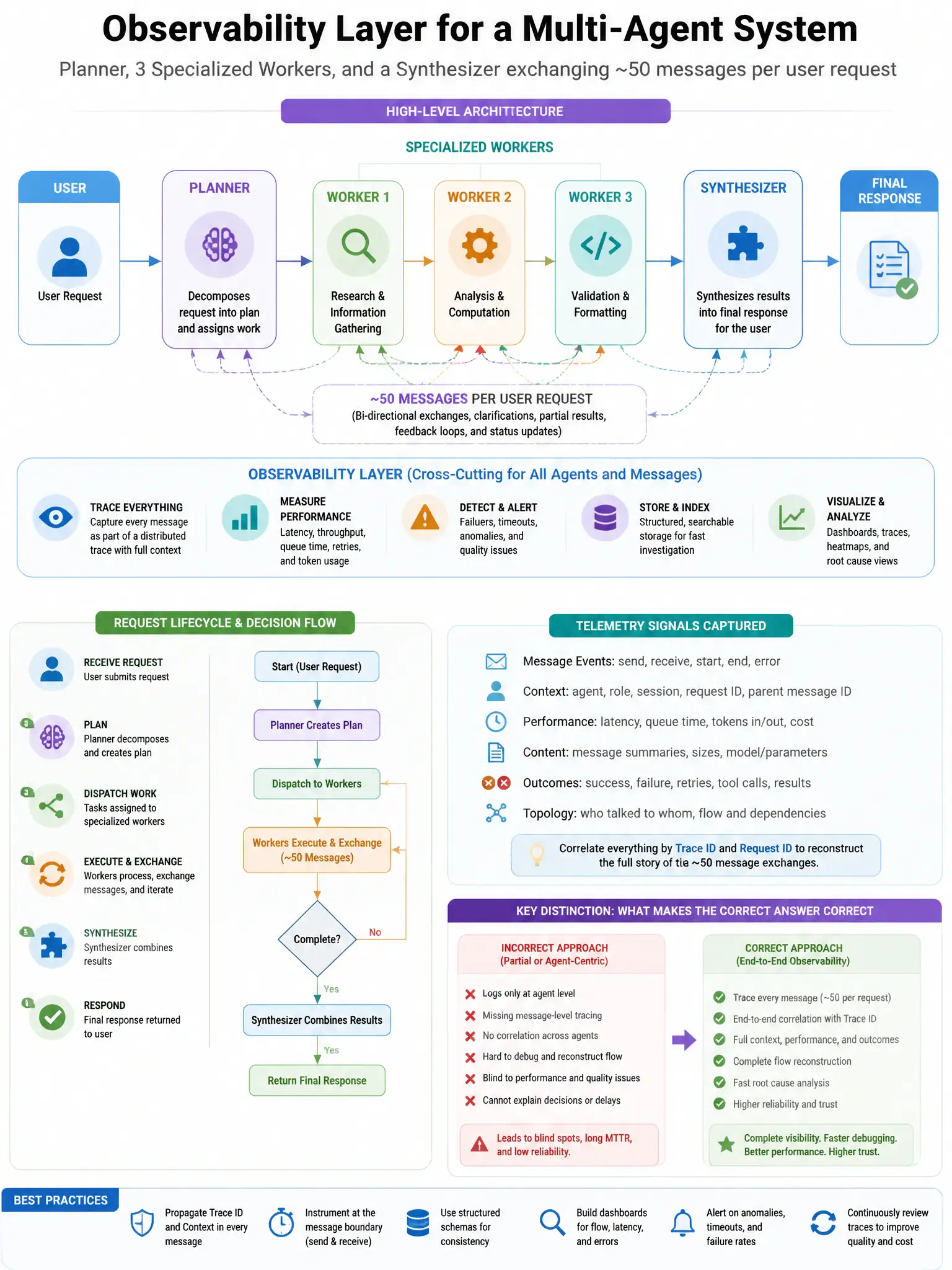
You are designing the observability layer for a multi-agent system where a planner, three specialized workers, and a synthesizer exchange approximately 50 messages per user request. An incident last week took 3 hours to diagnose because there was no way to replay the exact message sequence that caused a failure. What is the minimum observability architecture that would have prevented this diagnostic delay?
Select an answer to reveal the explanation.
Short Explanation
Here's the deal — instrumenting a distributed trace with a propagated root trace ID is right because it lets you correlate every message in a 50-turn agent conversation to one request. Capturing full inputs, outputs, tool calls, timing, and durable structured errors gives you the exact message sequence you need to replay the failure.
Full Explanation
The correct approach is instrumenting a distributed trace that captures a root trace ID propagated through all agent turns, the full input/output of every agent call, tool invocations with their parameters and results, timing for each step, and a structured error log with the trace ID — stored durably so any failed request can be replayed. The described 3-hour diagnostic delay was caused by the inability to replay the exact message sequence. Distributed tracing with a propagated root trace ID allows every message in a 50-turn agent conversation to be correlated to a single request. Full input/output capture enables exact replay. Tool call logs with parameters and results identify where tool failures introduced bad state. Durable storage ensures traces survive system restarts. This provides the complete observability needed to reproduce any incident. The option that logs Claude's final output for each agent turn is wrong because logging only final outputs loses all intermediate reasoning steps, tool calls, and inter-agent messages — precisely the data needed to diagnose multi-agent failures. The option that monitors the API response codes for each agent call is wrong because API response codes only surface transport-level errors; logic errors, hallucinated tool parameters, and incorrect reasoning that produce 200 responses are the more common multi-agent failure modes. The option that implements a test suite covering the 20 most common request types is wrong because test suites cover known patterns; the value of incident replay is handling unknown failure modes that did not appear in test design.