
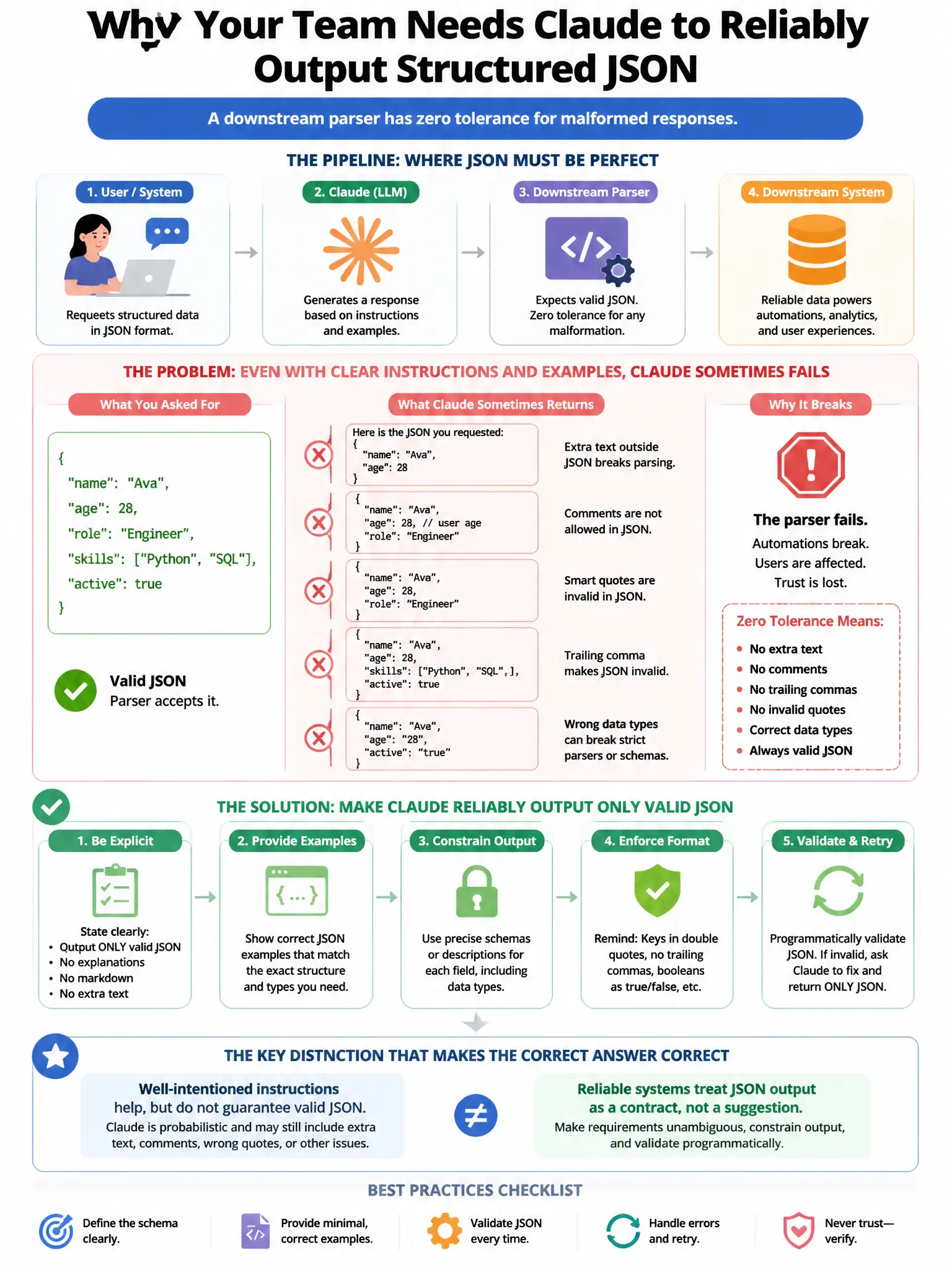
Your team needs Claude to reliably output structured JSON for a downstream parser that has zero tolerance for malformed responses. Despite clear instructions and examples, Claude occasionally outputs JSON with trailing commas or explanatory prose before the JSON block. What is the most reliable engineering approach to enforce output format?
Select an answer to reveal the explanation.
Short Explanation
Here's the deal — you want the approach that combines constrained generation through the tools parameter with a validation-and-retry loop. Tool use makes Claude return data against a defined schema instead of free-form text, and the retry loop catches rare deviations while logging failures for prompt refinement.
Full Explanation
The reliable engineering approach is to combine constrained generation using the tools parameter, where the expected schema is defined as a tool the model calls to return structured data, with a validation-and-retry loop that re-prompts on parse failure and logs the failure case for prompt refinement. Tool use, also called function calling, is the most reliable mechanism for structured output because when Claude is asked to call a tool with a defined schema, it outputs data conforming to that schema rather than free-form text. Combining this with validation and retry provides a safety net for rare deviations, and the logged failures provide signal for further prompt refinement. This layered approach achieves near-zero parse failure rates. The uppercase urgency instruction is wrong because urgency framing provides marginal benefit and is not a reliable engineering solution; it addresses the symptom of low compliance without using the structural mechanisms designed for this purpose. The fine-tuned model variant specifically trained for JSON output is wrong because fine-tuned models are not necessary; Claude's tool use mechanism provides sufficient structural constraint, and the premise that prompt engineering cannot solve this is incorrect when tool definitions are used. The post-processing regex that strips prose before the first { character and after the last } character is wrong because a simple regex trim is fragile: it cannot handle JSON embedded within prose mid-response, nested JSON strings containing {, or multi-object responses, and it provides false confidence in correctness.