
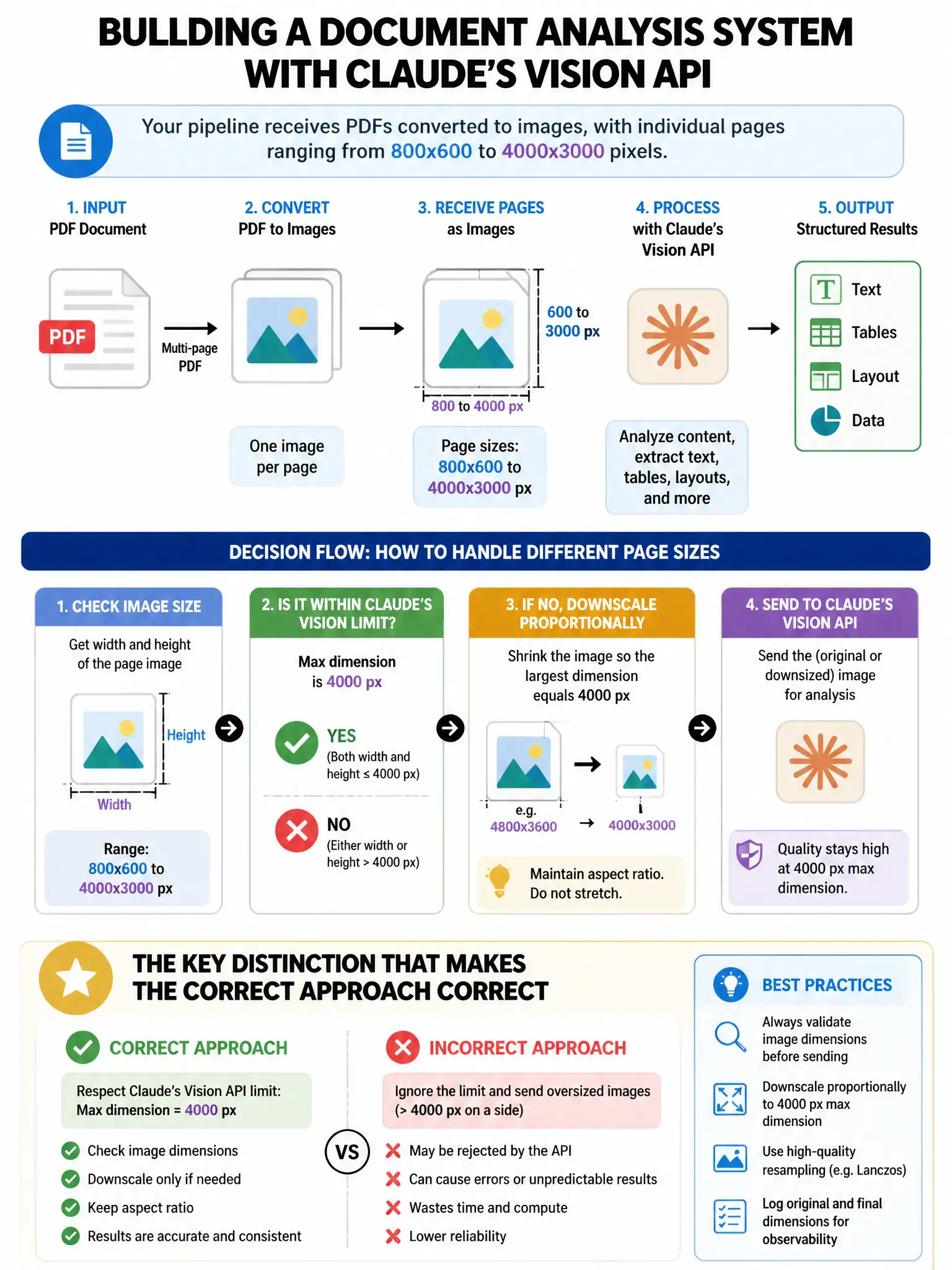
You are building a document analysis system using Claude's vision API. Your pipeline receives PDFs converted to images, with individual pages ranging from 800x600 to 4000x3000 pixels. Some pages contain dense technical tables. What constraint must the architect account for when designing the image preprocessing step?
Select an answer to reveal the explanation.
Short Explanation
Here's the deal — you need to respect the hard limits: Claude's vision API rejects images over 5MB or over 8000 pixels on the longest edge. For dense pages, you need preprocessing to resize, compress, or tile before sending them.
Full Explanation
The correct constraint is that images must be under 5MB in file size and under 8000 pixels on their longest edge; images outside these limits are rejected with a validation error. Dense technical tables at 4000x3000 pixels can approach these limits once converted to images, so the architect must design preprocessing that validates dimensions and file size, then resizes, compresses, or tiles pages as needed. Anthropic's vision documentation states the maximum dimensions per image are 8000x8000 px and that API images larger than the size limit are rejected (https://platform.claude.com/docs/en/build-with-claude/vision). The claim that the API automatically downscales all images to 1024x1024 before processing is wrong because oversized images are not silently degraded; they return an error. The claim that Claude processes images at full submitted resolution with no limits but charges are calculated per megapixel is wrong because explicit size and dimension limits exist, and the cost model is based on tokens computed from image size rather than raw megapixels in a user-defined way. The claim that the vision API accepts JPEG and PNG only, so TIFF or WebP must be re-encoded or return a 400 error, is wrong for this scenario because the primary operational constraint is the size/dimension limit, not a blanket format rejection of WebP or TIFF; format support matters, but the size/dimension constraint is the most operationally critical constraint for this architecture.