
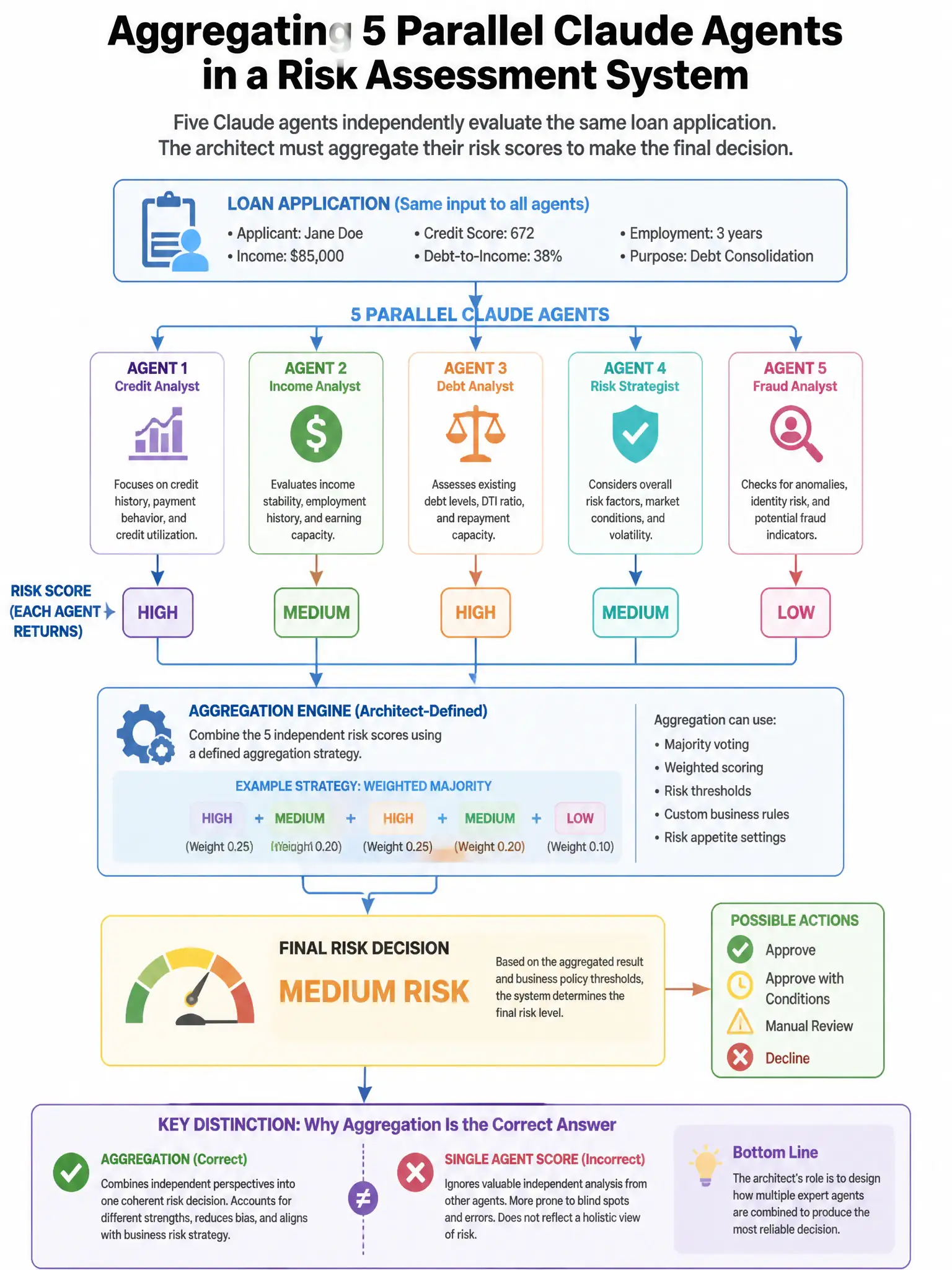
A risk assessment system deploys 5 parallel Claude agents to independently evaluate the same loan application. The architect must aggregate their risk scores (each returns High/Medium/Low with a confidence score) into a single decision. Scores arrive as: 3x High (confidence 0.9, 0.85, 0.8), 1x Medium (confidence 0.7), 1x Low (confidence 0.6). Which aggregation strategy is most appropriate for a financial risk context where false negatives (approving risky loans) are costly?
Select an answer to reveal the explanation.
Short Explanation
In financial risk, you care more about not approving a risky loan than rejecting a safe one. You should use the conservative consensus rule, because if any agent flags High with enough confidence, you treat the application as High instead of letting weaker votes dilute the risk signal.
Full Explanation
The conservative consensus rule is correct because in financial risk contexts, the cost of false negatives, such as approving a risky loan, typically exceeds the cost of false positives, such as rejecting a safe loan. A conservative consensus rule that elevates to the highest risk category when any agent exceeds a confidence threshold, such as 0.75, ensures that high-confidence risk signals are not diluted by lower-confidence dissenting agents. This asymmetric rule reflects the asymmetric cost structure. The simple majority-vote approach is wrong because it ignores confidence scores, so a 0.6-confidence Low vote and a 0.9-confidence High vote carry equal weight, which is inappropriate when confidence information is available. The confidence-weighted voting approach is wrong because it still allows low-confidence dissenting votes to reduce the overall score below what the high-confidence majority indicates, and in a risk-averse context, this averaging is dangerous. The median-confidence approach is wrong because it is a heuristic that conflates the confidence of individual assessments with the risk category selection; the correct risk output is High in this case, but the reasoning based on median confidence is incorrect and would fail in other distributions.