
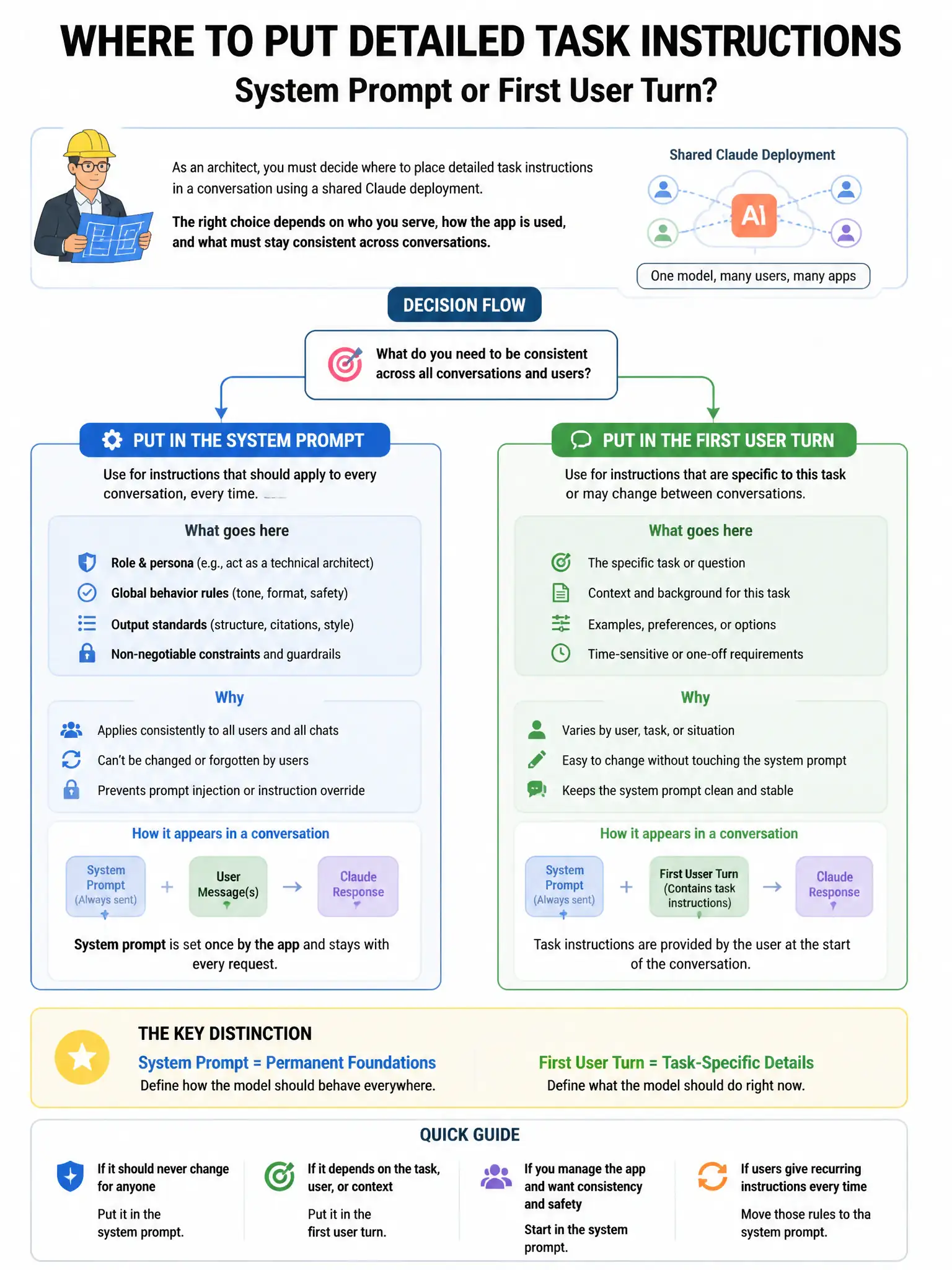
An architect must decide whether to place detailed task instructions in the system prompt or the first user turn of a conversation. The application uses a shared Claude deployment with a fixed system prompt across all users. Which consideration most strongly argues for placing complex task instructions in the system prompt rather than the first user turn?
Select an answer to reveal the explanation.
Short Explanation
You should put the big instruction block in the system prompt because it can be cached once and reused across many requests in a shared deployment. If you repeat it in every first user turn, you pay for those tokens over and over and lose the caching win.
Full Explanation
The correct consideration is prompt caching efficiency: in a shared Claude deployment with a fixed system prompt, system prompt content is eligible for prompt caching and can be processed once per cache TTL across many requests. Large instruction blocks placed in the system prompt can be cached after the first request and reused across subsequent requests within the cache TTL, reducing input token costs. Repeating large instruction blocks in every user turn multiplies token costs and cannot be cached at the user-turn level as efficiently. The claim that system prompts are cheaper to process because they are cached more aggressively is wrong because system prompts are not inherently cheaper due to a more aggressive cache policy; the advantage comes from the fixed system prompt forming a stable cache prefix that can be reused across requests, while user-turn content varies and is not shared as a stable prefix. The claim that instructions in the system prompt are processed with higher priority and override user turn instructions is wrong because system prompt and user-turn instructions are not prioritized differently at the architectural level; the model sees all content in context. Effective prompt design may place authoritative instructions in the system prompt for behavioral consistency, but that is not an architectural override. The claim that user turn instructions are visible to end users who might modify them while system prompts are hidden is wrong because both system prompts and user-turn content can be made invisible to end users through application design; hiding is not inherently a system prompt property.