
A SaaS application charges users based on Claude API token consumption. The billing system must accurately attribute tokens to users before invoices are generated. An architect needs a reliable way to count tokens. Which approach is most accurate for pre-request token estimation?
Select an answer to reveal the explanation.
Short Explanation
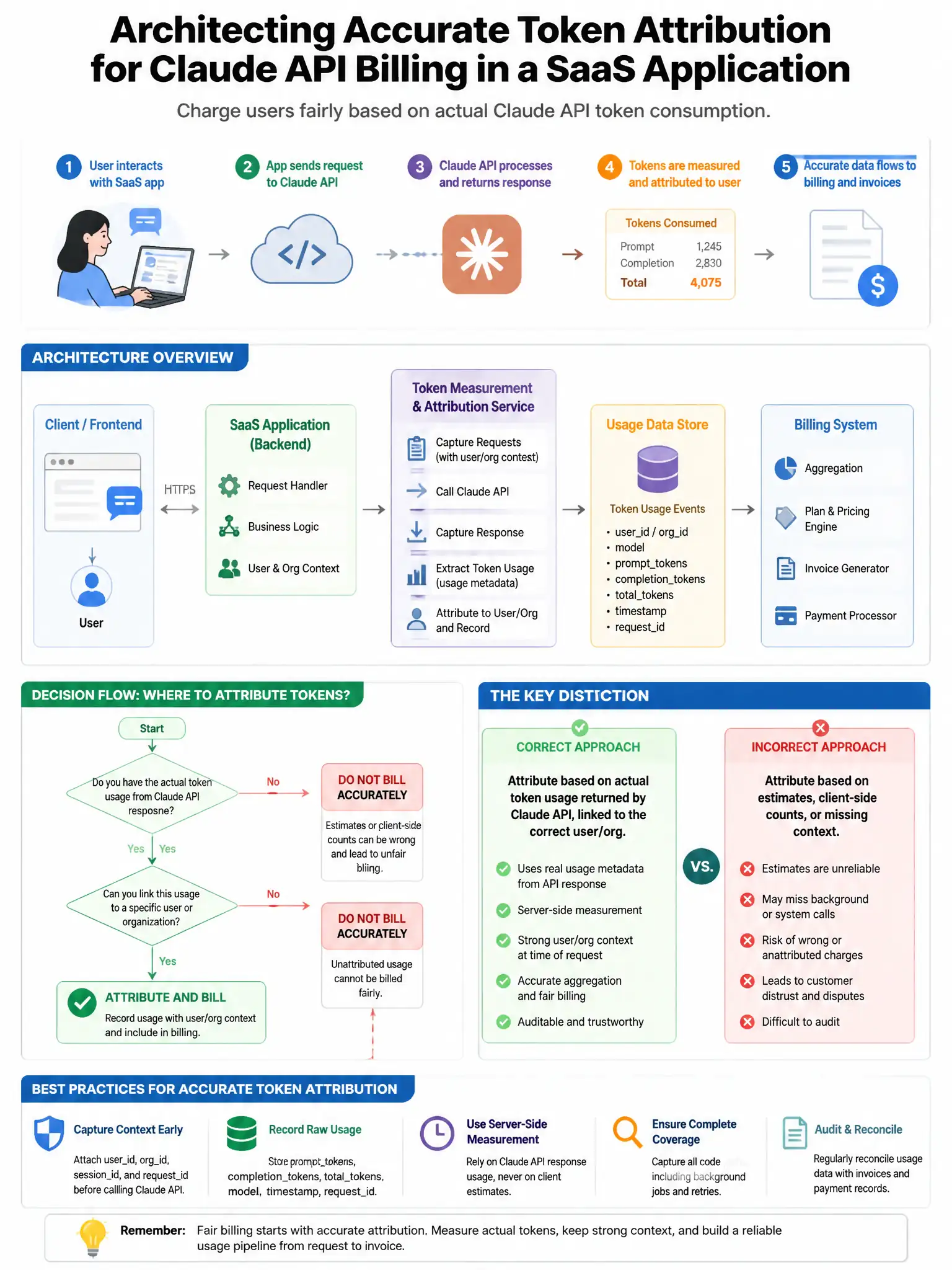
Here's the deal — you need exact token counts before the request goes out, so use the Anthropic tokenizer through the token counting API endpoint and store that count for billing. That matches the tokenizer used during inference, so you can attribute spend and enforce budgets accurately. Character heuristics and whitespace splitting miss subword tokens, and response usage is too late for pre-request controls.
Full Explanation
The most accurate approach is the one that uses the Anthropic tokenizer available via the token counting API endpoint to count exact tokens before sending the request, then stores that count for billing attribution. This works because the token counting endpoint applies the exact same tokenizer used during inference, giving precise token counts before the request is sent and enabling accurate pre-billing attribution and budget enforcement. The approach that uses the usage field in the API response after generation completes and attributes tokens post-hoc is wrong as a primary strategy: it is accurate but reactive, because by the time you know the exact token count, the API call has already been made and charged; pre-request counting enables budget enforcement and cost caps. The approach that counts characters in the prompt and divides by four to estimate tokens is wrong because the character/4 heuristic is inaccurate for non-ASCII content, code, and structured data, and errors compound across thousands of requests, creating billing disputes. The approach that estimates tokens using a whitespace tokenizer that splits on spaces and punctuation is wrong because whitespace tokenization does not match Claude's byte-pair encoding tokenizer; byte-pair encoding tokenizes subword units that do not align with word boundaries, especially for code, symbols, and technical content.