
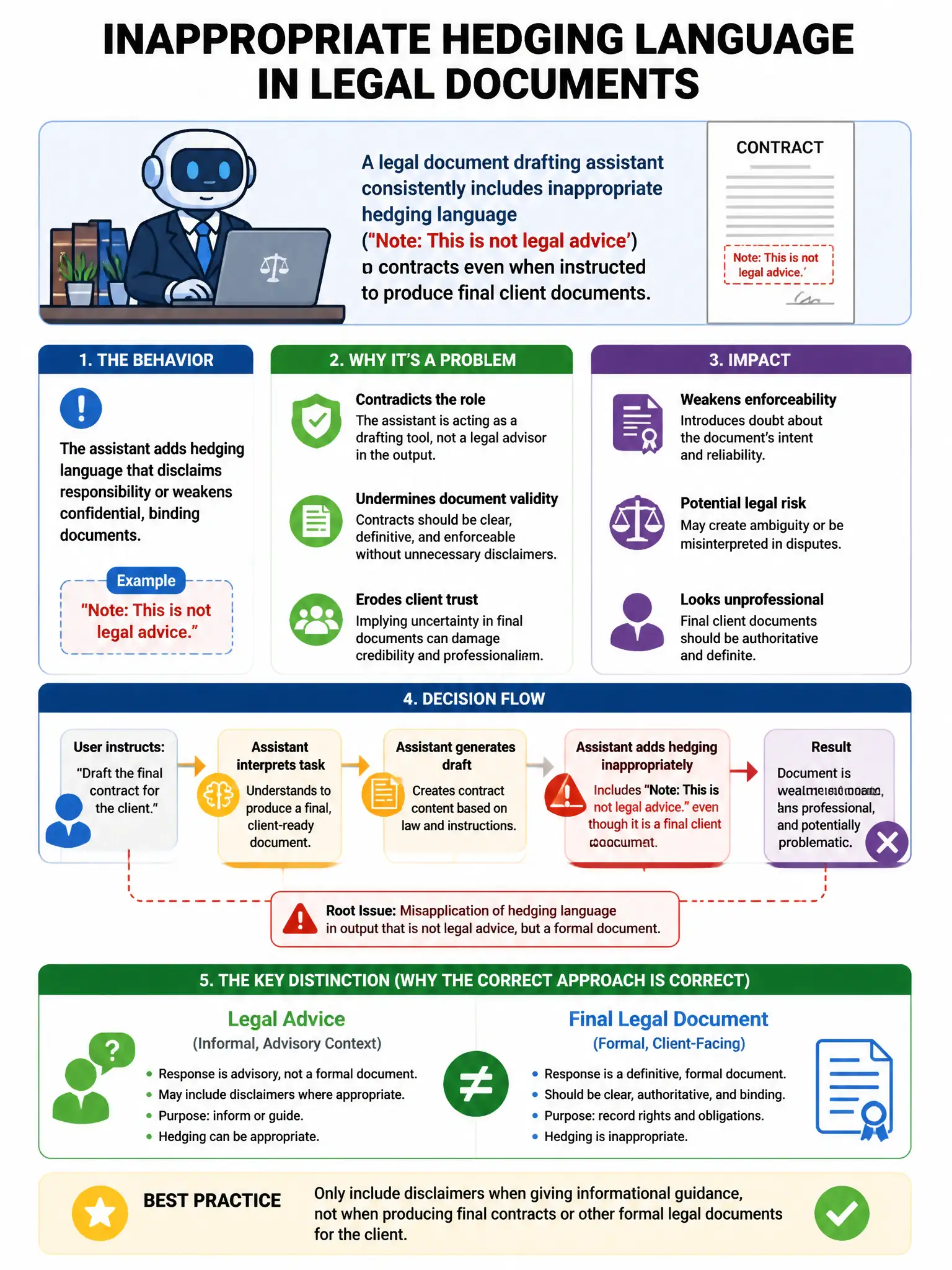
A legal document drafting assistant consistently includes inappropriate hedging language ('Note: This is not legal advice') in contracts even when instructed to produce final client-ready documents. The system prompt includes: 'Draft professional legal documents as requested.' What is the most effective fix?
Select an answer to reveal the explanation.
Short Explanation
Here's the deal — you need to tell the model exactly what not to do and what to do instead. The detailed prompt wins because it names the hedging, shows examples, and gives a final-deliverable attorney voice.
Full Explanation
The correct fix is the system prompt that explicitly characterizes the prohibited behavior and provides a positive replacement: 'Draft documents as a practicing attorney drafting for clients. Documents should read as final deliverables. Do not include meta-commentary, hedging phrases, or disclaimers such as "this is not legal advice" — these undermine the document's authority.' This works because effective negative prompting combines three elements: naming the specific prohibited behavior, providing example language to avoid, and framing the positive alternative. The multi-layered instruction disambiguates the intended behavior. The prompt that only says 'Do not include disclaimers' is too abstract — the model may not classify its hedging as 'disclaimers'; naming specific phrases and patterns is more reliable. Using temperature 0 is wrong because it maximizes output determinism but does not change which behaviors the model considers appropriate — if the model's default is to include disclaimers, determinism will consistently produce disclaimers. Adding a post-processing regex to strip disclaimer text is wrong because it is a fragile workaround that misses paraphrased hedging and creates maintenance burden; fixing the prompt is more robust and prevents the problem at generation time.