
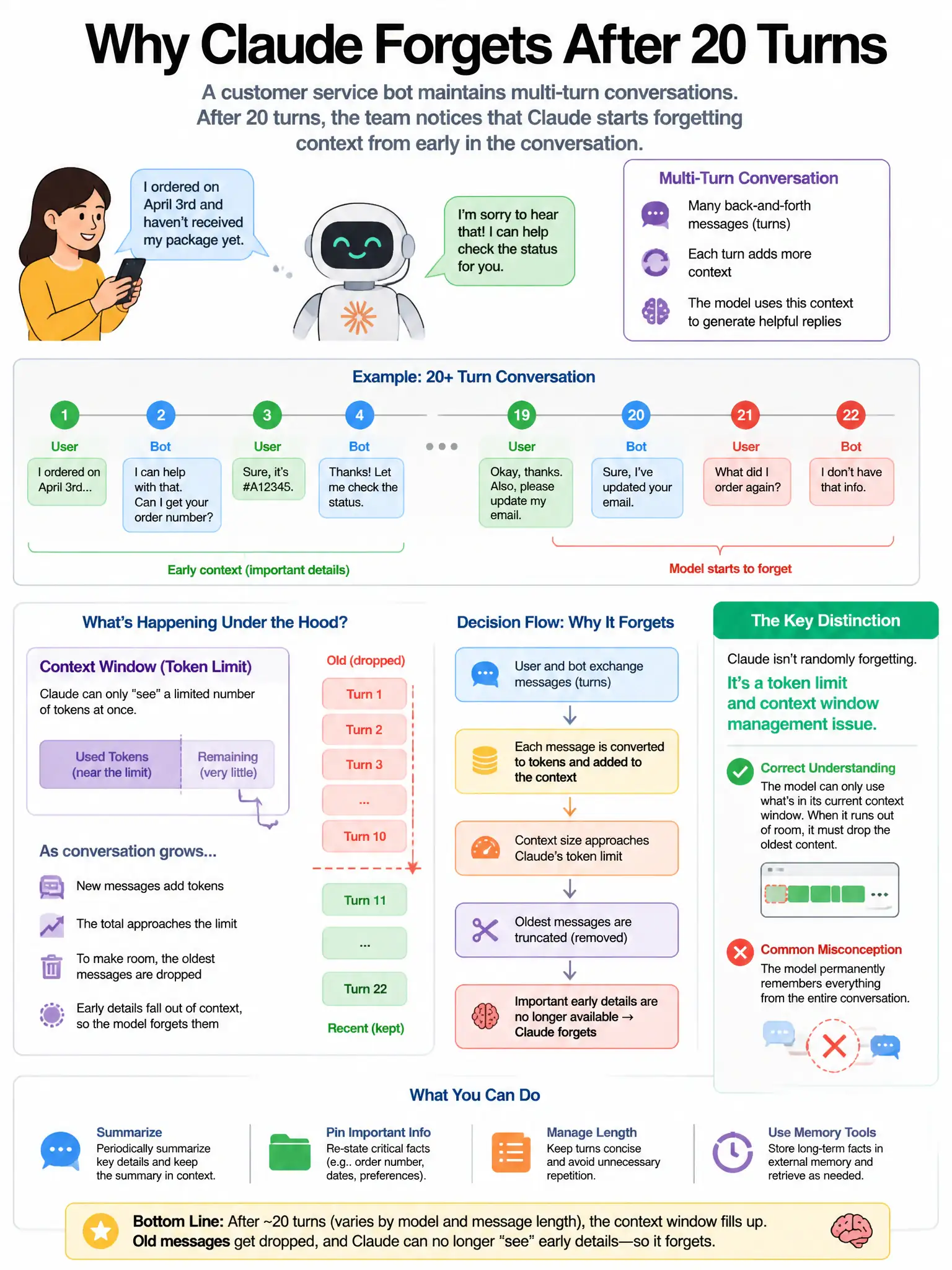
A customer service bot maintains multi-turn conversations with users. After 20 turns, the team notices that Claude starts 'forgetting' context from early in the conversation. Token usage logs show conversations approaching 150,000 tokens. What is the architecturally correct solution?
Select an answer to reveal the explanation.
Short Explanation
You need conversation summarization because it preserves the essential context while shrinking token count. The summary captures the user's issue, what was tried, and current state in far fewer tokens than raw turns, so you can keep appending new turns and continue indefinitely.
Full Explanation
The architecturally correct solution is implementing conversation summarization: periodically summarize the conversation history into a compressed summary, replace old turns with the summary, and continue from there. This preserves semantic continuity while reducing token count — the summary captures the essential context (user's issue, what was tried, current state) in far fewer tokens than the raw turns. New turns are appended after the summary, so the conversation can continue indefinitely. Truncating the conversation by removing the oldest messages when approaching the context limit, keeping only recent turns, is wrong because simply truncating old messages loses critical context — the customer's original complaint, their account details shared early, and prior resolution attempts may all be in the truncated portion, causing the bot to ask for information already provided. Increasing max_tokens to allow longer responses, which will help Claude retain more context, is wrong because max_tokens controls the length of the model's output, not the size of the context window it can process — increasing it does not expand context retention. Switching to a stateful Claude API endpoint that maintains conversation state server-side is wrong because the Anthropic Claude API is stateless — there is no server-side conversation state endpoint; conversation history must be managed client-side.