
A business intelligence dashboard displays Claude-generated summaries that update as new data arrives. Users expect to see the summary begin appearing within 2 seconds of triggering an update. Full generation takes 15–25 seconds. The backend is a Node.js server. Which streaming architecture is correct?
Select an answer to reveal the explanation.
Short Explanation
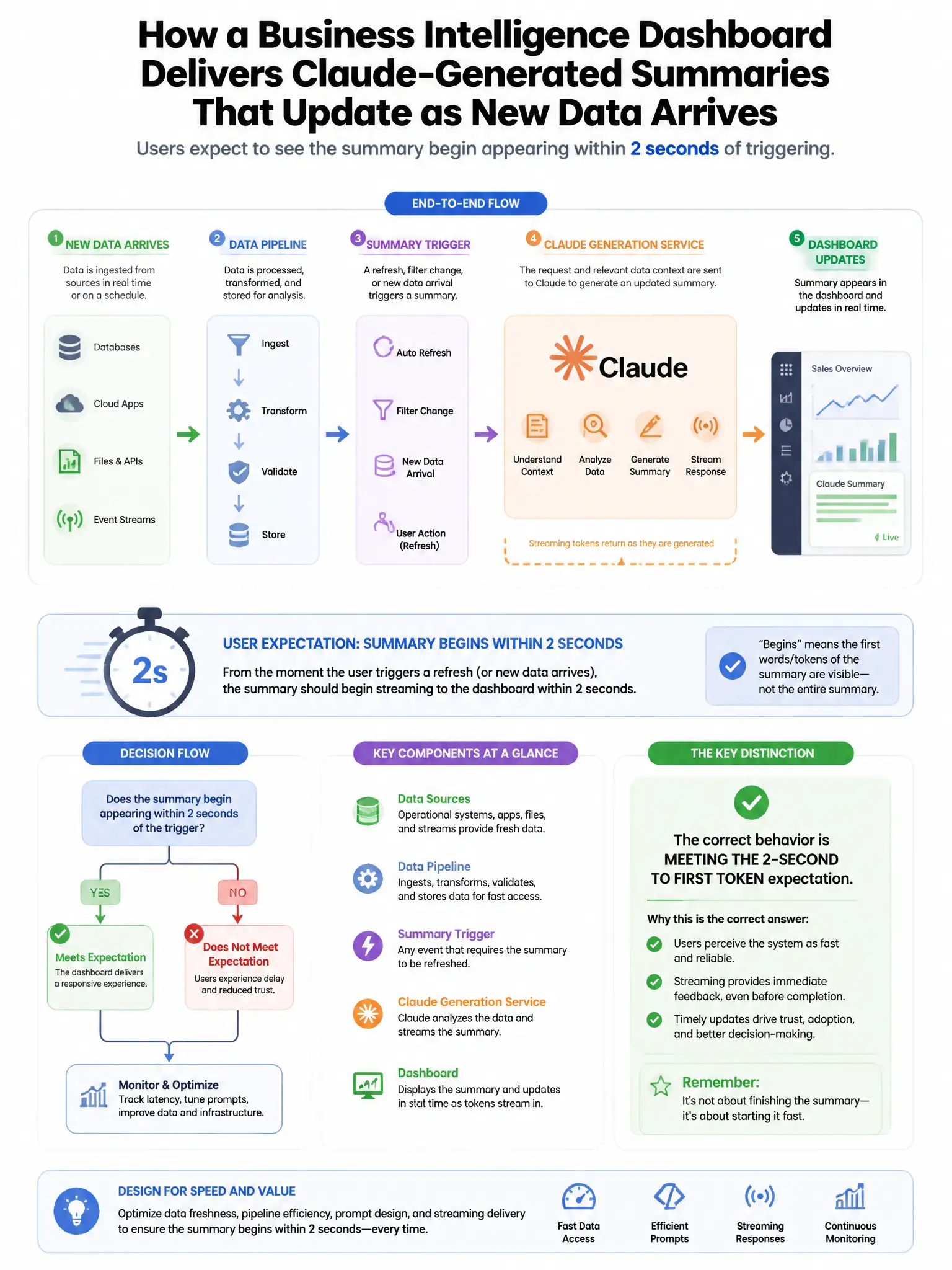
Here's the deal — use Claude's streaming API and pipe the token stream from the Node.js server to the client with SSE or WebSocket. You'll render tokens as they arrive, so the summary can start appearing within seconds while full generation continues.
Full Explanation
The correct approach is Claude's streaming API with SSE passthrough: Claude streams tokens to the Node.js server, which forwards them immediately to the client via SSE or WebSocket. The client renders tokens as they arrive, achieving first-token display within seconds. This pipeline adds minimal latency. The non-streaming full-response approach is wrong because waiting for full generation before sending defeats the requirement — users would wait the full 15–25 seconds with no feedback, experiencing the exact problem the requirement is trying to solve. The multiple-call chunking approach is wrong because the Claude API does not support chunked generation via multiple calls — each call starts generation from scratch, making concatenation produce incoherent output; and max_tokens limits output length, not generation chunks. The buffered streaming approach is wrong because server-side buffering of the full streaming response before forwarding is functionally identical to the non-streaming full-response approach — it buffers the entire response before the user sees anything.