
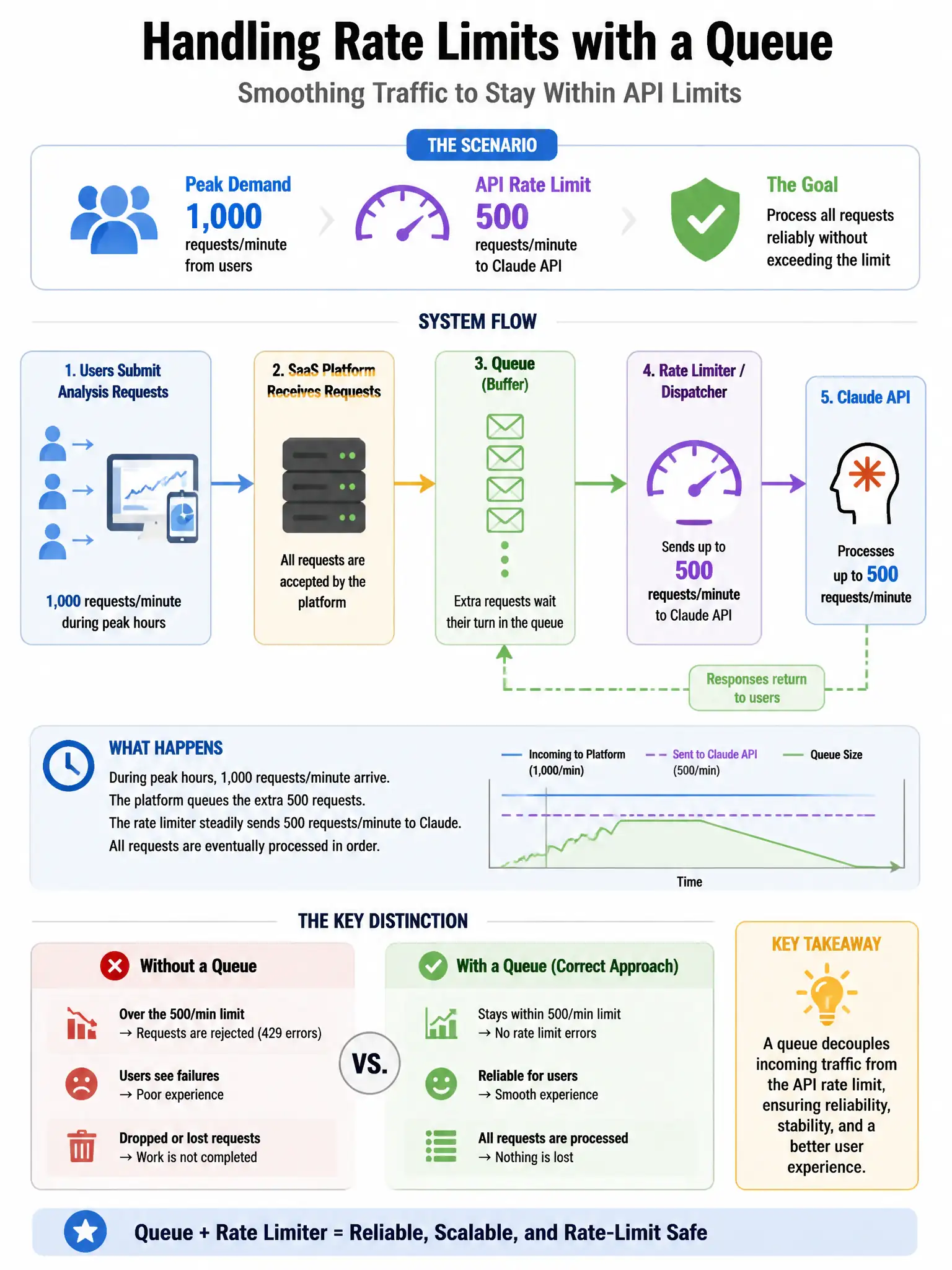
A SaaS platform allows users to submit analysis requests to Claude. During peak hours, the platform receives 1,000 requests/minute but the API rate limit is 500 requests/minute. An architect must design a queue that prevents rate limit errors while maintaining fairness across users. Which approach is most appropriate?
Select an answer to reveal the explanation.
Short Explanation
Here's the deal — you need a token bucket queue with per-user limits, exponential backoff on 429 errors, and priority lanes for premium users. That smooths bursts, keeps one user from hogging capacity, recovers from transient API throttling, and supports paid tiers. It's the production-grade way to stay under 500 requests/minute without starving users.
Full Explanation
The token bucket queue with per-user rate limiting, exponential backoff on 429 errors, and priority lanes for premium users is correct because it handles the mechanics of smoothing request bursts to stay within rate limits, prevents one user from monopolizing capacity, handles transient 429s from the API gracefully, and allows the platform to monetize higher service tiers. This is a production-grade queue architecture. The FIFO queue with no per-user limits is wrong because it allows one user to submit 999 requests and starve all other users — it is unfair and creates a denial-of-service vector. Dropping excess requests above 500/minute and returning HTTP 429 to the caller immediately is wrong because it fails the user experience — users lose work during peak periods, creating churn; queuing is preferable to rejection. Caching all recent responses and returning cached results for semantically similar requests is wrong because semantic caching can supplement but not replace a queue — many analysis requests are unique and cannot be cache-hit; and the cache hit rate on user-specific analyses is typically very low.