
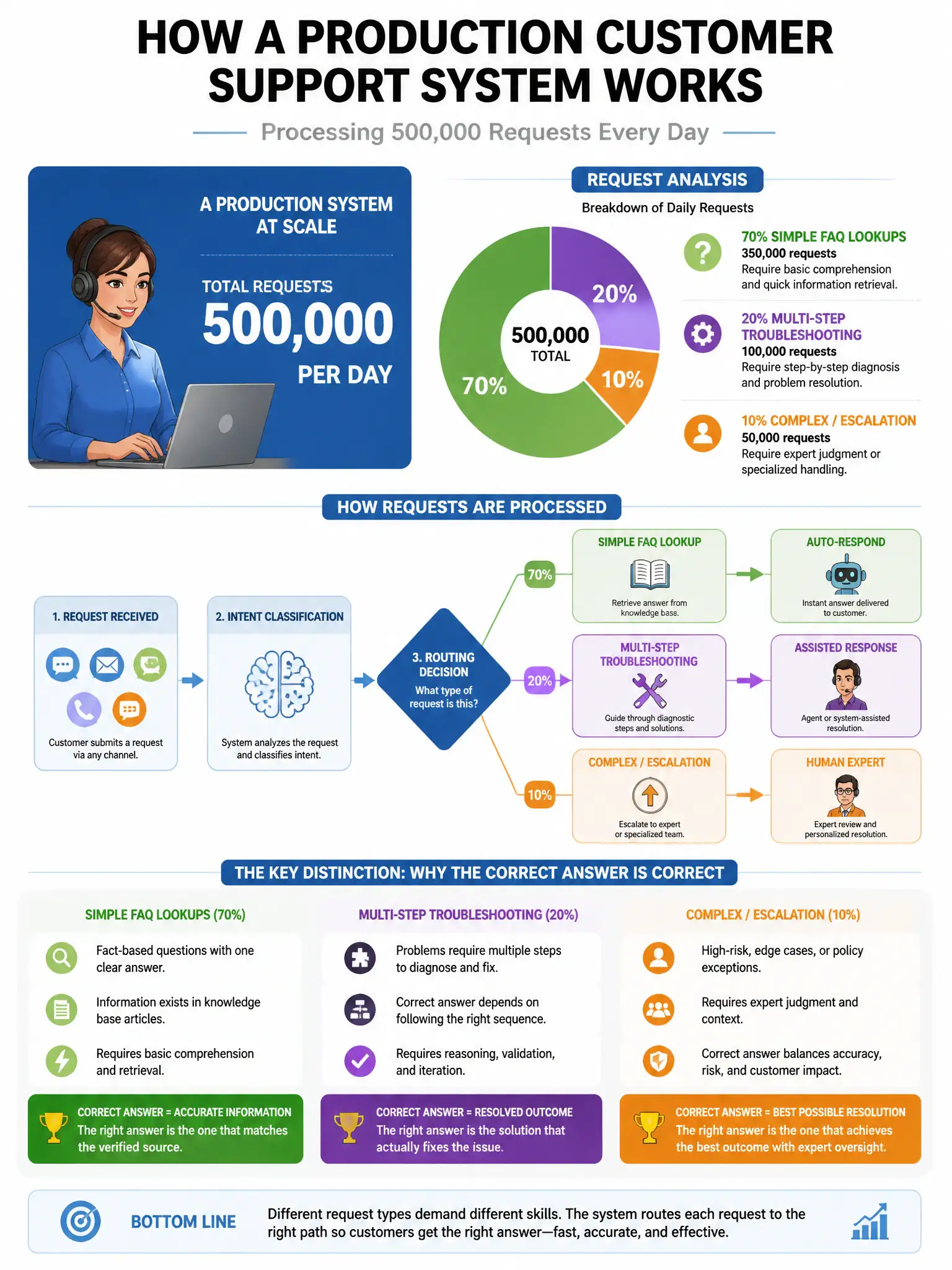
A production customer support system processes 500,000 requests per day. Analysis shows 70% are simple FAQ lookups requiring basic comprehension, 20% involve multi-step troubleshooting requiring reasoning, and 10% involve complex escalations needing deep analysis. An architect is designing a routing layer. Which model assignment strategy best balances cost and quality?
Select an answer to reveal the explanation.
Short Explanation
Match the model to the job: use Haiku for the 70% of simple FAQ lookups, Sonnet for the 20% of multi-step troubleshooting, and Opus for the 10% of complex escalations. That keeps quality where it matters and cuts cost on the high-volume, low-complexity traffic.
Full Explanation
The strategy that routes FAQ lookups to claude-3-haiku, troubleshooting to claude-3-5-sonnet, and escalations to claude-3-opus is correct because it matches model capability to task complexity: Haiku handles simple lookups efficiently at the lowest cost for 70% of volume, Sonnet handles multi-step troubleshooting adequately at moderate cost for 20%, and Opus handles the most complex escalations where quality is paramount for 10%. The all-Sonnet strategy is wrong because routing everything through Sonnet wastes cost on the 70% of simple requests that Haiku handles just as well. The strategy that routes FAQ lookups and troubleshooting to Haiku while sending escalations to Sonnet is wrong because Haiku's reasoning capability is insufficient for multi-step troubleshooting workflows that require sustained logical chains. The strategy that uses Haiku for all requests but increases temperature to improve complex-query quality is wrong because temperature controls output randomness, not reasoning depth or capability; using Haiku at higher temperature for complex queries degrades quality further.