
A developer is using the Anthropic SDK and wants to implement a timeout so that API calls that take longer than 30 seconds raise an exception rather than blocking indefinitely. The team is using the Python SDK. What is the correct approach?
Select an answer to reveal the explanation.
Short Explanation
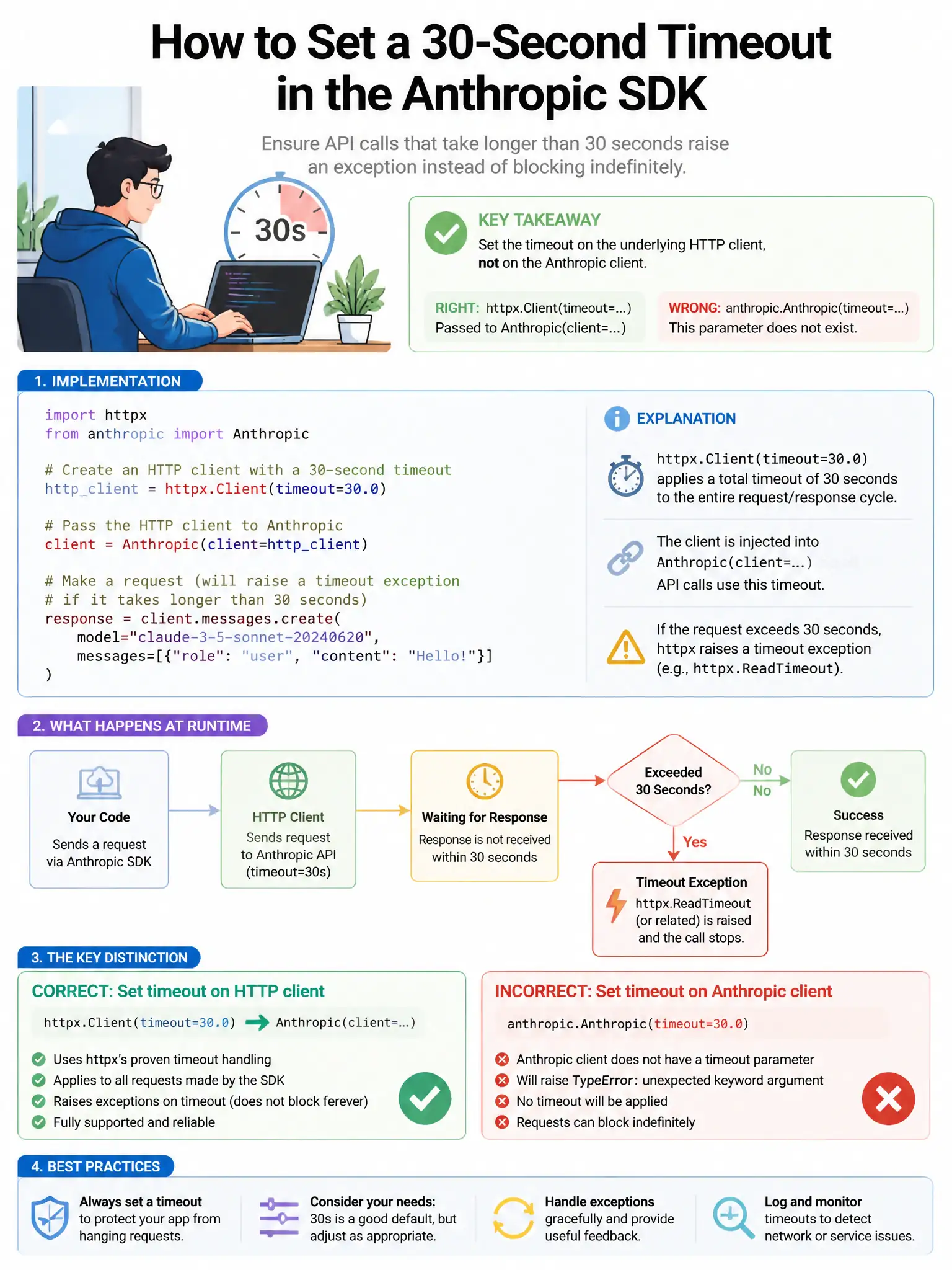
You pass timeout=30 when creating the Anthropic client. That sets a 30-second deadline for every call made through that client, and you'll get an APITimeoutError if it runs too long.
Full Explanation
The correct approach is to pass timeout=30 to the Anthropic client constructor; this sets a global 30-second timeout applied to all API calls made by that client instance. The Anthropic Python SDK accepts a timeout parameter in the client constructor, and also per request, that configures the request timeout in seconds. Setting timeout=30 at the client level applies a 30-second deadline to all calls made through that client, raising an APITimeoutError if exceeded. The asyncio.wait_for option is wrong because the Anthropic Python SDK supports both synchronous and asynchronous usage; it is not exclusively async. The asyncio.wait_for pattern is valid for async code but is not the SDK's recommended timeout mechanism and is not applicable to synchronous use. The environment variable option is wrong because while some SDKs support environment variable timeout configuration, ANTHROPIC_TIMEOUT is not a documented environment variable in the Anthropic Python SDK; the timeout parameter is set in code. The threading.Timer option is wrong because calling client.close() from a timer thread is not the SDK's timeout mechanism; it would close the client abruptly and may cause undefined behavior across concurrent requests, not a clean exception for the affected request.