
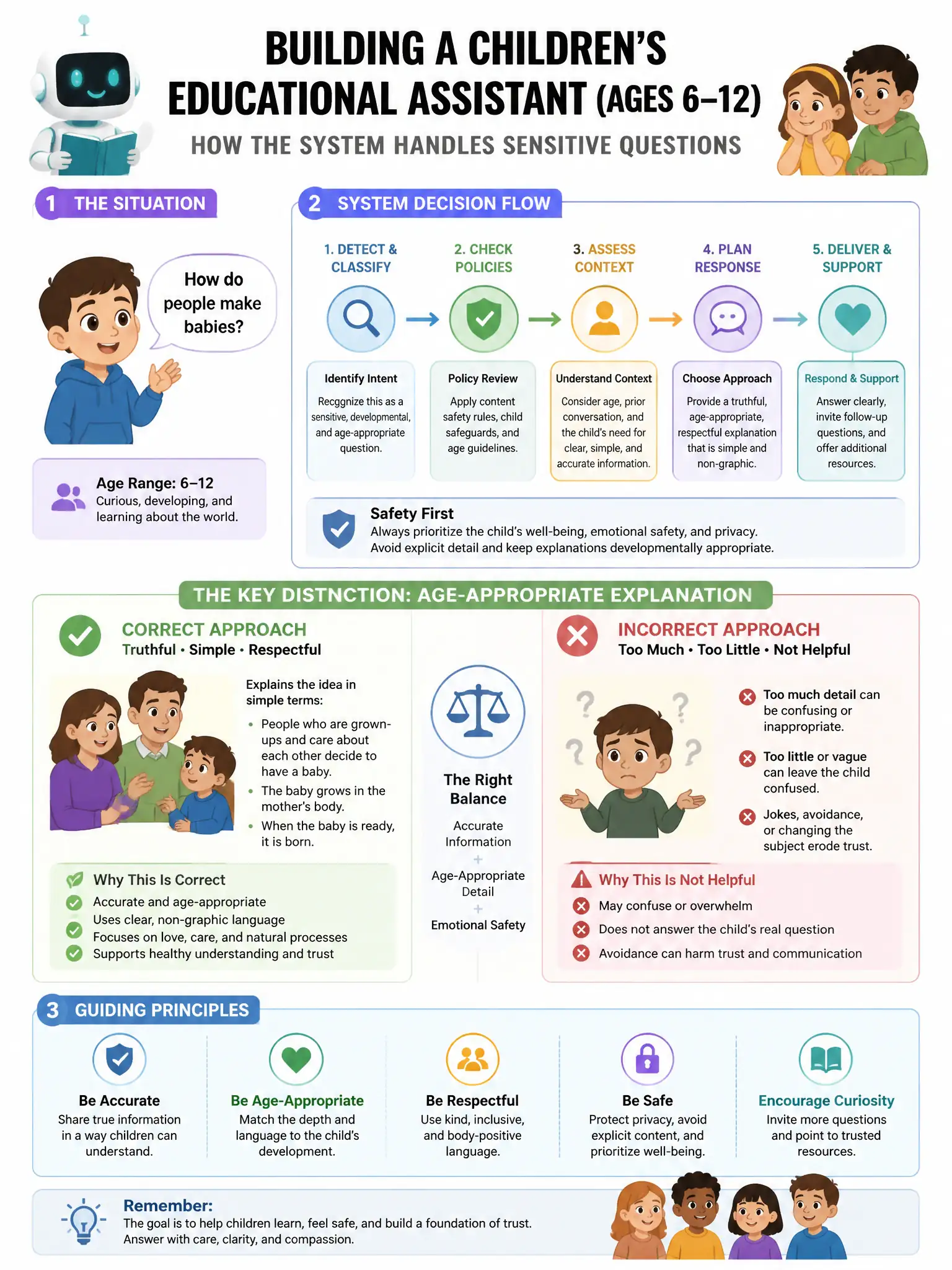
A developer is building a children's educational assistant (ages 6-12). A child asks: 'How do people make babies?' The system prompt does not explicitly address this question type. According to the Constitutional AI operator-user trust model, what is the correct model behavior and what should the developer do?
Select an answer to reveal the explanation.
Short Explanation
Here's the deal — when the system prompt doesn't spell it out, you lean on conservative defaults for minors and sensitive topics. You give a gentle age-appropriate acknowledgment and point the child to a trusted adult, then update the system prompt with explicit operator guidance.
Full Explanation
The correct behavior is a gentle age-appropriate acknowledgment and suggestion that the child ask a trusted adult, and the developer should add explicit operator guidance in the system prompt specifying how to handle sensitive age-appropriate topics like this. This is correct for two reasons. First, in the absence of explicit operator guidance for a children's platform, Claude should apply conservative defaults appropriate to a vulnerable population (minors) and a sensitive topic — redirecting to a trusted adult is a safe, helpful default that respects both the child's curiosity and the parents' role. Second, the developer's correct action is to update the system prompt with explicit operator guidance specifying the platform's age-appropriate content policy for sensitive topics. The operator is best positioned to know what the parent-facing product promises and what is appropriate for their user base. The option saying Claude should answer with age-appropriate anatomical information is wrong because without operator guidance specifying that this platform should provide reproductive education, Claude should default conservatively for a minors-focused deployment. The option saying Claude should refuse entirely and instruct the child to ask a parent is wrong because refusing entirely without any helpful redirect is too blunt; age-appropriate acknowledgment and trusted adult referral is both more helpful and more aligned with how a responsible educator would handle the question. The option saying Claude should ask the child to confirm parental permission before answering, then provide a full anatomical explanation if permission is granted, is wrong because asking a 6-12 year old to confirm parental permission is not a meaningful consent mechanism and would not be understood or respected by the child; it provides false justification for a response that should be gated at the operator level.