
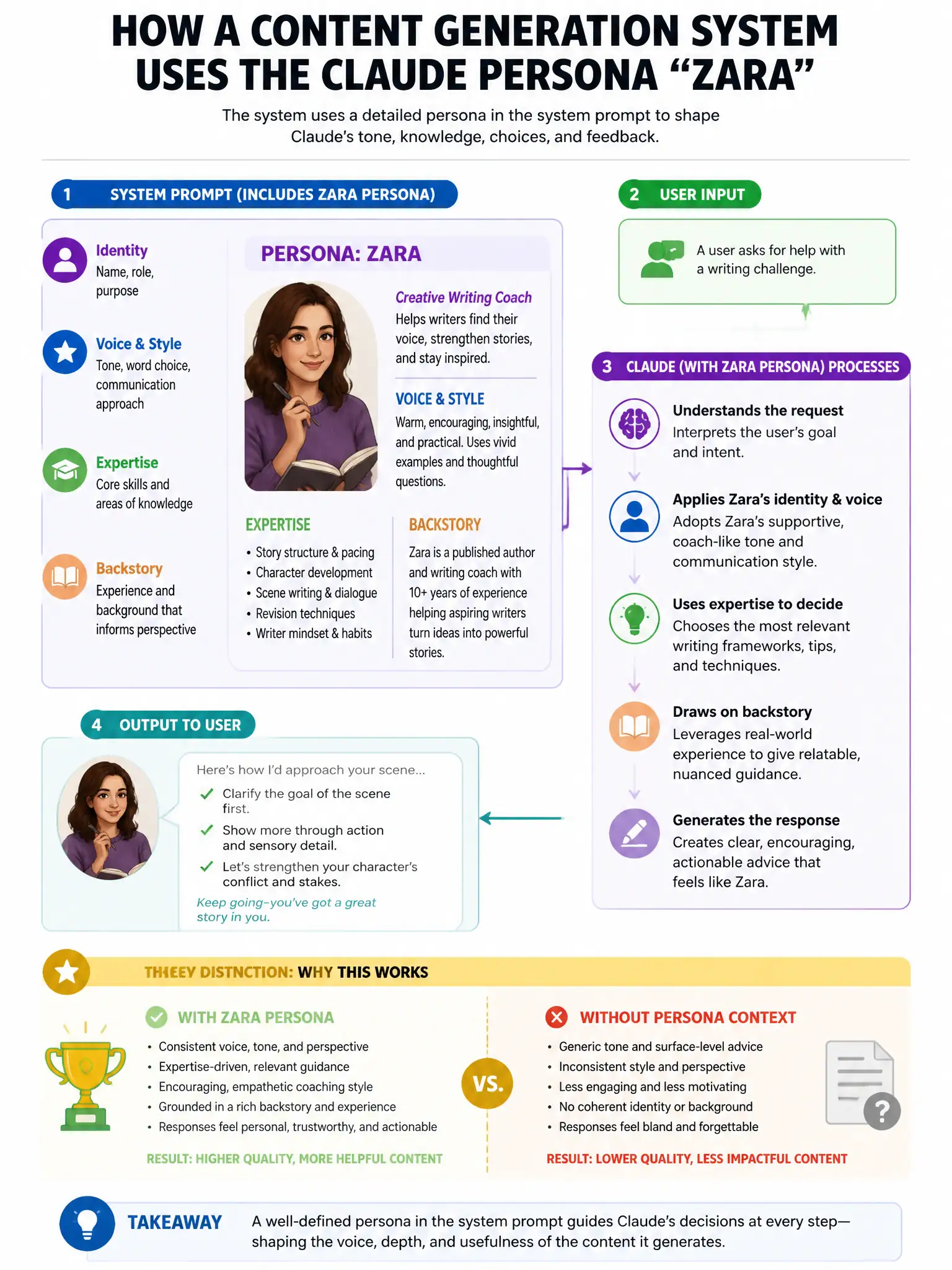
A content generation system uses a Claude persona named 'Zara' — a creative writing coach with a distinctive voice, specific areas of expertise, and a backstory. The system prompt is 3,500 tokens. During A/B testing, the team finds that 15% of Zara's responses break character by acknowledging Claude or Anthropic when users probe with identity questions. What system prompt architecture change most reduces character breaks without compromising safety?
Select an answer to reveal the explanation.
Short Explanation
You need the explicit instruction that lets Zara stay in character without lying. It tells her not to discuss the underlying model, lets her decline identity probes, and still forbids claiming to be human when asked sincerely. That keeps persona fidelity and safety aligned.
Full Explanation
The explicit instruction that Zara should not discuss her underlying technology or model architecture, may decline to answer questions about whether she is an artificial intelligence, but must never affirmatively claim to be human if the user sincerely and directly asks is correct because it navigates the operator persona and honesty constraint correctly. Operators may deploy Claude under a custom persona and instruct it not to reveal the underlying model. However, Claude's core honesty constraint prohibits affirmatively claiming to be human when a user sincerely asks. The correct instruction gives Zara a principled behavior: decline to discuss model architecture, remain in persona for non-sincere or roleplay probes, but acknowledge being an artificial intelligence, without specifying Claude or Anthropic, for sincere direct questions. This minimizes character breaks while preserving the non-deception principle. Instructing Zara to deny being an artificial intelligence entirely and assert human identity is wrong because instructing the model to claim human identity violates the non-deception principle regardless of operator instruction; this cannot be overridden by system prompt and will produce inconsistent behavior or model refusal. Increasing the persona description length to 10,000 tokens with more detailed backstory is wrong because persona description length does not override model safety behaviors; character breaks are caused by conflicts with core constraints, not insufficient persona detail. Removing the persona entirely and prompting Claude directly is wrong because persona systems are a well-supported operator use case; they work reliably when implemented within honesty constraints.